
Strategy Mosaic vs. AtScale
Enterprise AI needs more than metric definitions. It needs Mosaic.
Mosaic turns trusted business logic into governed enterprise AI infrastructure. It makes metrics reusable, secure, and ready for dashboards, AI agents, apps, and workflows. AtScale centralizes definitions for BI teams. Mosaic makes trusted logic operational across the enterprise.
Capabilities | Strategy Mosaic | AtScale |
|---|---|---|
Governed delivery across workflows |
|  |
Business-user modeling |
|  |
Linked model inheritance |
| |
In-memory, live, and hybrid execution |
| |
Scale without per-object pricing |
| |





35+ years of semantic layer heritage. Gartner Peer Insights Customers’ Choice for 3 consecutive years.
Why teams choose Mosaic over AtScale
Strategy Mosaic is built for teams moving beyond BI-centric semantic modeling into governed enterprise AI. Mosaic gives business and IT one trusted layer for metrics, models, dashboards, AI agents, applications, mobile, and embedded workflows, with reusable logic, inherited governance, semantic-layer monitoring, in-memory and hybrid performance, and predictable growth without object-count pricing.
AtScale is narrower. It can support semantic BI use cases such as OLAP-style modeling, MDX-heavy Excel or Power BI workloads, and technical teams that want to manage a semantic layer through SML or YAML workflows. Mosaic is the stronger choice when trusted semantic logic has to become enterprise AI infrastructure.

Semantic Layer Monitoring
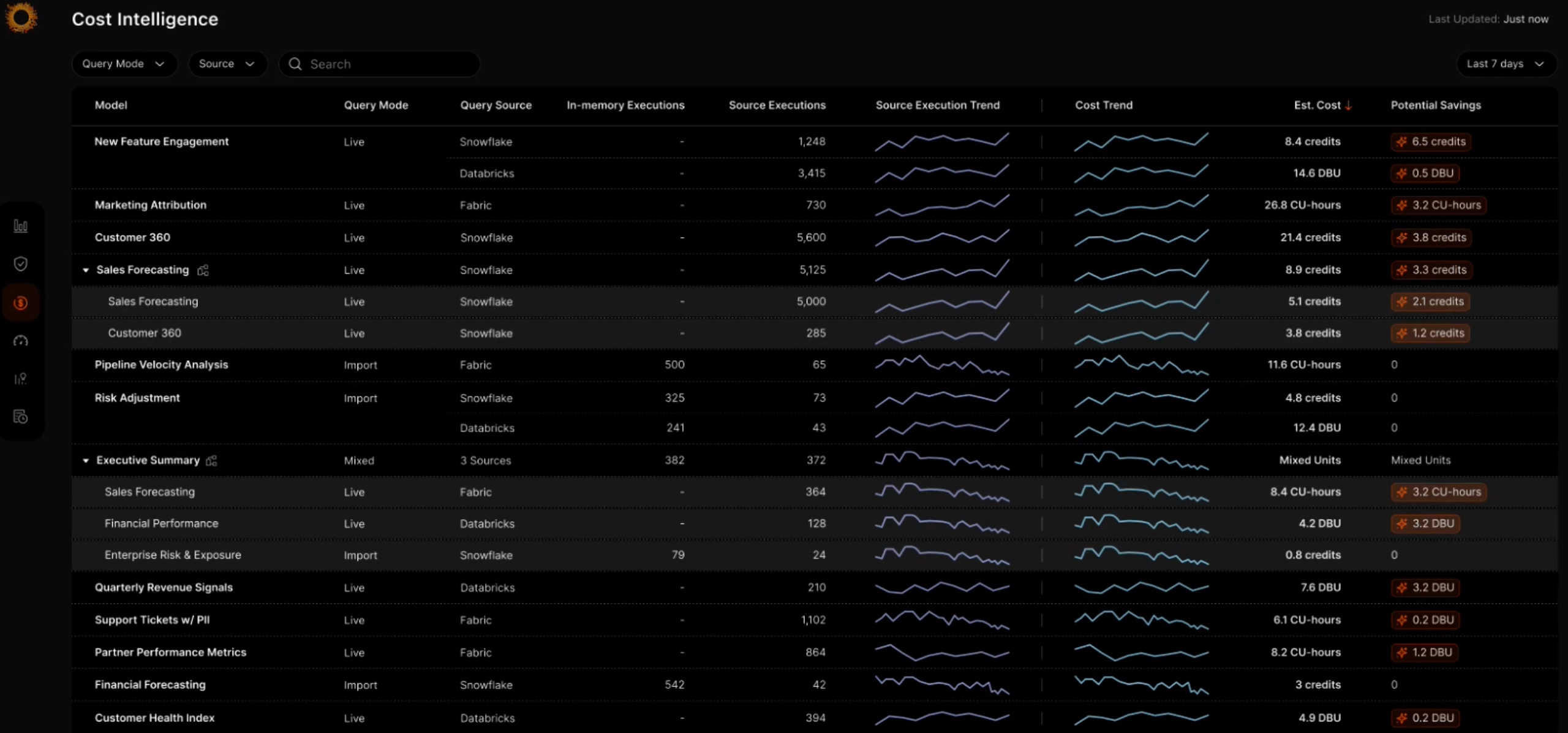
Monitor governed metrics, models, and queries across the semantic layer, with visibility into adoption, cost, and risk.

No Per-Object Semantic Tax
Add metrics, attributes, hierarchies, and models without object-count billing.

Linked Model Inheritance
Reuse governed models without rebuilding definitions, security, lineage, or caching.

In-Memory + Live + Hybrid
Choose performance or freshness by model instead of relying only on warehouse-side aggregate tables.

Last-Mile Included
Deliver governed analytics through dashboards, scorecards, mobile, and embedded experiences from the same platform.
Go even more in-depth about Mosaic’s features

From definitions to delivery
One governed definition. Every dashboard, app, agent, and workflow.
Mosaic carries trusted business logic into dashboards, scorecards, mobile, embedded analytics, applications, and AI workflows from the same governed platform. AtScale centralizes semantic access, then depends on downstream tools for delivery. Mosaic closes the gap between defining trusted logic and operationalizing it where decisions happen.
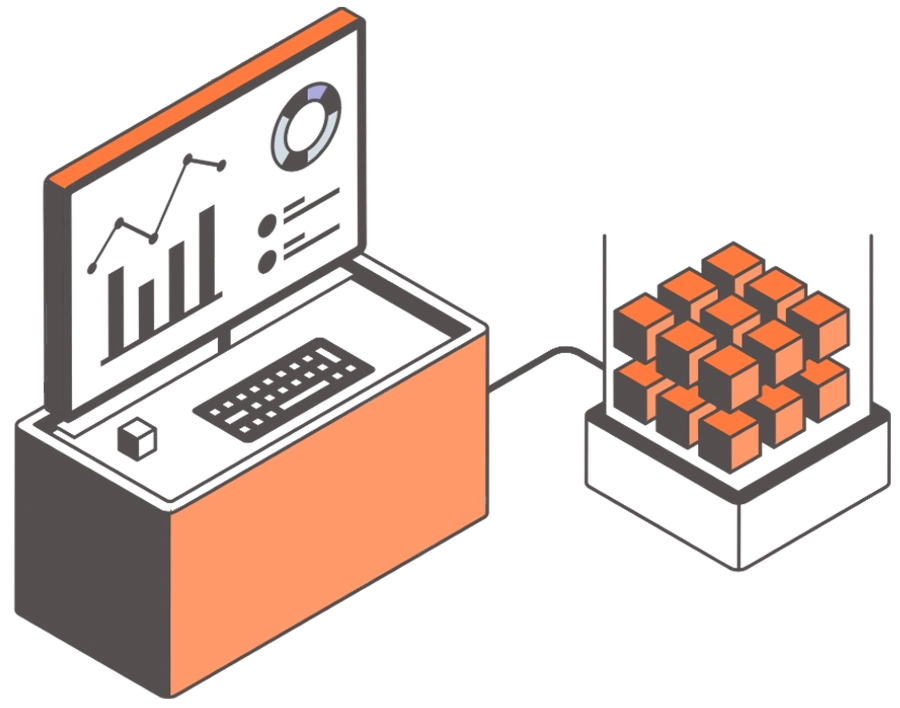
Architecture at a Glance
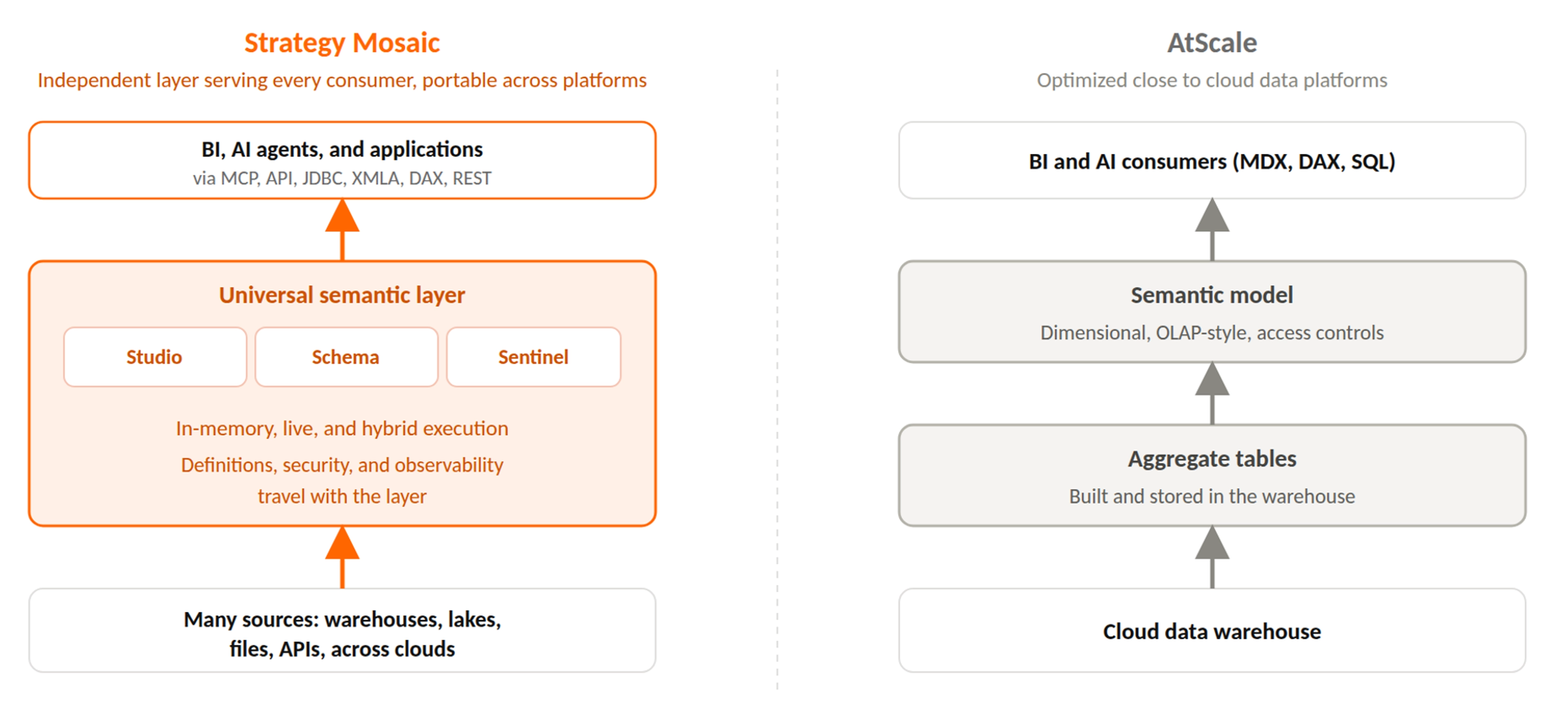
Strategy Mosaic (left): independent layer serving every consumer. AtScale (right): optimized close to cloud data platforms
Lotte scales governed AI analytics across business teams
Lotte Department Store used Strategy AI agents built on a governed semantic layer to make trusted analytics easier for business users. With shared definitions, metrics, and business context, teams could ask questions in natural language, reduce hallucination risk, and get faster answers across retail operations.
400%
increase in advanced analytics usage
9,500+
AI-powered analysis cases in six months
90%
efficiency improvement, with insights delivered 10× faster
8
purpose-built AI agents
.png&w=3840&q=100)

Bring one metric
A KPI different teams define differently. Test whether the same governed answer holds across tools, users, and permissions.

Bring one model
A governed model another team needs to reuse. Validate whether definitions, security, lineage, and performance work carry forward.

Bring one workload
A dashboard, AI query, or growth scenario that needs to scale. Compare performance, governance visibility, and cost impact on your data.

Bring one growth scenario
Model what happens as more teams, AI workflows, delivery formats, and semantic assets go live. See how the cost model changes as adoption grows.
What is the main difference between Strategy Mosaic and AtScale?
AtScale centralizes semantic models and metric definitions for BI and data teams. Strategy Mosaic goes further by operationalizing trusted business logic across dashboards, AI agents, applications, mobile, embedded analytics, and workflows. The difference is scope: AtScale helps govern access to semantic models, while Mosaic is built to make governed business context reusable across the enterprise.
When should buyers choose Mosaic over AtScale?
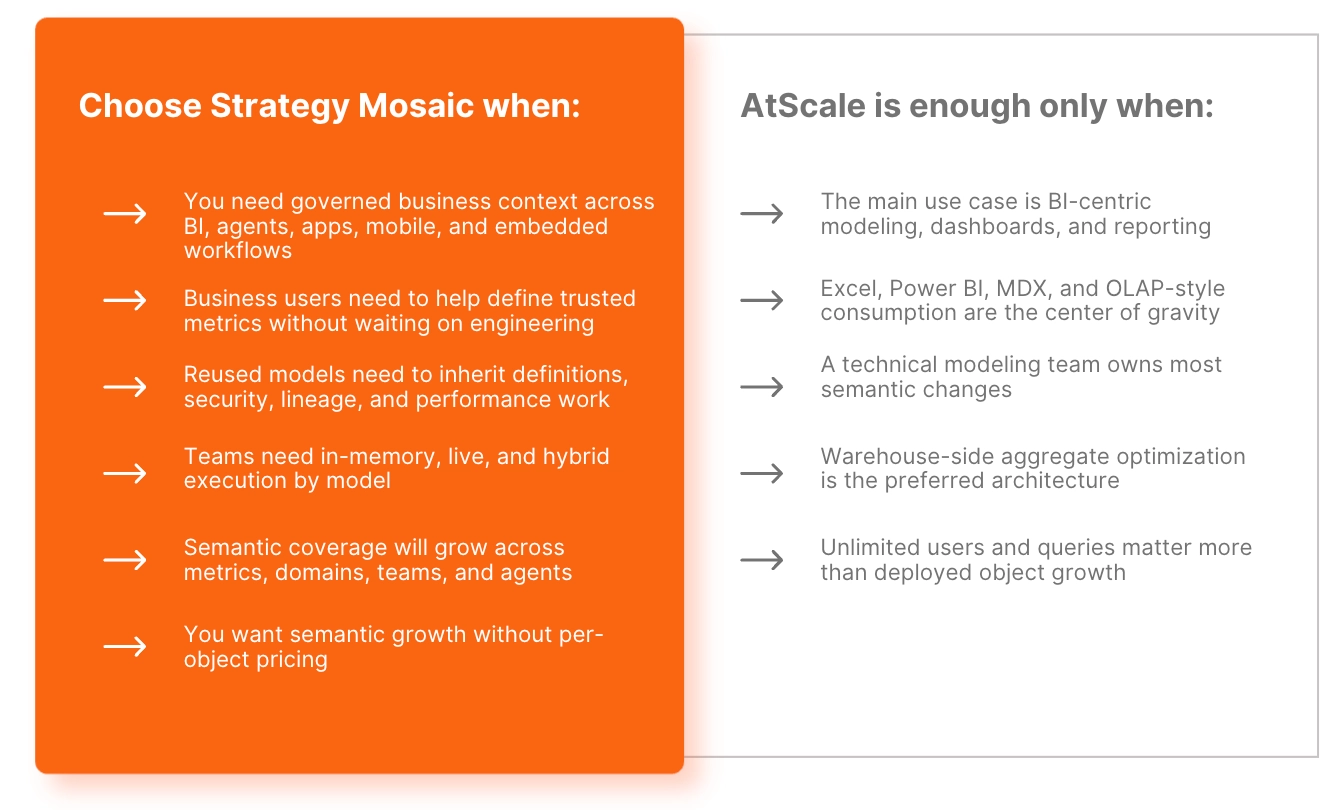
Choose Mosaic when your semantic layer needs to support more than BI definitions. Mosaic is designed for teams that need business-user modeling, governed AI access, linked model inheritance, in-memory, live, and hybrid execution, and semantic growth that is not tied to deployed object count. AtScale can be a fit when the main need is technical semantic modeling for BI, especially around dimensional, OLAP-style, Excel, Power BI, MDX, or warehouse-aggregate-heavy use cases.
How does Mosaic handle aggregate awareness compared with AtScale?
Mosaic takes a different architectural approach. AtScale is known for aggregate-aware query optimization and warehouse-backed aggregate tables. Mosaic supports in-memory, live, and hybrid execution, so teams can choose the right execution pattern by workload. For repeated queries, Mosaic can serve results from compressed in-memory storage. For fresher data needs, teams can use live or hybrid execution. Buyers should test both platforms against real workloads, concurrency, refresh requirements, and warehouse cost.
How do Mosaic and AtScale support AI agents and MCP?
Both Mosaic and AtScale support AI access to semantic context, and buyers should evaluate the maturity, availability, and governance model of each implementation. The key difference is not simply whether an AI agent can query a semantic layer. The more important question is whether the platform can provide governed business meaning, policy validation, auditability, and trusted context across the workflows where decisions happen. Mosaic is built to connect governed AI access with dashboards, applications, agents, and enterprise analytics workflows.
Does Mosaic support YAML and Git like AtScale’s SML?
Yes. Mosaic supports YAML-based model portability and Git-based lifecycle workflows for engineering teams. The difference is that Mosaic does not make YAML the only path. Business users can participate through Mosaic Studio, while technical teams can still use YAML, Git, version control, and CI/CD. AtScale has a strong SML and Git-centered story. Mosaic’s differentiation is combining engineering control with business-user modeling and governed enterprise delivery.
How is Mosaic pricing different from AtScale pricing?
AtScale publicly uses deployed semantic object pricing with unlimited users and queries. That can be attractive when broad user access is the main scaling variable. Mosaic does not make deployed object count the pricing meter, so teams can expand metrics, attributes, hierarchies, models, domains, and AI use cases without turning every new semantic object into a pricing decision. Buyers should compare both models using their expected semantic growth, not only today’s object count.
See your data, unified.
Book a product demo tailored to your data stack.