

How one semantic layer delivered over 500% ROI
Most data teams know the pain: analysts spending days reconciling numbers, IT buried in report requests, and millions lost to manual data consolidation. One financial services firm was losing $80 million annually because employees spent hours consolidating data instead of booking loans.
The hidden cost of data friction
When companies grow, their analytics needs expand beyond what initial platforms can support. Organizations end up with separate tools for dashboards, analysis, metric definitions, and report distribution.
The Strategy ROI survey conducted by UserEvidence reveals this creates expensive inefficiencies: duplicate datasets, redundant queries, and repeated KPI calculations across reports
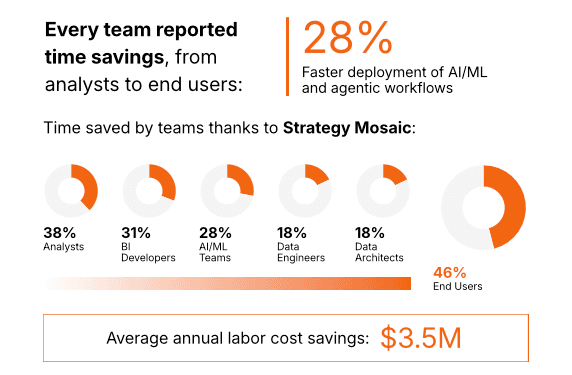
IT teams become bottlenecks. End users wait days for simple reports. Data engineers spend 18% of their time on rework triggered by metric changes. Meanwhile, confidence in data accuracy erodes as teams question which numbers are correct.
Enter Mosaic: Strategy’s universal semantic layer
Strategy’s semantic layer changes this dynamic through a “define once, reuse everywhere” approach. Standardized metric definitions eliminate duplicate datasets and prevent unnecessary refreshes. Centralized business logic cuts redundant queries across reports and dashboards
The results are immediate and measurable:
- 2-month payback period with $280,000 in monthly value realization
- 67% reduced IT dependency as users gain drag-and-drop access to reports
- Time savings across every role: End users save 46% of their time, analysts 38%, and BI developers 31%
- 80% increase in metric consistency and report accuracy confidence
Beyond time: infrastructure and cost savings
Moving calculations from data pipelines to the semantic layer prevents KPI changes from triggering widespread data rebuilds. This architectural shift delivered substantial infrastructure savings
- 20% reduction in downstream compute usage across analytics and AI workloads
- $375,500 saved from reduced infrastructure costs
- $138,000 saved by retiring an average of two BI tools per organization
Organizations also consolidated their tech stacks. Instead of maintaining separate platforms for different use cases, Strategy’s semantic layer facilitated multiple functions on a unified platform.
The 5x Return on Investment
After accounting for implementation costs, customers realized net savings of $3.4 million annually: a 551% return on investment. One retail manager summarized the transformation:
“Once we implemented Strategy’s semantic layer, users didn’t need a technical background to pull reports—it’s all drag-and-drop.”
The financial services firm that was losing $80 million annually? They recovered that lost productivity, with representatives and managers gaining 3-4 hours daily for revenue-generating activities instead of manual data work.


Beata Socha
With over 15 years of experience as a tech journalist and content creator, Beata heads Content Marketing at MicroStrategy. An economics graduate, she specializes in finance and the impact of AI on business, bringing expert insights to the industry.
Related posts
Discover how the lack of a shared semantic layer in data engineering leads to inefficiencies and mistrust, and learn how Strategy Mosaic offers a unified solution for consistent business metrics and streamlined analytics.

Saurabh Abhyankar
March 12, 2026
Discover the March 2026 updates that enhance your semantic layer control and integration with AI tools, featuring Mosaic Model Versioning with GitHub, built-in time intelligence, and smarter content discovery for faster, more reliable insights across your organization.

Henry Guo
March 20, 2026
Unlock the full potential of AI in retail with a universal semantic layer that ensures consistent data logic, enabling scalable predictive analytics and reliable insights across your enterprise. Discover how Strategy Mosaic empowers retailers to transform isolated AI efforts into cohesive, enterprise-wide intelligence.

Tanmay Ratanpal
March 16, 2026

Gartner predicts universal semantic layers will become critical infrastructure for enterprise AI. Learn why semantic layers now sit alongside cybersecurity and data platforms—and how they eliminate metric drift and AI risk.

Lauren O’Connor
March 16, 2026