

The Strategy Intelligence Platform
AI native platform for building AI apps and agents. Integrated by design.
The platform provides common definitions, governed data, security and workflows. This is what makes AI native app development fast, lightweight and integrated with each other without a warehouse.
Delivers | → Definitions · Governance · Workflow · AI |
Removes | → ETL · Warehouse · Integration layer |
Priced at | → 50% of what it replaces |
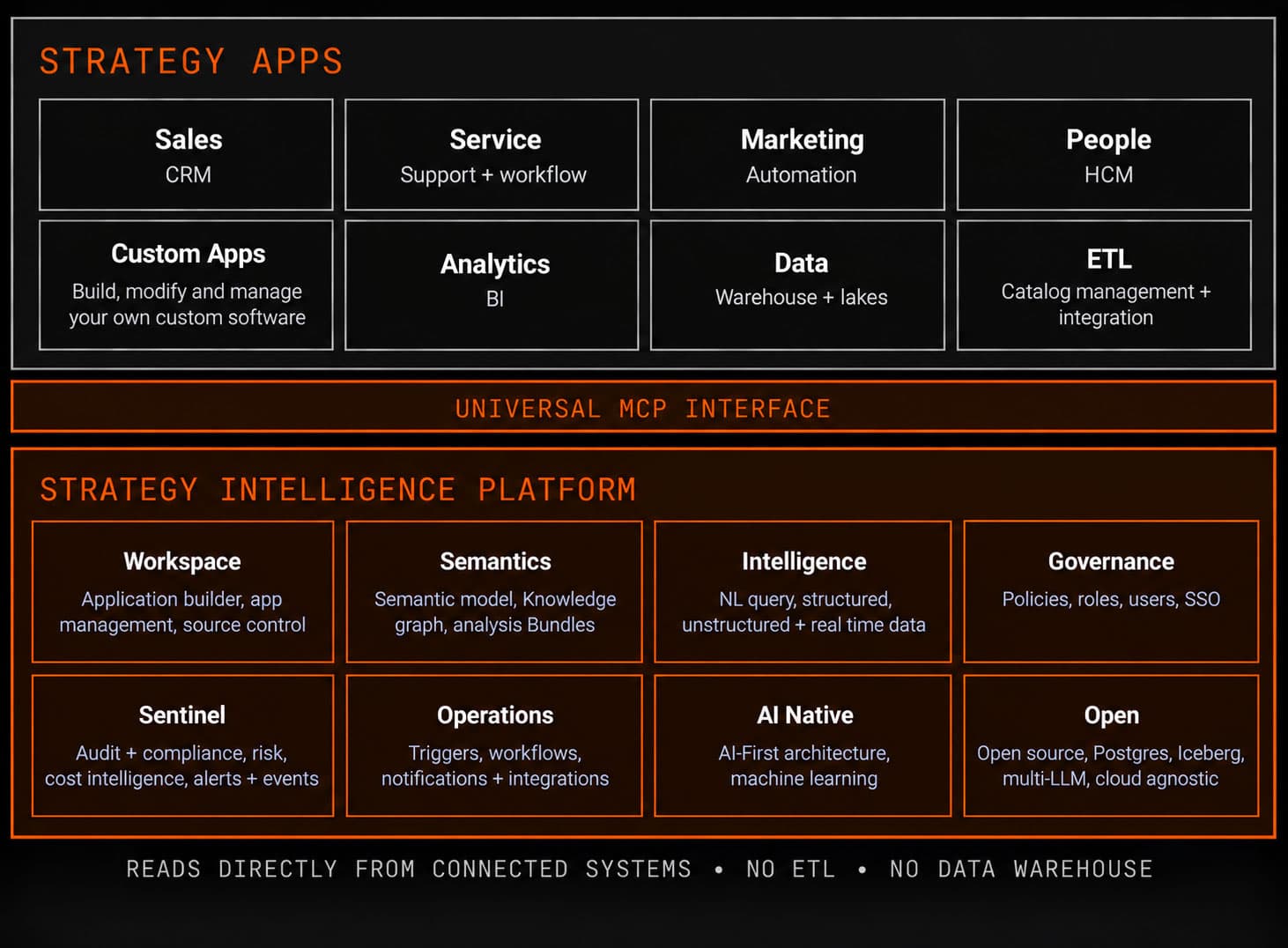
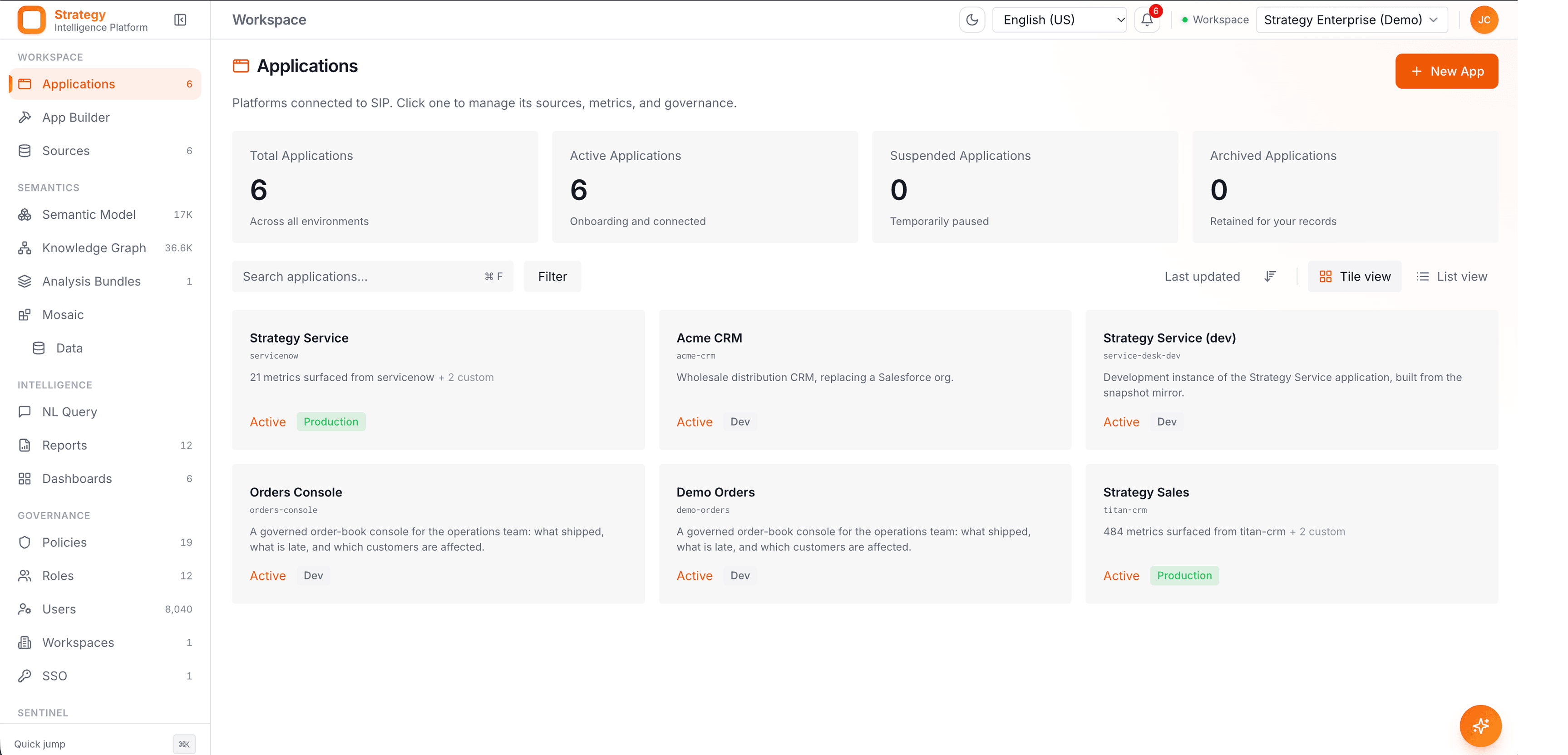
Business semantics and ontologies
Governance and policies
Workflows and custom fields
Unified apps and data
A unified platform across applications and data
Unifying the core business information and logic makes the applications on top lightweight and quick to build and deploy. It also removes the need for integrations, ETL and data warehouses.
Applications
Custom applications for people and AI agents
Workflows, integrations, records and interfaces customized for how your business operates.
Systems of record
The applications hold their own records and transactions. When a rep changes an opportunity or someone closes a case, that write lands in a system you own rather than a vendor's tenancy.
Workflow and business rules
Approvals, routing, entitlement and stage logic are configured around your process, instead of your process being rebuilt around a product's constraints.
Interface
Screens built for the job, not a generic object model with your terminology bolted on top of it.
Actions and agents
Agents that do the busywork inside the system of record, with the same entitlements and the same audit trail as a person.
Data
Consistent data for advanced intelligence
One model of the business that every application, query and agent inherits.
Shared meaning
"Customer", "renewal" and "net revenue" are defined once. Two applications built a year apart still agree, because neither one owns the definition.
Policy in one place
Row and column rules live underneath every application rather than being re-implemented in each one, so an entitlement change takes effect everywhere at once.
Trusted answers
Reporting and analysis resolve through the same definitions the applications write against, so what the dashboard shows and what the record holds are the same.
Zero copy data access
Systems you have not replaced yet are read in place, without the need for costly and complex ETL pipelines.
Integrated by design
One common store for apps and data
Business logic • Data • Semantics • Workflows
Apps and data all read and write from the same foundation. In a conventional stack each side keeps its own copy and integration software spends its life reconciling them, which is usually expensive and the first thing to break when either side changes.
Inside the platform
Key platform services
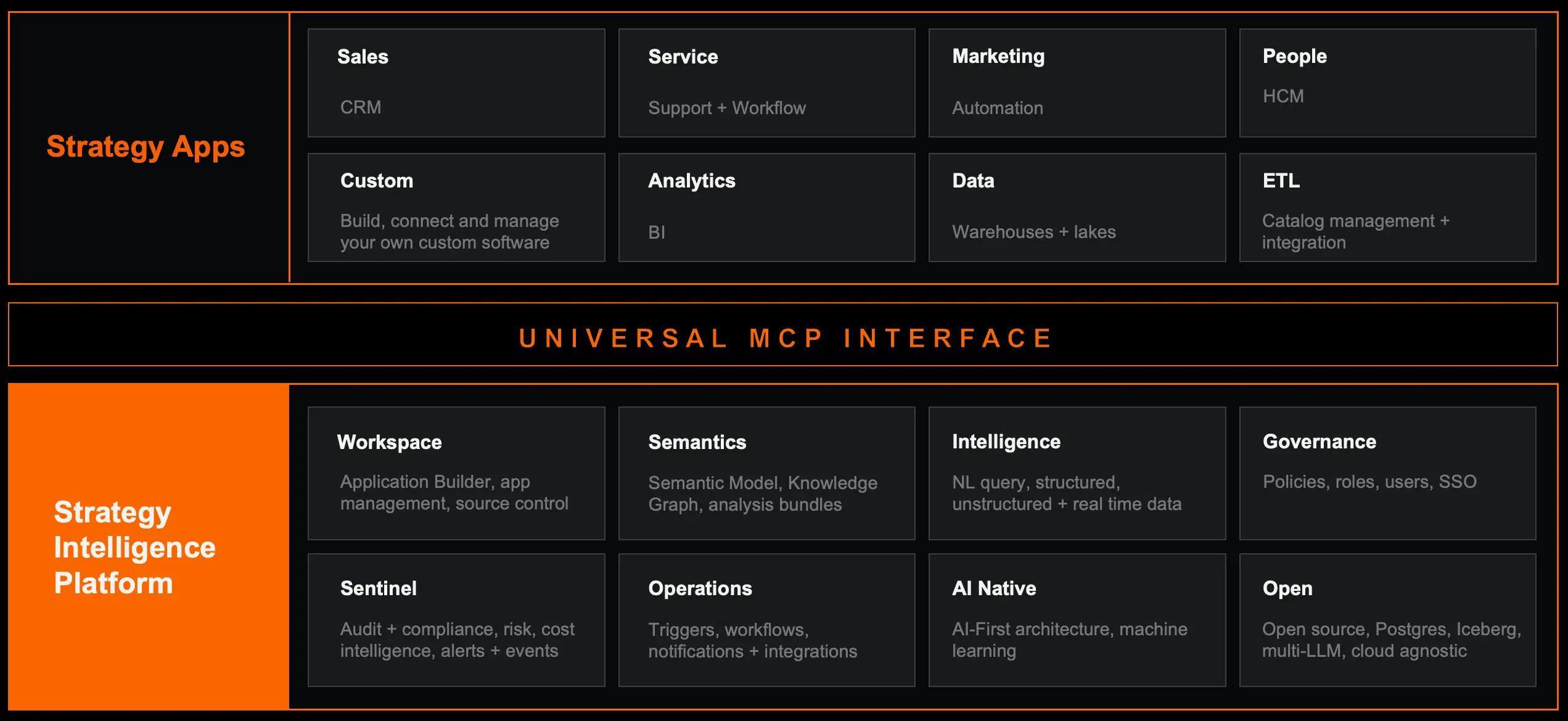
Component | What it is | Why it matters |
|---|---|---|
01 / Reasoning Intent and planning | Turns a request into an executable, verifiable plan. It does not answer from the model's own knowledge. |
|
02 / Semantic layer Common definitions | One registry of business meaning: metrics, dimensions, hierarchies and time grains, versioned and shared by every application. |
|
03 / Knowledge graph Business ontology | The typed model of your business and the relationships between its parts, with identity resolved to one record per thing. |
|
04 / Actions Governed writes | Every change of state goes through one authorized, logged interface, with the action that undoes it declared up front. |
|
05 / Sentinel Security and observability | One place to set roles, policy and security, and to see every action taken by every application, person and agent. |
|
06 / Unstructured data Documents in the platform | Contracts, tickets and notes are read where they already live and linked to the business objects they refer to. |
|
07 / Federated query Cross-system answers | One question across many systems, pushed down into each source and joined at the right grain. Nothing is copied to answer it. |
|
08 / App registry Build and register | New applications declare what they expose and register through MCP, which makes them available to every other application at once. |
|
Anatomy of a request
What happens when someone asks, and when someone acts
Transactional workflows and analytics finally unified on a single platform. Two paths run through it: one for the questions people ask, one for the actions they take.
— Path A · A question
Read 01
The ask
A person or an agent asks for something in business language. The model works out what is being asked, never how to compute it.
IN → "NRR for enterprise, last quarter"
Read 02
Semantic resolution
The request is matched to governed definitions. "Enterprise" and "net revenue retention" already mean one specific thing across the business.
→ metric + grain + filters
Read 03
Policy check
Entitlements are applied before anything runs. The caller's access to rows and columns is resolved in the data plane, not inside the application.
→ scoped to the caller
Read 04
Deterministic query
The platform generates the query from the definition. The same request always produces the same query, so a question asked twice comes back with one number.
→ generated, not guessed
Read 05
Answer
The query runs against your records and the systems still read in place, and the answer comes back with the query that produced it.
OUT → value + query + audit
— Path B · An Action
Write 01
The action
Someone closes a case, approves a discount, or an agent proposes the same. It starts in the application, where the work is happening.
IN → "approve discount, 18%"
Write 02
Business rules
Your rules decide whether the action is valid and what else it triggers. Thresholds, approvals and routing are configuration, not a rebuild.
→ validated against your logic
Write 03
Policy check
The same entitlement model that governs reads governs writes. The platform answers once, centrally, whether that person may take that action on that record.
→ permitted, and by whom
Write 04
Committed to the record
The transaction lands in the system of record you own, against the same definitions everything else reads.
→ written, with provenance
Write 05
Everything downstream sees it
Reporting, agents and the next application do not need to be told. They read the same model, so there is nothing to synchronize.
OUT → one truth, immediately
Reads and writes together. A platform that only does Path A is analytics, and analytics cannot replace the software your business runs in. A platform that only does Path B is one more application with its own private idea of the truth. Running both against one governed model is what lets a new application launch already agreeing with everything around it.
Where it runs
You own the application. Run it yourself, or we run it for you.
The software, its records and the logic inside it are yours either way. We can operate it for you as a service, or hand it over and let your team run it.