
Forrester Research: Context Is the Missing Layer in AI-Ready Data

To act reliably, AI needs context: governed definitions, business relationships, rules, and constraints that turn raw data into something machines can understand. For example, when you ask a question about your top five customers, your AI agent needs context to know which customers you’re referring to.
AI often fails because data lacks machine-readable meaning. Without shared semantics, mature ontologies, and connected knowledge graphs, AI agents cannot reliably interpret business terms, resolve ambiguity, or reason across complex enterprise systems.
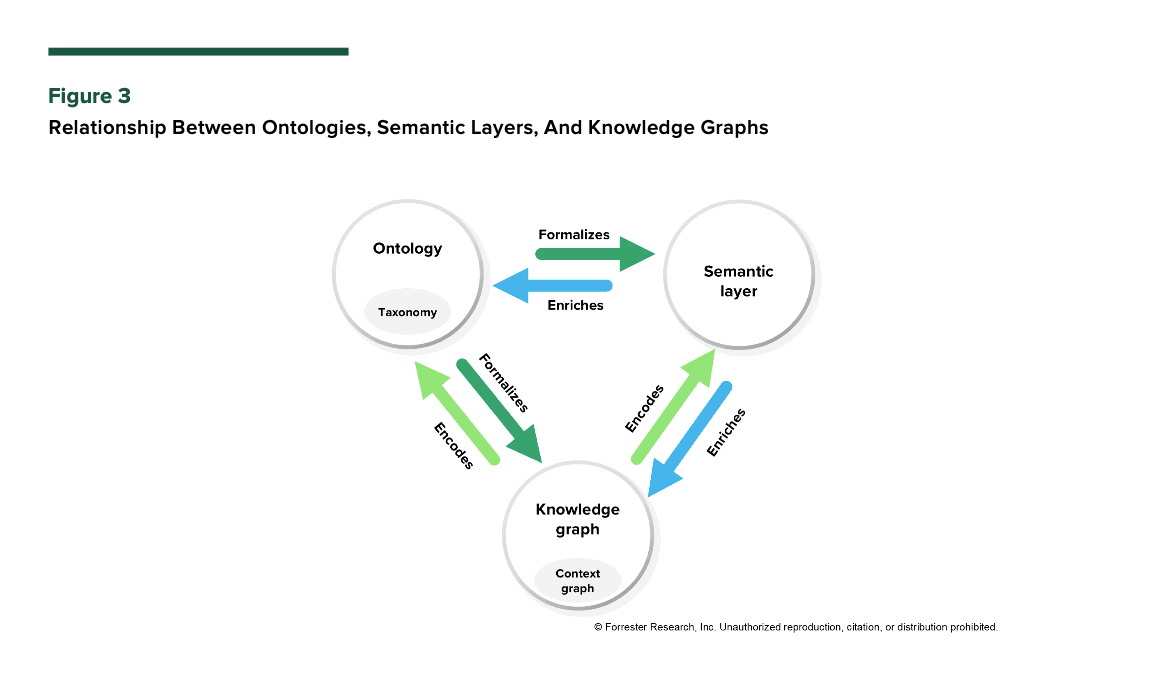
Forrester’s June 2026 report, “Combine Semantics, Ontology, And Knowledge Graphs For AI-Ready Data,” shows why AI-ready data depends on more than schemas, pipelines, and retrieval. This validates what Strategy has been building toward: a universal semantic layer where business meaning is governed, reusable, and operational across every AI system and operations tool.
For Strategy, which was interviewed as part of this research, the report reinforces a core architectural principle: trusted AI and analytics require a semantic foundation. The semantic layer, like Strategy Mosaic, is where business meaning becomes reusable, governed, and operational across BI tools, data products, AI agents, and enterprise workflows.
Why is context essential?
- Agentic AI needs more than access to enterprise data; it needs a shared conceptual map of the business.
- Ontologies define the entities, attributes, and relationships that matter across business domains.
- Semantics add meaning, disambiguation, and context awareness so AI can interpret intent instead of guessing.
- Knowledge graphs connect concepts into navigable networks, helping AI reason across relationships, rules, and hidden dependencies.
Together, these capabilities help transform enterprise data from passive information into a foundation for context-aware reasoning.
What’s inside the report
- Why data without shared meaning and context falls short for agentic AI
- How semantics, ontologies, and knowledge graphs work together to make data AI-ready
- Why ontologies provide the conceptual map AI agents need to understand business domains
- How semantic layers help resolve ambiguity, interpret intent, and eliminate the need for schema awareness
- How knowledge graphs connect relationships and rules across enterprise data
- Why context-rich data improves reasoning, natural language querying, hybrid RAG, and LLM guardrails
- How enterprises can move from retrieval-based AI to AI that understands, reasons, and acts
Information in Forrester publications is based on Forrester’s efforts to compile and analyze the best resources reasonably available to Forrester at any given time. Opinions reflect judgment at the time and are subject to change. This report is part of a broader collection of Forrester resources, including interactive models, frameworks, tools, data, and access to analyst guidance.