

What is a semantic layer? A plain-language guide for business and data leaders
Strategy Software's new book, Semantic Layers for dummies, gives executives and data teams a shared vocabulary for the AI era.
Quick Answer
What is a semantic layer? A semantic layer is a centralized, governed business logic and metrics framework that enables consistent and trusted analytics and AI across tools and platforms.
It acts as a shared translation layer between raw data and the people — and AI systems — consuming it, ensuring that terms like "revenue," "customer," and "churn" carry the same meaning everywhere they appear.
Why it matters now: Gartner predicts that by 2030, universal semantic layers will be treated as critical infrastructure, alongside data platforms and cybersecurity.
Semantic layer is one of those terms that sounds technical enough to nod along with, specific enough to feel like it should mean something, and just unfamiliar enough that most of the people making decisions about it have quietly avoided asking for a definition. That window is closing — because semantic layers are moving from an architecture conversation to a boardroom one, and the organizations that understand them first will build AI they can actually trust.
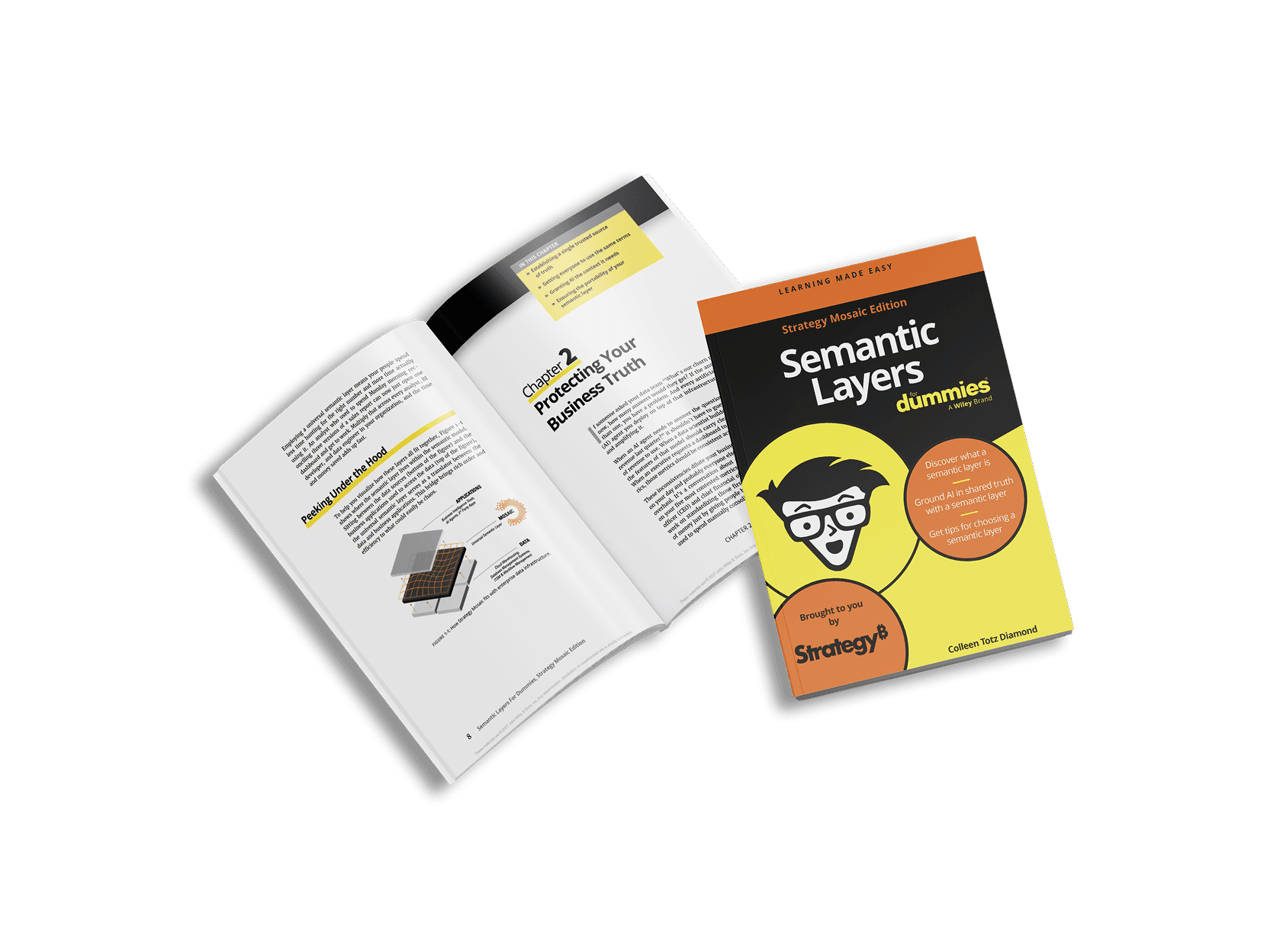
After months of research, writing, and collaboration with Wiley, Strategy Software has published Semantic Layers for dummies, Strategy Mosaic Edition — a practical guide for both business leaders trying to make sense of conflicting data and data professionals building more reliable foundations for analytics and AI.
We created this book because semantic layers are rapidly becoming a critical part of enterprise AI and data infrastructure, yet the concept is still far from universally understood.
At the Gartner Data & Analytics Summit 2026, Gartner predicted that by 2030, universal semantic layers will be treated as critical infrastructure, alongside data platforms and cybersecurity. That is quite a shift for a technology that, until recently, rarely made it into board-level conversations.
Why semantic layers need a clearer explanation now
Data and AI teams may talk about semantics every day, but many of the executives making decisions about AI strategy, governance, architecture, and investment are much less familiar with the concept.
In a recent SmartBrief and Strategy Software study of 75 executives, only about one-third said they were very familiar with semantic layers, even when the question supplied a definition:
What is a semantic layer?
A centralized, governed business logic and metrics framework enabling consistent and trusted analytics and AI across tools and platforms.
Among the retail executives surveyed, one in five said they did not know what a semantic layer was at all.
_1.png&w=3840&q=75)
Figure 1: How a universal semantic layer connects governed business context to every analytics and AI experience.
That knowledge gap matters because the problem semantic layers solve is becoming more urgent as organizations deploy AI.
An AI agent can retrieve and analyze information at extraordinary speed. But if Sales, Finance, and Marketing each define revenue differently, AI does not resolve the disagreement. It produces another answer, faster.
As the book puts it:
“The problem isn’t the AI. It’s the absence of shared business context underneath it.”
From conflicting numbers to one business truth
Imagine an executive meeting where three teams arrive with three different revenue figures and each is confident its number is correct.
The problem may not be bad data. Each team may simply be applying a different definition, using different systems, or relying on business logic embedded in separate tools. That is exactly the scenario the book uses to show why enterprise AI needs a semantic layer.
A universal semantic layer creates a consistent business view across those environments. It connects disparate data sources, standardizes definitions and metrics, and makes that shared context available wherever the data is consumed.
The goal is not to force every team into the same BI tool or data platform. The goal is ensuring that “revenue,” “customer,” “churn,” or any other critical business concept carries consistent meaning wherever it appears.
That becomes even more important as organizations scale AI. The book describes the semantic layer as organizational intelligence made explicit and machine-readable: the business rules, relationships, definitions, and context that humans learn over time but AI systems need to be given deliberately.
Strategy Software built Mosaic as an independent universal semantic layer: one designed to sit above any data warehouse, BI tool, or AI model, so that business context travels with the organization rather than getting locked inside any single platform.
Governance from the start
The book also addresses a concept that has become so common it can start to lose its force: governance.
Governance determines who can access which data, under what conditions, and through which tools. As organizations add BI platforms, custom applications, and AI agents, defining those policies separately at every access point creates more opportunities for inconsistency.
A universal semantic layer provides a centralized framework for applying governance rules across the data environment. Rather than recreating security logic tool by tool, organizations can define policies centrally and apply them consistently across dashboards, applications, and AI systems. This creates a stronger foundation for scaling access without losing control.
Why independence matters
Another major theme of the book is independence. Business logic is too valuable to be trapped inside one data warehouse, BI platform, cloud provider, or AI model.
An independent semantic layer separates business definitions, rules, and metrics from the tools that happen to consume them today. That gives organizations more freedom to change warehouses, adopt new analytics tools, or switch AI models without rebuilding their business context from scratch.
This is also where performance and cost enter the conversation.
Repetitive compute is one of the hidden expenses of modern data environments. If the same KPI is requested repeatedly, a semantic layer with an in-memory cache can serve a recent, valid answer without sending every request back to the warehouse.
In Strategy's analysis of query-level data across its cloud customer base, Mosaic's cache deflected 48.9% of all queries, meaning nearly half were answered without incurring warehouse-side compute.
From explanation to implementation
Semantic Layers for dummies was not designed to explain why semantic layers matter and then leave readers with the hard part.
The final chapter turns the concept into a practical ten-step implementation framework organized around three phases: plan, build, and scale. It begins with business outcomes rather than the data model and recommends starting with a focused set of problems where value can be demonstrated quickly.
That practical focus matters. A semantic layer should not begin as an abstract architecture project. It should begin with a business problem: conflicting KPIs, duplicated logic, uncontrolled access, rising query costs, or AI systems that cannot reliably interpret enterprise data.
A common language for the AI era
Ultimately, Semantic Layers for dummies is meant to give business and technology leaders a shared vocabulary for a conversation they increasingly need to have.
Because before you can scale AI, you need to know what your business means.
It was a privilege to work on this book alongside the Wiley team, whose openness, expertise, and professionalism shaped the project from start to finish. Particular thanks go to author Colleen Totz Diamond and project manager and editor Carrie Burchfield-Leighton for helping bring it to life.
Looking for More?
Learn how to create one trusted semantic foundation for every tool, team, and AI.
Frequently Asked Questions
What is a semantic layer in simple terms?
A semantic layer is a shared translation layer between your data and the people or AI systems using it. It stores the business definitions — what “revenue” means, how “churn” is calculated, who counts as an “active customer” — so every tool, dashboard, and AI agent works from the same answer instead of each inventing its own.
What is the definition of a universal semantic layer?
A universal semantic layer extends those consistent business definitions across all tools and data consumers simultaneously — not just one BI platform or one AI model, but every application, dashboard, and agent in the environment. Gartner predicts that by 2030, universal semantic layers will be treated as critical infrastructure, comparable to data platforms and cybersecurity.
Why does a semantic layer matter for AI?
AI agents can retrieve and process data at high speed, but they cannot resolve definitional disagreements that exist in the underlying data. If Sales, Finance, and Marketing each define revenue differently, an AI will produce another conflicting answer faster — not a correct one. A semantic layer ensures AI systems work from governed, consistent business context rather than raw, unresolved data.
What is Mosaic by Strategy Software?
Mosaic is Strategy Software's universal semantic layer — an independent platform that sits above data warehouses, BI tools, and AI models to provide centralized, governed business logic. Mosaic's in-memory cache deflected 48.9% of queries across Strategy Software's cloud customer base, reducing redundant compute costs significantly.
What is the difference between a semantic layer and a data warehouse?
A data warehouse stores and organizes raw or structured data. A semantic layer sits above the warehouse and defines what that data means in business terms — the rules, relationships, and metrics that make data interpretable across tools and teams. The two work together: the warehouse holds the data; the semantic layer holds the business context.
How do you implement a semantic layer?
Semantic Layers for Dummies recommends a ten-step framework across three phases: plan, build, and scale. The plan phase starts with business outcomes — not the data model — and identifies a focused initial use case where value can be demonstrated quickly. Common starting points include resolving conflicting KPIs, consolidating duplicated business logic, or establishing governed access for AI agents.

Beata Socha
With over 15 years of experience as a tech journalist and content creator, Beata heads Content Marketing at MicroStrategy. An economics graduate, she specializes in finance and the impact of AI on business, bringing expert insights to the industry.