

July 2026: Portable Semantics, AWS Bedrock AI, and Safer Analytics Deployments
Quick Answer
Strategy Software's July 2026 release reduces handoffs across Mosaic, AI, and BI.
In Mosaic, teams can map Mosaic Models to Mosaic Schema for inherited governance and import or export semantic assets using Apache Ossie (Incubating) YAML.
In AI, Strategy AI can connect to AWS Bedrock inside the customer's approved cloud architecture.
In BI, administrators can promote content across trusted environments from Workstation Web, and business teams can build native Gantt views directly in Strategy.
Together, these updates reduce the places where semantics, AI choices, deployments, and business workflows can drift apart.
Most enterprise analytics problems do not start with a bad dashboard. They start with a handoff.
A self-service model gets rebuilt outside governance. Semantic definitions move into a file that no one quite owns. A promotion to production depends on a fragile desktop workflow. An AI pilot uses an approved model provider, but runs outside the controls of the analytics platform. A project schedule lives in one tool while the metrics that explain the work live somewhere else.
Each one looks small on its own, but together they are where trust in the analytics breaks down.
July 2026 is about making those connections stronger. Mosaic semantics, AI model choice, and BI operations should not have to live in separate lanes.
Mosaic: portable semantics without shadow governance
Map Mosaic Models to Mosaic Schema
Self-service semantic modeling only scales when speed does not create a second governance system. If every team recreates access rules inside its own model, the organization gains momentum and risk at the same time.
Ungoverned speed is still risk. It just arrives faster.
Mosaic Models can now be mapped to existing Mosaic Schema attributes so they inherit centrally defined dimensions, object ACLs, and row-level security filters. The mapping is configured in Mosaic Studio. Once mapped, the model follows rules already defined in Mosaic Schema without separate security logic to rebuild, review, or audit. Attributes can be unmapped at any time to return to default model behavior.
The controls carry through to dashboards, Hypercards, Agents, subscriptions, and caches. Data teams move faster because they are not rebuilding the same guardrails over and over. Administrators have fewer parallel rules to chase. Business users get models that are easier to use and safer to trust.
For enterprises trying to scale Mosaic Models, self-service becomes an extension of governed semantics, not an exception to it.

Import and export Mosaic Models as Apache Ossie (Incubating) YAML
A team importing an existing model, or exporting one to another tool, needs a shared format, not a workaround. Open standards matter most when they reduce friction without creating a new place for truth to drift.
Mosaic can now import and export semantic information using Apache Ossie (Incubating), formerly Open Semantic Interchange. This gives teams a standardized way to exchange semantic models across platforms while keeping Mosaic as the governed system of record for refining, securing, and maintaining enterprise business logic.
A file is fine for moving definitions between systems. It is a poor place to govern enterprise business logic. With this open standard support, teams can onboard existing semantic work, collaborate across a broader ecosystem, and reduce lock-in without scattering definitions across disconnected files, all while Mosaic stays the accountable home for how those models are maintained.
AI: approved model choice inside governed analytics
Certified AWS Bedrock Integration for AI Workloads
AI platform decisions are no longer theoretical. Many enterprises have already made their AI infrastructure decisions. They know which cloud environments are approved, which model providers are allowed, and which controls need to stay in place. Analytics should fit into that architecture, not route around it.
Strategy AI can now connect to a customer's own AWS Bedrock environment and use selected models, including Llama, GPT-OSS, and Cohere. Strategy invokes those models directly on the customer's Bedrock tenant through native AWS APIs.
Strategy AI keeps those workloads inside the cloud model environment the enterprise has already approved. Teams that standardize on Bedrock do not need to route analytics AI through a separate, less governed path.
Enterprise AI adoption depends on fit as much as model capability, and the harder work is usually not picking another model but making approved models usable inside governed workflows.
BI: governed promotions, native timelines
BI has its own version of the handoff problem. A package moves to production without a clear, governed path. A project timeline lives in a separate tool from the metrics that explain the work. July closes both gaps.
Trusted Multi-Environment Workflows in Workstation Web
Workstation Web now supports trusted connections between Strategy environments, giving administrators a secure way to manage cross-environment workflows directly in the browser.
Administrators can connect development, test, and production environments by establishing explicit trust between them. Once trusted, they can promote content through migrations, reverse migrated packages when needed, and duplicate projects across environments, all from Workstation Web.
This makes it easier to manage the BI development lifecycle across connected environments, with clearer governance and less dependency on desktop tooling.
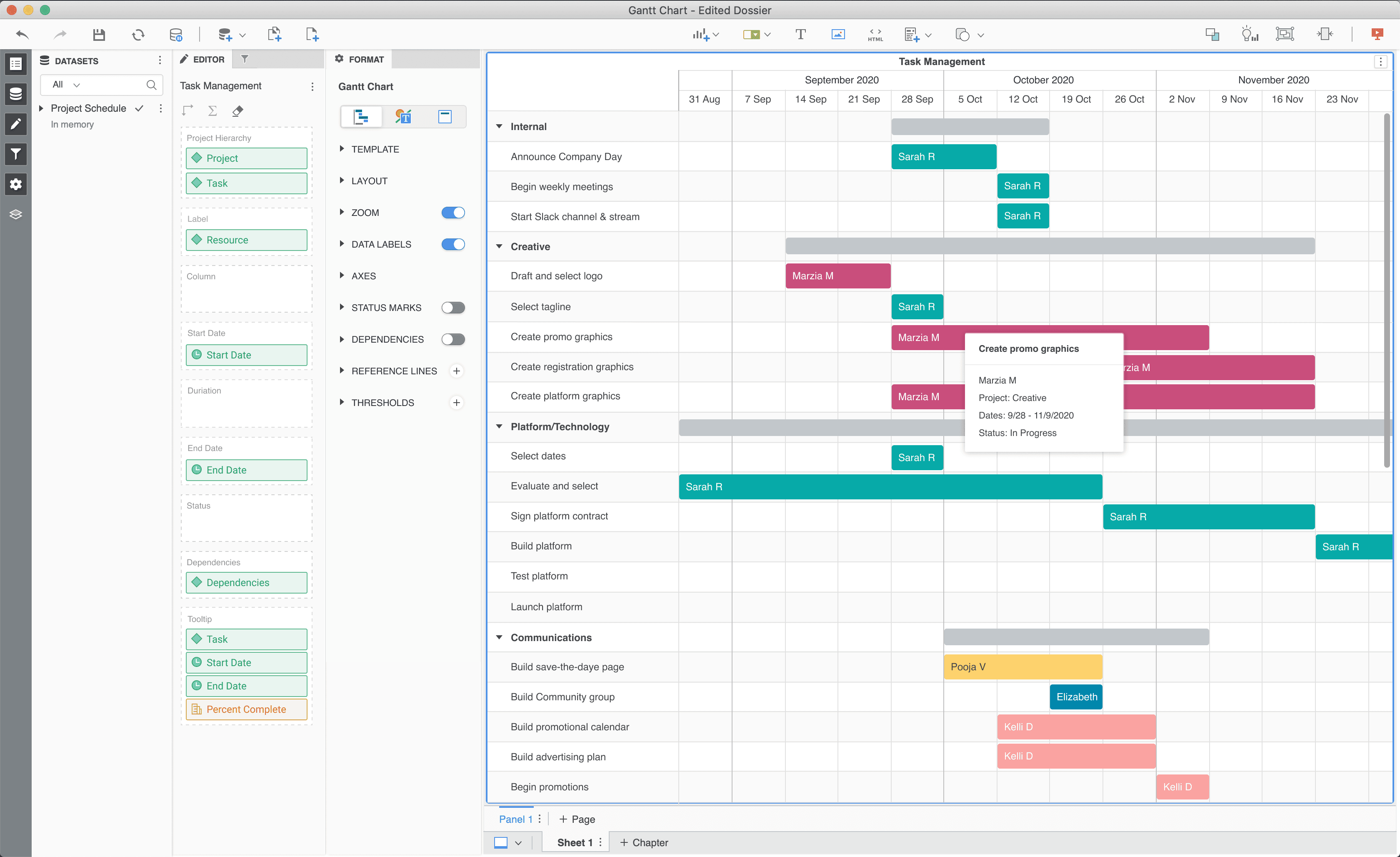
Plan Timelines with New Gantt Chart
Visualize project timelines and schedules directly in Strategy with the new out-of-the-box Gantt chart. Build Gantt views using existing attributes and metrics, such as tasks, owners, start and end dates, and status, without relying on third-party or custom visualizations.
Track progress, overlaps, and dependencies for portfolios, campaigns, or resource plans in a familiar, interactive grid. The Gantt chart is fully integrated with Strategy's formatting, localization, accessibility, and responsiveness standards, helping teams manage time-based work more clearly and efficiently.
The Core Pillars
The July release makes Mosaic stronger in the places enterprise customers care about most: governance, openness, AI choice, and day-to-day usability.
Mosaic Models now connect more naturally to the governance customers have already built in Mosaic Schema, so teams can move faster without creating another layer of rules to manage. Apache Ossie (Incubating) YAML makes semantic assets easier to move across tools, while Mosaic remains the place where business meaning is maintained and trusted. Strategy AI can work with AWS Bedrock in the customer's approved cloud architecture, instead of forcing AI into a separate path. Workstation Web gives administrators a cleaner way to manage trusted deployments from the browser. And with native Gantt charts, teams can bring timelines, ownership, and progress into the same analytics experience they already use to understand the business.
Learn more about these July updates on our What's New page and product documentation.
Frequently Asked Questions
What updates does this blog highlight from the Strategy Software July 2026 release?
This blog highlights five July 2026 updates across Mosaic, AI, and BI: Mosaic Model mapping to Mosaic Schema, Apache Ossie (Incubating) YAML import and export for Mosaic Models, certified AWS Bedrock integration for Strategy AI workloads, trusted multi-environment workflows in Workstation Web, and a native Gantt chart.
Does mapping Mosaic Models to Mosaic Schema slow down self-service teams?
No. The goal is the opposite. Teams can build Mosaic Models faster while inheriting the governance already defined in Mosaic Schema. That means less duplicated security work, fewer parallel rules to manage, and a cleaner path for self-service modeling to scale without becoming shadow governance.
Why does Apache Ossie (Incubating) YAML matter if Mosaic is still the governed model?
Because openness and governance need to work together. Apache Ossie (Incubating), formerly Open Semantic Interchange, gives teams a standard way to move semantic assets across tools. Mosaic remains the place where business meaning is refined, secured, and maintained. The point is portability without letting definitions drift into disconnected files.
How does AWS Bedrock support help enterprise AI teams?
Enterprise AI infrastructure choices are usually made before analytics teams get involved. With AWS Bedrock support, Strategy AI can work inside the customer’s approved AWS architecture instead of forcing teams down a separate path. That makes AI adoption easier to align with existing infrastructure, security, and governance decisions.
Why do trusted multi-environment workflows in Workstation Web matter?
Enterprise BI changes need the same discipline customers expect from software delivery. Workstation Web gives administrators a browser-based way to establish trust between environments, promote content, reverse migrated packages when needed, and duplicate projects across connected environments. That brings deployment closer to the auditability and rollback discipline of a software release.
Why add Gantt charts to Strategy?
Because timelines often explain what metrics alone cannot. A campaign milestone, implementation delay, resource conflict, or project dependency can change how teams interpret performance. The native Gantt chart brings tasks, owners, dates, status, dependencies, and progress into Strategy, so teams can analyze execution alongside the governed data they already use to run the business.

Henry Guo
Henry Guo is Director of Outbound Product Management at Strategy, driving go-to-market and turning customer insights into discovery and validation for its semantic layer and AI products. With 15+ years in AI, data and security, he helps ship trusted secure enterprise platforms with measurable value.
Related posts
Strategy's June 2026 release delivers cloud cost visibility, flexible Mosaic modeling, and governed AI access via MCP. See what analytics costs to run.
Henry Guo
June 18, 2026
Strategy’s May 2026 release introduces Databricks Unity Catalog metadata integration for Strategy Mosaic, GDPR-aligned telemetry anonymization, SQL transaction forms in Library Web dashboards, and customizable global legends to strengthen governed analytics and AI workflows.
Henry Guo
May 15, 2026
Strategy Software's April 2026 updates introduce Save As for Mosaic models, filter carry-through for linked dashboards, Google Sheets export from Strategy Library, and full HyperIntelligence Card authoring in the browser.
Henry Guo
April 17, 2026
Discover the March 2026 updates that enhance your semantic layer control and integration with AI tools, featuring Mosaic Model Versioning with GitHub, built-in time intelligence, and smarter content discovery for faster, more reliable insights across your organization.
Henry Guo
March 20, 2026