

Cost Intelligence in Mosaic Sentinel: From cloud spend to model decision
Quick Answer
- What is Cloud Spend and why does it matter for AI? Cloud spend refers to the total cost associated with cloud infrastructure, including compute, storage, networking, data services, and AI workloads. As organizations deploy more AI models and agents, cloud spend can increase rapidly, making visibility and governance essential for controlling costs.
Enterprise AI runs on two meters: AI token consumption and data-platform compute. Cost Intelligence in Mosaic Sentinel brings visibility and control to the second.
By automatically tagging runtime queries and combining them with daily Snowflake and Databricks billing data, Sentinel attributes cloud spend to individual governed datasets.
When usage patterns reveal waste, Sentinel provides AI-generated recommendations that take administrators directly into Mosaic Studio to optimize query modes, adjust refresh cadences, or unload inactive assets.
Connect cloud spend to the model decisions driving it
Snowflake and Databricks can tell you what the infrastructure consumed. That is essential. But they do not tell a model architect which governed dataset caused the work, how that dataset was executed, or which model decision should change.
That gap gets more expensive as AI scales. Agents do not wait for business hours. They explore, retry, and ask follow-up questions continuously. A useful agent can still become an expensive agent when repetitive questions keep returning to the live warehouse.
Cost Intelligence in Mosaic Sentinel closes the loop. It connects warehouse spend to the datasets behind analytics and AI, then surfaces the model-level action most likely to help. This is not another cost report. It turns the semantic layer into a control point for cloud economics.
Enterprise AI now runs on two meters
The first meter is AI consumption: the tokens used while an agent interprets context and reasons through a request. The second is data-platform compute: the Snowflake credits or Databricks resources consumed when the query executes.
If you only track token counts, you are missing half the bill. The hidden multiplier is the warehouse compute triggered every time an agent explores, retries, or reaches into live tables. You want visibility into both meters before you scale to hundreds of active agents, not after an unexpected Snowflake or Databricks invoice arrives.
The cloud bill stops one level too early
A warehouse-level spike is a symptom. The cause might be an executive dashboard, an over-refreshed model, a rarely used in-memory asset, or an agent repeatedly querying a live dataset. Each one requires a different response.
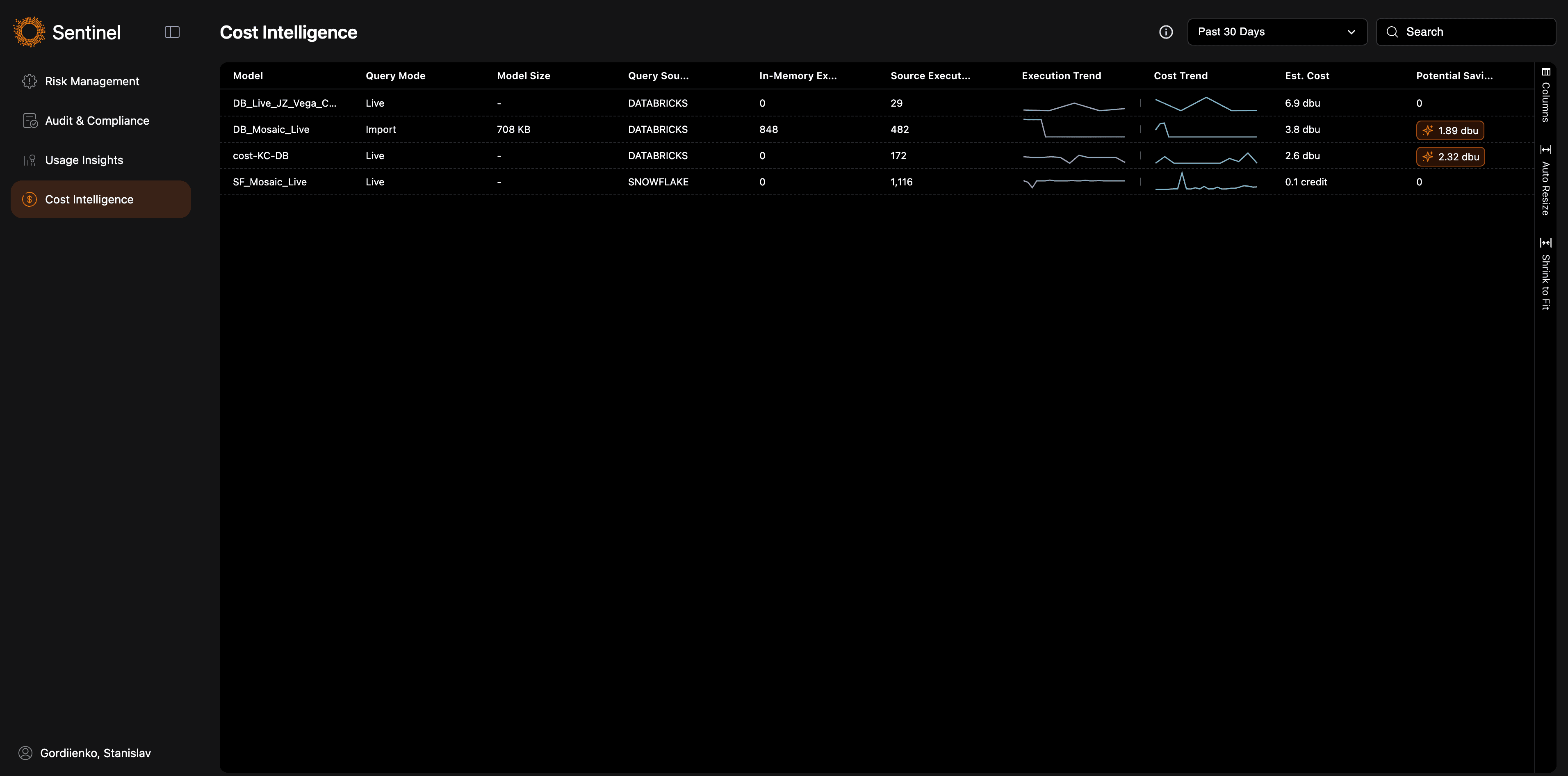
Cost Intelligence adds the semantic context that infrastructure billing lacks. It shows the dataset, query mode, source and in-memory execution volume, cost trend, estimated cost, and potential savings in one view. Instead of asking whether the warehouse is expensive in the abstract, administrators can ask which governed asset is driving the spend and why.
The savings opportunity can be material
Strategy's public cloud spend analysis, based on real customer environments, estimates potential annual savings of approximately $63,000 for $250,000 to $1 million in Snowflake or Databricks spend, $609,000 for $1 million to $5 million, and $4 million for $5 million to $25 million. Actual results depend on workload patterns and architecture. See the cloud spend control analysis.
How attribution works without turning billing into query overhead
Cost Intelligence separates two jobs that operate on very different timelines.
Runtime attribution. When an administrator enables a Snowflake or Databricks billing source, Sentinel automatically applies tracking tags to the associated data sources. As analytics and AI workloads run, those tags provide the context needed to connect warehouse activity directly to the Mosaic datasets behind it, cleanly segregating Mosaic execution from third-party queries. The administrator does not need to maintain a separate manual tagging scheme.
Daily billing ingestion. Snowflake and Databricks expose billing information asynchronously. Sentinel retrieves those financial signals through a background process once every 24 hours, then combines them with runtime activity to calculate dataset-level cost attribution, query and cost trends, potential savings, and AI-generated recommendations.
We made a deliberate engineering choice here. Billing data is retrieved asynchronously through a daily background job, outside the interactive query workflow. Dashboards, applications, and AI agents can keep querying data while Sentinel builds the cost-attribution signal separately. Once the billing data is available, Sentinel combines it with the runtime tags to show what ran, what it cost, and which model decision could improve the economics.
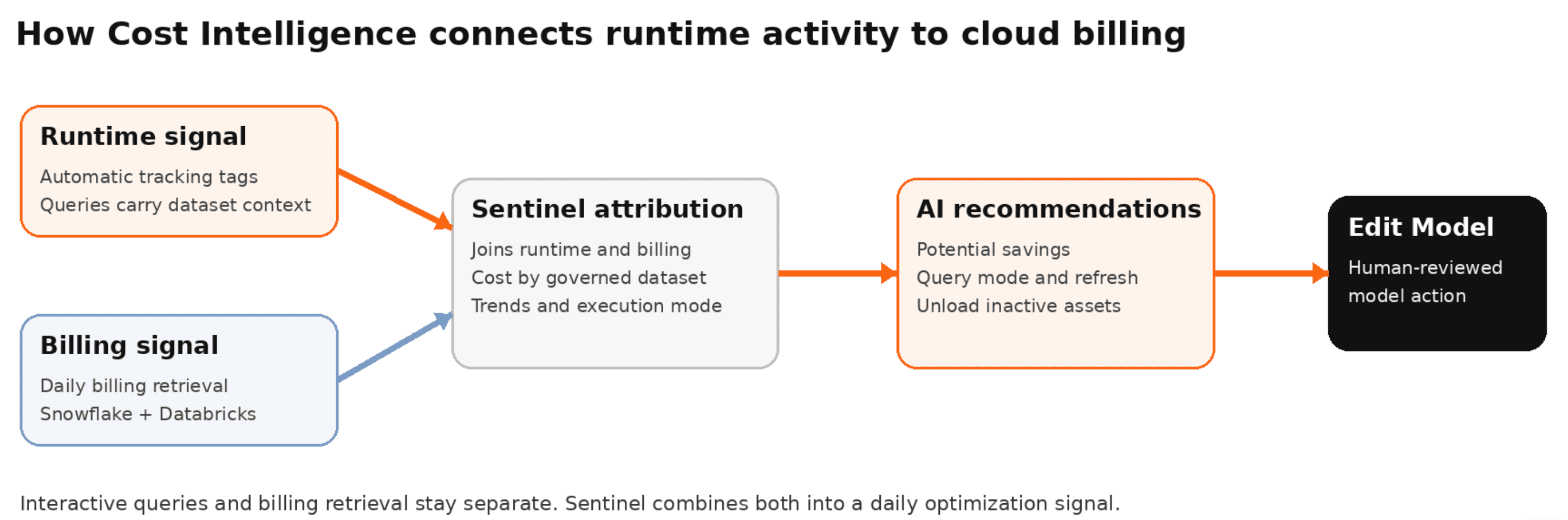
Runtime attribution and daily billing ingestion remain separate, then meet in Sentinel at the governed dataset level.
The real decision: matching execution mode to demand
Here is the reality of model optimization: caching everything in memory is not the goal, and neither is sending every request back to the live warehouse. The right choice depends on how the dataset is actually used.
Live execution: Best suited to fast-changing operational data where freshness is critical. The trade-off is that every repeated request continues to consume Snowflake credits or Databricks compute.
In-memory execution: Well suited to stable, frequently queried datasets. Repeated dashboard and AI requests can be served without sending every query back to the cloud platform, reducing redundant warehouse compute. The trade-off is Strategy platform memory.
Unload or adjust refresh frequency: Useful for inactive or over-refreshed assets that consume memory and processing capacity without corresponding business demand.
Cost Intelligence gives model owners the usage, cost, and savings evidence to make that choice based on actual demand rather than architecture assumptions.

The Cost Intelligence view connects query mode, executions, cost trends, and potential savings at the dataset level.
Turn cost signals into model action
Visibility alone does not reduce spend. The value comes from turning a cost signal into the right model decision.
Sentinel evaluates a dataset’s execution pattern, query mode, cost trend, and estimated savings to generate a recommendation. That recommendation might be to unload an inactive asset, adjust a refresh cadence, or switch between live and in-memory execution when usage patterns support it.
Not every high-cost dataset represents waste. In many enterprises, a core data product like a master Book of Business carries high compute or memory costs simply because it powers queries across the entire organization. In those cases, Cost Intelligence provides essential transparency. Seeing heavy, steady usage against a critical dataset tells an architect or CIO that the spend is fully justified, allowing them to validate performance and continue monitoring without making unnecessary changes.
When architectural changes are required, an administrator can open the potential-savings recommendation and go directly to Mosaic Studio to edit the model, closing the gap between a FinOps alert and the analytics architecture responsible for the spend.
We deliberately do not auto-apply these changes. Sentinel provides the financial evidence, the recommendation, and a direct path to edit model, while the model owner stays in control.
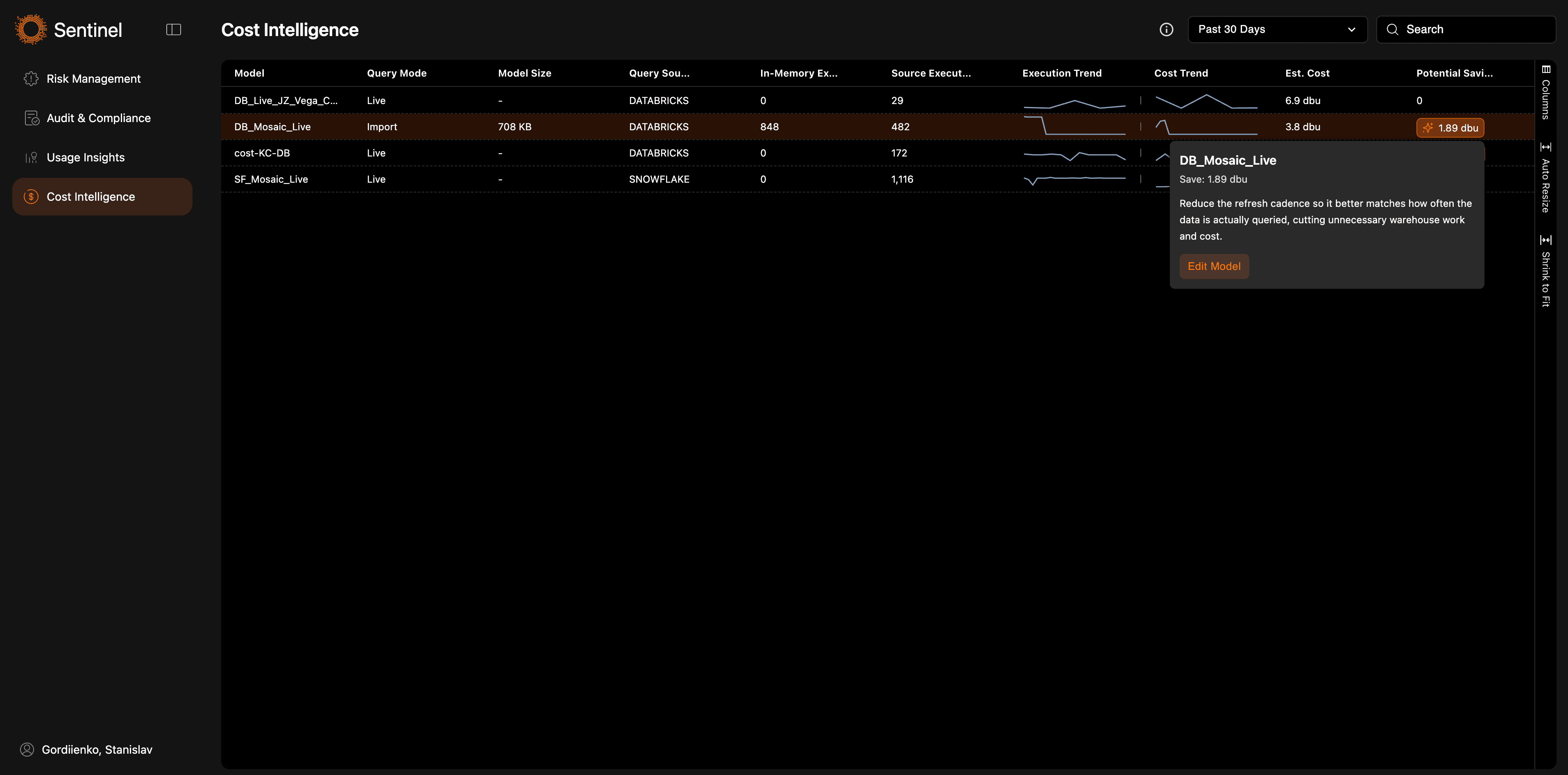
Sentinel connects estimated savings directly to the model action an administrator can review.
Cost Intelligence completes the Mosaic loop
The goal is not to minimize every query. It is to spend cloud compute where freshness and scale require it, use memory where reuse is economical, and remove work that no longer delivers value.
Cost Intelligence extends the broader role of Mosaic. Mosaic does more than give analytics and AI consistent business definitions. It governs how those definitions connect to data, how the resulting queries execute, and now what that execution costs. By bringing meaning, execution, and economics into the same governed layer, Mosaic gives enterprises a more sustainable foundation for scaling analytics and AI.
Explore Strategy Mosaic and read the Cost Intelligence technical documentation.
Frequently Asked Questions
How are costs attributed to a Mosaic dataset?
Sentinel automatically tags the data sources associated with an enabled billing account. It combines that runtime context with the platform billing data collected by the daily background job, then assigns cost and execution signals to individual datasets.
Does Sentinel add a billing lookup to every interactive query?
No. Runtime tagging and billing retrieval are separate. Billing data is collected asynchronously through the daily background job, outside the interactive query workflow. Dashboards, applications, and AI agents continue to query data while Sentinel builds the cost-attribution signal separately.
How current is the cost data?
Cost and usage insights refresh once every 24 hours because Snowflake and Databricks billing data is not real time. Cost Intelligence is designed for daily optimization and model decisions, not real-time incident response.
What permissions does the billing connection require?
The user configured for the Snowflake or Databricks billing source needs sufficient billing-read privileges. Without that access, Sentinel cannot retrieve and attribute cost information.
Does moving everything in memory always reduce cost?
No. Live and in-memory execution optimize different constraints. Frequently reused, stable datasets may benefit from in-memory execution. Fast-changing workloads may need live freshness, while inactive in-memory assets may consume resources without delivering value. Cost Intelligence helps teams choose from actual demand and cost patterns.

Stanislav Gordiienko
Stan Gordiienko is Senior Product Manager with a background in Business Intelligence, Semantic Layer, Audit & Telemetry. He is a former BI practitioner and engages with Strategy customers regularly to improve the product.
Content:
- Connect cloud spend to the model decisions driving it
- Enterprise AI now runs on two meters
- The cloud bill stops one level too early
- How attribution works without turning billing into query overhead
- The real decision: matching execution mode to demand
- Turn cost signals into model action
- Cost Intelligence completes the Mosaic loop
- Frequently Asked Questions
Related posts
AI agents sound confident but guess without context. See how Mosaic and MCP give agents trusted definitions and governed metrics.

Kaylee Ritter
July 31, 2026

AI agents need governed business context before they act. Learn why a universal semantic layer is now critical infrastructure for agentic AI.

Henry Guo
July 29, 2026
Enterprise AI fails when it lacks business context. Forrester Research shows how ontology, semantics, and knowledge graphs work together to give AI systems the definitions, relationships, and governed meaning they need to answer business questions accurately.

Beata Socha
July 28, 2026
AI is now a consumption layer for analytics. Learn why governed metrics and a semantic layer must sit outside the LLM to keep answers consistent.

Tanmay Ratanpal
August 3, 2026