

Why Banks are Investing in an AI-Ready Data Foundation
Quick Answer
Banks have invested heavily in modern data platforms and AI experimentation.
91% of banks and financial institutions expect to increase investment in data governance and architecture over the next 12 to 24 months.
But to move AI from pilots into production, banks need consistent business context: governed definitions, access, and reusable business logic that can be applied across use cases.
A semantic layer helps provide that AI-ready data foundation by standardizing business definitions and governance across analytics and AI.
Instead of rebuilding context for every project, banks can make it reusable.
Banks Are Fixing the Foundation Beneath the AI
Banking's first phase of enterprise AI investment focused heavily on data modernization and experimentation. Institutions launched pilots and tested use cases, but most have not yet converted that activity into standardized, governed AI deployment across the enterprise.
The next investment phase is moving beneath the model.
According to the AI Context Gap in Banking Report, 91% of banks and financial institutions expect to increase investment in data governance and architecture over the next 12 to 24 months.
That is the foundation AI depends on: trusted definitions, governed access, reusable business logic, and architecture that can support AI consistently across the organization.
More Pilots Don't Solve the AI Context Problem
More pilots can prove more use cases. They don't create shared infrastructure.
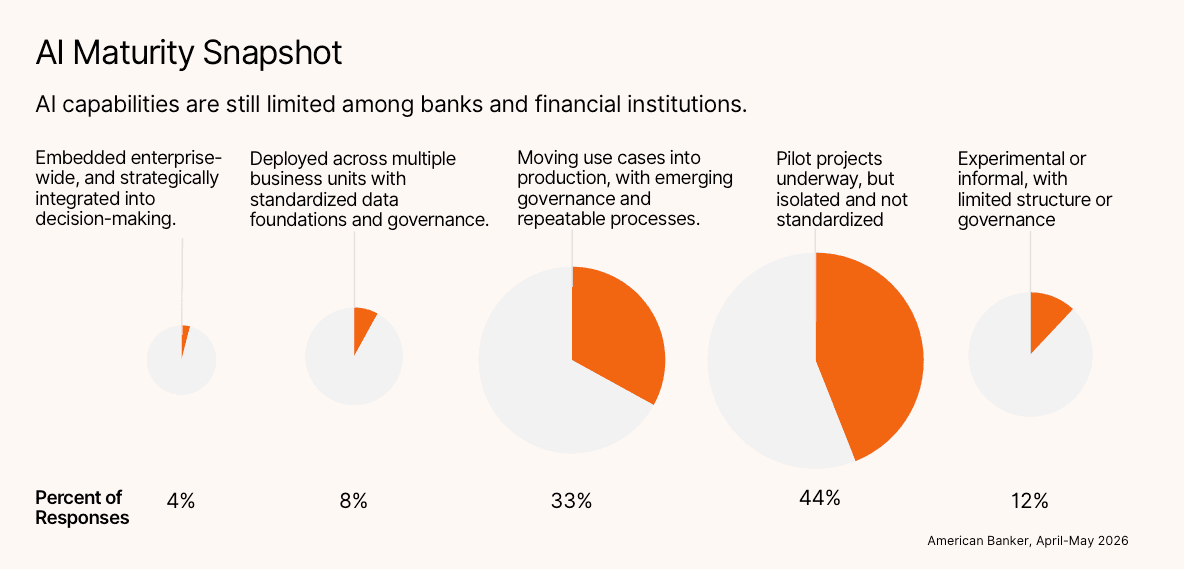
According to the report, more than half of organizations remain at the experimental or isolated pilot stage, while only 12% report AI deployed across multiple business units or embedded enterprise-wide.
Launching more pilots without improving the underlying architecture risks repeating the same pattern:
- Each project may connect to different datasets
- Each dataset may rely on different definitions
- Each definition may go through its own governance process
If every new pilot introduces its own data connections, definitions, and governance process, the bank scales duplication alongside AI.
The result is a growing collection of AI applications that appear useful individually but can't be managed consistently across the bank. That's an AI context problem, not a model problem.
To deliver consistency at scale, AI systems need the business context that tells them which definitions, relationships and rules apply. Without that context, a model may generate valid-looking output from the wrong interpretation of the data.
Example: AI hallucinating SQL
AI may generate syntactically valid SQL against the wrong table, apply the wrong join, or use a metric definition intended for another team. At enterprise scale, those inconsistencies become harder to govern, trace, and audit.
AI Data Governance Must Extend Below the Model
Managing AI models is essential, but it's only one part of enterprise governance. Banks must also govern the data, definitions, and business logic that AI systems rely on.
Scaling AI therefore expands the scope of governance. Banks need to control not only who can access data, but which definitions are authoritative, which business rules apply, and how that context is reused when AI interacts with the data.
AI data governance must establish:
- Which metric definitions are approved
- How business logic is reused
- Which access policies apply to AI requests
- How outputs can be traced back to source data and governed logic
- How the same question is answered consistently across tools
- How AI-generated queries are reviewed and audited
These controls need to operate across dashboards, applications, agents, and enterprise BI platforms with AI. Otherwise, a bank may have strong model oversight while still allowing different systems to produce conflicting answers from the same data.
A Semantic Layer Makes the AI-Ready Foundation Reusable
A governed AI semantic layer enables banks to define metrics, business concepts, and access rules once, then reuse them across analytics and AI systems.
This shared layer sits between source data and the tools consuming it, providing a consistent definition of concepts such as customer, revenue, profitability, or risk exposure.
Instead of asking each AI model or application to infer meaning independently, the bank supplies approved business context. As a result, the AI semantic layer directly supports:
- Consistent metrics across business units
- Reusable business logic across dashboards, applications, and AI tools
- Governed access across different consumers
- Stronger governance, compliance, and audit readiness
- More consistent analytics and AI outputs as adoption scales
- A more reliable foundation for text-to-SQL and other AI interactions with enterprise data
What's Next for AI in Banking?
The report points to where banking investment is moving next: beneath the AI layer, into the governance and architecture that make AI usable at scale.
That investment matters because reusable definitions, policies, and business logic reduce the need to rebuild the same foundation for every new use case. A successful pilot becomes easier to extend when the next application starts from the same governed context.
Strategy Mosaic is designed for this architecture.
It centralizes governed business definitions so the same context can be reused across analytics, AI agents, and applications while working with the existing data stack.
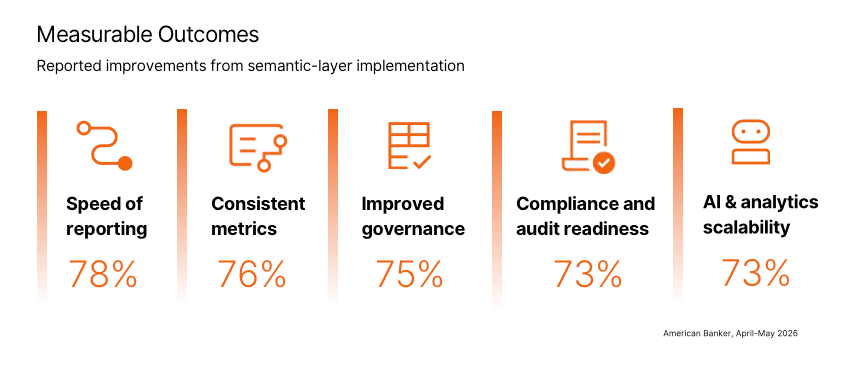
The benefits are already visible. Among institutions that have implemented a semantic layer, 78% report improved reporting speed, 76% more consistent metrics, 75% improved governance, 73% improved compliance and audit readiness, and 73% improved AI and analytics scalability.
From AI Pilots to Production-Scale AI
The next phase of banking AI is about scaling what works on top of consistent definitions, governed access, and reusable business context.
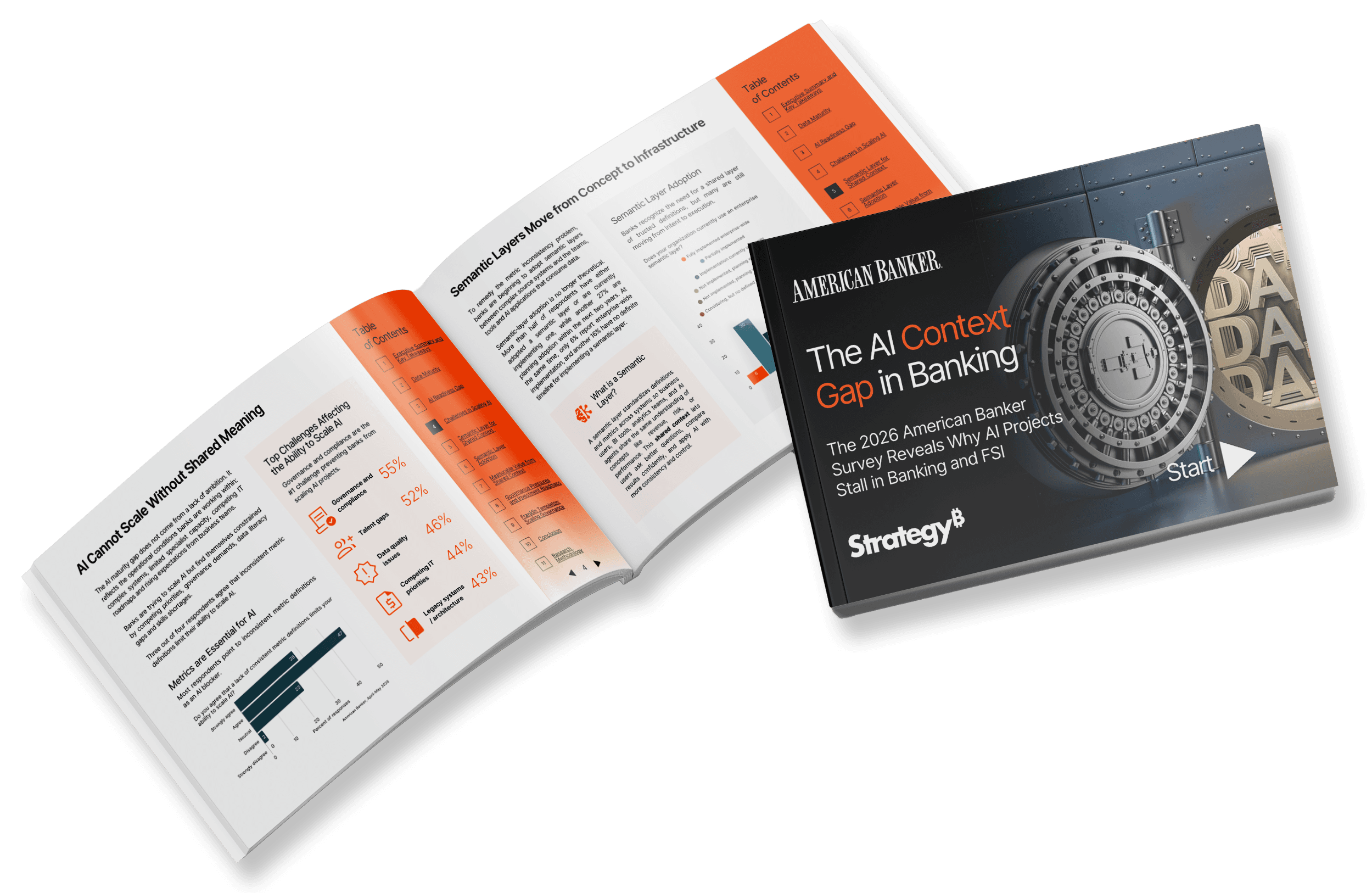
Read The AI Context Gap in Banking to see where institutions are investing next, what early semantic-layer adopters are already reporting, and what it takes to move analytics and AI from isolated pilots toward enterprise scale.

Beata Socha
With over 15 years of experience as a tech journalist and content creator, Beata heads Content Marketing at MicroStrategy. An economics graduate, she specializes in finance and the impact of AI on business, bringing expert insights to the industry.