

What an AI-Ready Semantic Layer Must Provide in Banking
Quick Answer
An AI semantic layer needs to do more than make enterprise data easier to access. It must give AI governed definitions, reusable business logic, security controls, and consistent query logic.
For banks, those capabilities matter because AI must work across different business units, applications, and data sources. Critically, that context must remain governed and portable across use cases, so banks do not have to reconstruct meaning and security rules for every new AI application.
An AI-ready semantic layer should improve analytics and governance today while creating a reusable foundation for production-scale AI.
The first blog in this series introduced the AI Context Gap in banking and explained why simply accessing enterprise data is no longer enough. The second showed why banks are investing in the data and governance foundation beneath AI.
The next question is more practical: what should that AI-ready foundation actually provide?
4 Capabilities an AI-Ready Semantic Layer Must Provide in Banking
AI needs consistent, governed business meaning to produce reliable answers.
Banks don’t need another tool to manage their data access. They need an AI semantic layer that combines the context, security, and consistency required to produce trusted answers at scale.
For banks evaluating an AI semantic layer, four capabilities matter.
1. Governed Definitions and Shared Business Context
The first requirement is simple: the same business concept must mean the same thing everywhere.
A bank can’t build trusted AI when key concepts are defined differently across teams and systems. The bank must agree on the logic and definition for terms such as:
- Revenue
- Customer
- Exposure
- Profitability
- Delinquency
According to the 2026 Whitepaper by American Banker and Strategy, 75% of banks and financial institutions agree that inconsistent metric definitions limit their ability to scale AI.
The priority isn’t whether a semantic layer can define a metric. It’s whether those definitions can become shared, governed context across the bank.
How should an AI-ready semantic layer ensure governance?
An AI-ready semantic layer should standardize KPIs, metrics, and business logic across source systems, reporting tools, applications, and AI agents. That gives both human users and AI systems the same governed business context instead of requiring each application to interpret the data independently.
2. Reusable Business Logic Across Every Point of Consumption
An AI-ready semantic layer should define business logic once, then reuse it everywhere.
The same approved context, relationships, and definitions should support the tools consuming enterprise data, including:
- Dashboards
- Applications
- Workflows
- Enterprise BI platforms with AI
- Native AI agents
Every duplicated metric creates another opportunity for drift and governance failure. An AI semantic layer should act as a common foundation that supports existing analytics while making the same governed logic reusable for new AI use cases.
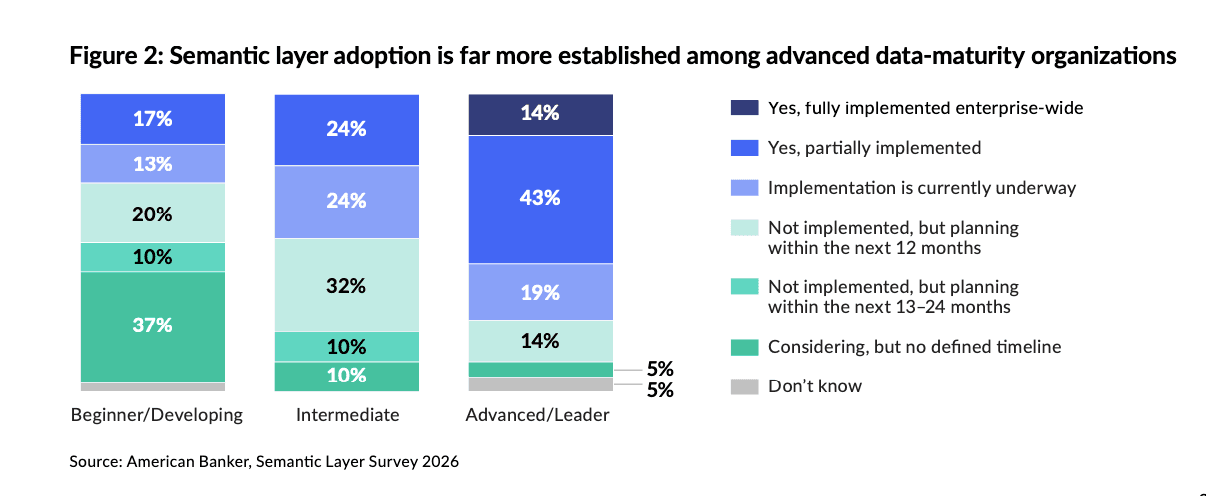
The Whitepaper data shows how far banks still need to go. Only 6% of surveyed institutions report a semantic layer fully implemented enterprise-wide.
3. Consistent Security, Visibility, and Audit Trails
AI data governance must extend beyond the model. An AI semantic layer should apply the same security policies, access controls, and governed definitions across human and AI users.
It should support traceability, so banks can determine which data and business logic contributed to an AI-generated result. If AI generates inconsistent results in risk, compliance, or financial reporting, the bank needs to understand how those results were produced.
These capabilities also support AI hallucination prevention. They don’t eliminate every form of model error, but they reduce the amount of business meaning the model must infer and make departures from governed logic easier to identify.
“The ideal solution for financial institutions is a universal semantic layer: a single governed layer that sits between your AI and your data sources.” — Erika Moreno, VP of Product Management, Strategy
4. Model-Independent Query Generation
One of the most important requirements is also one of the least visible: query generation should not depend entirely on the AI model.
When text-to-SQL is handled inside a probabilistic model, the same question can produce different query logic. The SQL may look syntactically valid while applying the wrong join, metric definition, or business rule.
That is why natural-language interpretation and deterministic query generation should be separated. The LLM interprets the question. Governed business logic determines the query.
By keeping query generation outside the LLM, banks reduce the risk of AI hallucinating SQL through invented business logic and create greater consistency across models and use cases.
Banks evaluating an AI semantic layer should ask one basic architectural question: Does the platform allow the model to generate the business query logic itself, or does it generate the query through governed, reusable logic outside the model?
The AI-Ready Semantic Layer Must Deliver Clear Operational Value
An AI-ready semantic layer should improve the bank’s current operations, not only its future AI strategy. The four capabilities outlined above work together:
- Governed definitions create shared business context
- Reusable business logic keeps that context consistent across tools and applications
- Governance and auditability preserve control
- Model-independent query generation reduces the amount of business logic AI has to infer
The next step is to evaluate whether the architecture beneath your AI can deliver those capabilities consistently.
Explore The Data Foundation Banks Need for AI Scale to learn what financial institutions should look for as they build the governed data foundation beneath enterprise AI.
Read the full whitepaper “The Data Foundation Banks Need for AI Scale”

Beata Socha
With over 15 years of experience as a tech journalist and content creator, Beata heads Content Marketing at MicroStrategy. An economics graduate, she specializes in finance and the impact of AI on business, bringing expert insights to the industry.
Content:
- 4 Capabilities an AI-Ready Semantic Layer Must Provide in Banking
- 1. Governed Definitions and Shared Business Context
- 2. Reusable Business Logic Across Every Point of Consumption
- 3. Consistent Security, Visibility, and Audit Trails
- 4. Model-Independent Query Generation
- The AI-Ready Semantic Layer Must Deliver Clear Operational Value