

Strategy Recognized among Notable Vendors in the 2026 Forrester Data Fabric Platforms Landscape
Quick Answer
Strategy is recognized among Notable Vendors in The Data Fabric Platforms Landscape, Q3 2026. This is a market overview, not a product ranking.
In our view, the important shift is from connecting enterprise systems to making data consistently understandable and governed for analytics, applications, and AI.
Strategy Mosaic provides reusable business definitions and policies across existing data platforms, with governed access for BI and AI, MCP connectivity, semantic model portability, and operational visibility.
An AI agent can connect to multiple enterprise systems in seconds.
That does not mean it understands the business.
A CRM may define a customer one way. Finance may calculate revenue another. The warehouse may contain the right tables but not the relationships or policies explaining which definition applies to a decision.
The plumbing can be connected. The meaning can still be fragmented.
In our view, that gap helps explain why Strategy’s inclusion among Notable Vendors in The Data Fabric Platforms Landscape, Q3 2026, published by Forrester, is timely. The bigger question is how enterprises make business context reusable across their data environment.
The data fabric conversation is moving up the stack
For years, the data fabric discussion focused on connecting distributed systems, making data discoverable, and reducing the friction between clouds, databases, warehouses, and applications.
Agentic AI raises the stakes.
A person can review a questionable dashboard before acting. An AI agent may interpret the same information and initiate the next step without that pause.
It is not enough for an agent to find the right table. It also needs an approved metric, the relevant entity relationships, the user’s access rights, and the business rules needed to interpret the result.
Connectivity gets the agent to the data.
Context tells it what the data means.
What Strategy brings to the data fabric
Strategy selected business data context, real-time analytics, and security fabric as its three extended use-case focus areas in the Landscape. These are vendor-reported priorities, not independent functionality scores or rankings.
They reflect a practical combination: consistent business definitions, timely access to data, and governed permissions when dashboards, applications, and AI agents consume the same information.
Data fabric connects the estate. Mosaic makes it understandable.
Most enterprises already have platforms that store, move, and analyze data. The harder problem is ensuring that every consumer applies the same business meaning.
Strategy Mosaic provides that shared semantic layer. Teams can centrally define metrics, entity relationships, hierarchies, and business rules, then reuse them across BI tools, applications, APIs, and AI without replacing existing data platforms.
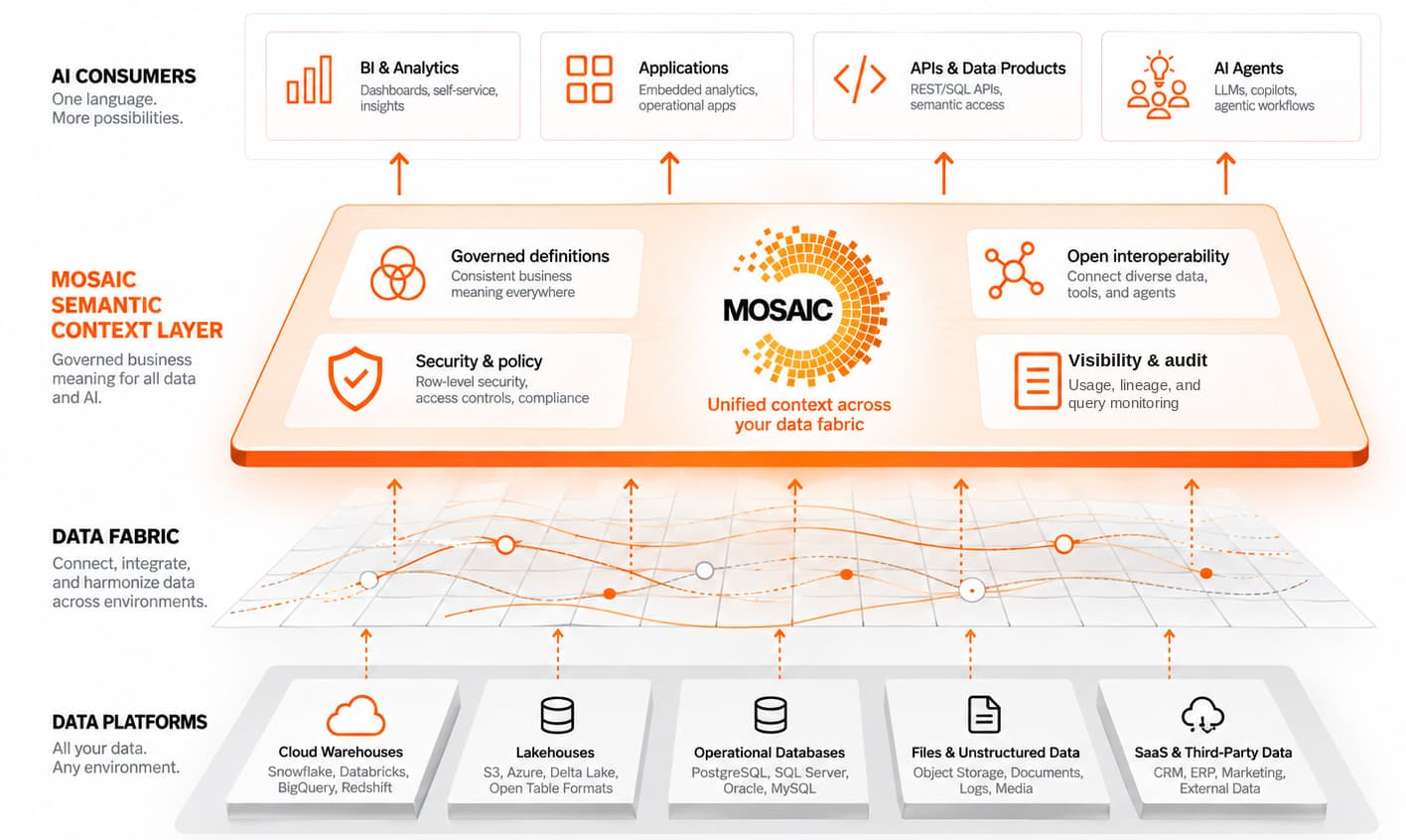
Figure 1: Mosaic provides a governed semantic context layer across existing enterprise data platforms and AI consumers.
For example, a finance dashboard, an external BI report, and an AI agent should not each reconstruct a different net-revenue calculation for returns, discounts, and recognized sales. They should use the same approved business definition, even when the records reside in different systems.
Mosaic Studio supports semantic model development and Model Validation, allowing authors to inspect relationships, queries, and results before publishing. Mosaic Schema provides shared enterprise definitions and governance for reuse in self-service analytics.
Published semantic models can be consumed through supported BI and application interfaces, including SQL, DAX, APIs, and MCP. Access remains subject to the applicable model and user permissions. That lets agents work from governed business definitions rather than generating new logic from raw schemas.
Mosaic Sentinel provides visibility into model usage, query performance, and supported cost-monitoring scenarios. Together, these capabilities make business context easier to develop, share, and operate across analytics and AI.
Open data needs open meaning
Interoperability matters at more than one layer. Open table formats, lineage exchange, portable semantic definitions, and agent interfaces solve different problems, but all help reduce the friction between systems.
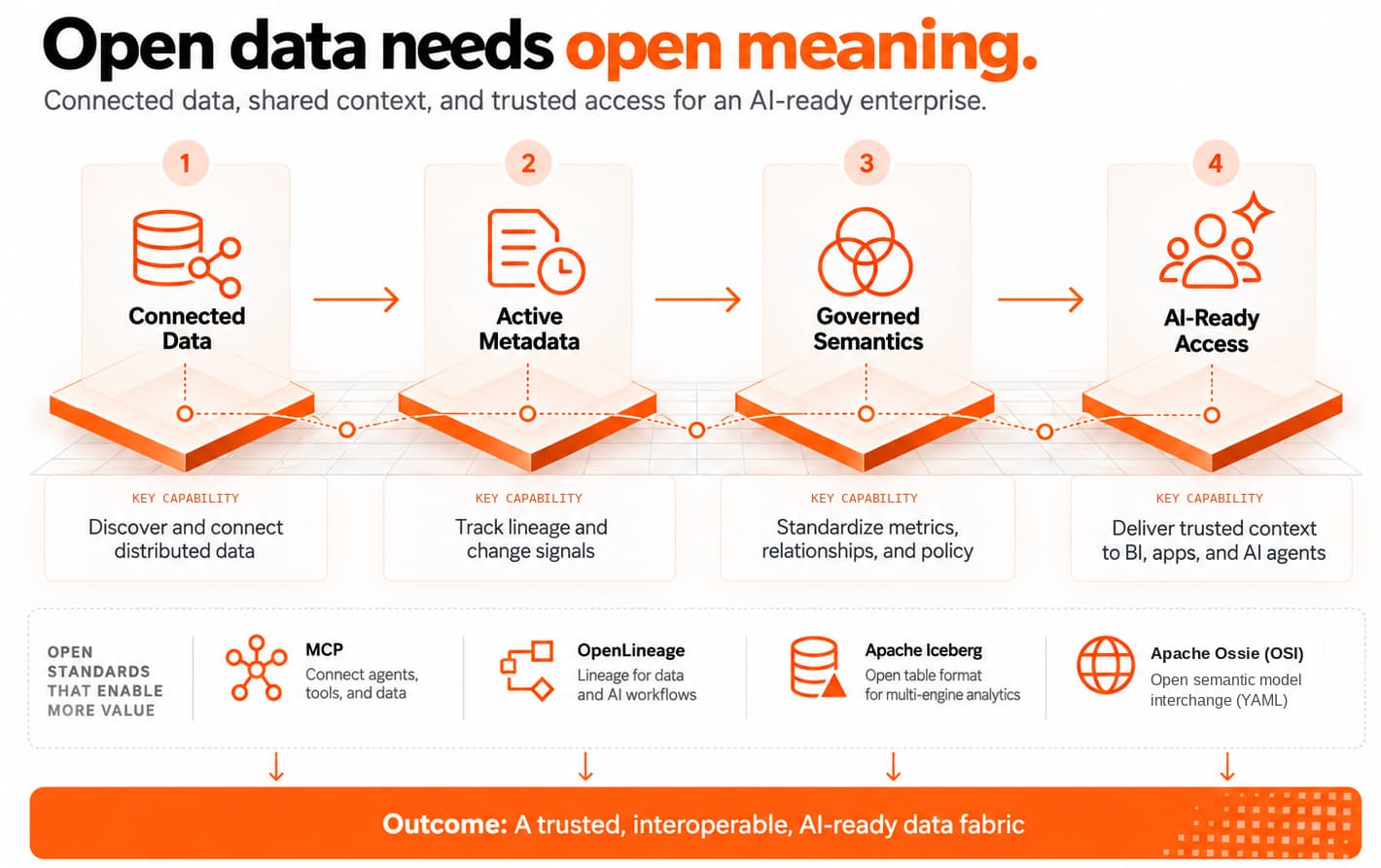
Figure 2: Complementary standards support interoperable data, lineage, semantic definitions, and AI access.
The standards in Figure 2 are complementary rather than interchangeable. Apache Iceberg addresses open table formats, OpenLineage addresses lineage exchange, Apache Ossie addresses semantic model interchange, and MCP connects AI clients with tools and governed context. The diagram illustrates an ecosystem architecture, not a claim that every standard is a native Mosaic capability.
For Mosaic, two connections are especially relevant: MCP can provide AI clients with access to approved semantic models and governed query tools; Apache Ossie (Incubating), formerly Open Semantic Interchange (OSI), supports exchange of semantic definitions through the supported YAML format.
An open data architecture can still leave business definitions trapped in individual tools. Open meaning makes those definitions more portable and useful beyond one application.
A practical test for AI-ready data fabric
“How did enterprise win rate change last quarter, and how does it relate to renewal risk for top accounts in regulated regions?”
The challenge is not just retrieving records. The agent needs consistent definitions of win rate and renewal risk, approved relationships between accounts and opportunities, and access rules for sensitive regions.
With Mosaic, an authorized AI client can use published, governed semantic models through MCP instead of inventing its own business logic from raw tables. Mosaic provides a consistent foundation for the underlying queries; the consuming AI application remains responsible for interpreting the results and presenting its final answer.
From connected data to governed AI context
Enterprise data has become more distributed. AI is making it more important for systems to share a consistent understanding of the business.
For Strategy, that is the significance of inclusion in the Landscape. Governed business context is becoming an important part of modern data architecture, not something every dashboard, application, or agent should have to reconstruct independently.
Mosaic’s role is to make that context reusable, interoperable, and governed across the data platforms enterprises already operate.
The data does not need another place to live.
It needs a consistent way to mean the same thing everywhere it is used.
About the Forrester report
Forrester does not endorse any company, product, brand, or service included in its research publications and does not advise any person to select the products or services of any company or brand based on the ratings included in such publications. Information is based on the best available resources. Opinions reflect judgment at the time and are subject to change. This report is part of a broader collection of Forrester resources, including interactive models, frameworks, tools, data, and access to analyst guidance. For more information, read about Forrester’s objectivity here.
See Strategy on your own data. Book a demo with our team.
Frequently Asked Questions
What is The Data Fabric Platforms Landscape, Q3 2026?
The Data Fabric Platforms Landscape, Q3 2026 is Forrester's overview of the data fabric platform market, including notable vendors, market trends, and key capabilities. Strategy was included among Notable Vendors. The Landscape is not a comparative product ranking or endorsement.
Where does Strategy Mosaic fit into a modern data fabric?
Strategy Mosaic provides a governed semantic layer that connects business definitions, metrics, relationships, and access policies across existing enterprise data platforms. It helps BI tools, applications, and AI agents use consistent business context without requiring organizations to replace their warehouses, lakehouses, or data-engineering systems.
How does Strategy Mosaic help AI agents access trusted enterprise data?
Through the Model Context Protocol (MCP), authorized AI agents can access published semantic models and execute governed queries using approved business definitions and user permissions. This helps ground AI analysis in consistent enterprise context rather than relying on each agent to interpret raw data independently.
Does Strategy Mosaic require organizations to move their data?
No. Mosaic can query data from existing enterprise systems, including cloud data warehouses and databases, without requiring wholesale data migration. It supports live access and appropriate in-memory optimization, allowing organizations to reuse governed business definitions across analytics and AI while keeping their existing data infrastructure.

Henry Guo
Henry Guo is Director of Outbound Product Management at Strategy, driving go-to-market and turning customer insights into discovery and validation for its semantic layer and AI products. With 15+ years in AI, data and security, he helps ship trusted secure enterprise platforms with measurable value.