

How an AI-Native Semantic Layer Makes Enterprise AI Reliable and Cuts Costs Fast
Quick Answer
- A semantic layer for enterprise AI is a governed, machine-readable map of your company's metrics, hierarchies, relationships, and rules. It sits between your raw data and the AI systems using it, so both people and AI can understand what the data means.
- If your AI outputs are inconsistent, the semantic layer is where you can fix that now, and it doesn’t take multiple years to implement.
- The semantic layer is also the foundation for a richer knowledge graph architecture over time. The work you do now doesn't get thrown away, instead it becomes the base the graph is built on.
- Strategy Mosaic is built to be that foundation. This post covers what to look for in a semantic layer, what it really costs, and why the decision is really about your long-term AI architecture.
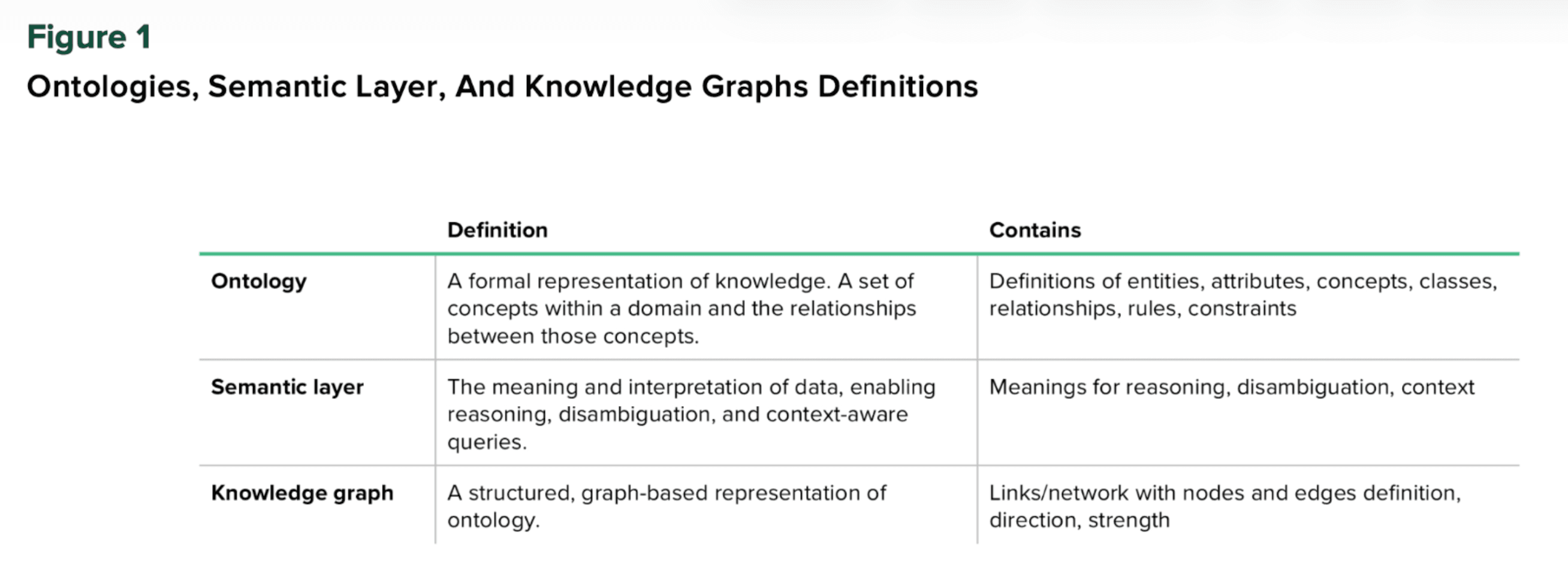
For years, enterprises have optimized their systems for human retrieval. Agentic AI requires something different entirely: machine reasoning. Forrester's June 2026 Trends Report, Combine Semantics, Ontology, And Knowledge Graphs For AI-Ready Data, underscores why that distinction matters and what it takes to close the gap, pointing to a semantically rich foundation as what turns AI from an inconsistent tool into a reliable reasoning partner.
The Decision Most AI Leaders Are Facing
By adopting a semantic layer, you get reliable, consistent results right away, and you lay the essential groundwork that will feed directly into the knowledge graph you build later. Today’s question isn't whether to invest in a semantic foundation, it's about which one will deliver value fast, and support long-term growth.
“Building and deploying semantically rich ontologies operationalized through enterprise knowledge graphs improves disambiguation, intent understanding, and context-aware reasoning while getting your enterprise data ready for agentic AI.”
— Forrester Research, Combine Semantics, Ontology, And Knowledge Graphs For AI-Ready Data, June 2026
The Compounding ROI of a Shared Semantic Layer
The June 2026 Forrester Research report is specific about the return on semantic investment:
“ Enterprises that embed semantics across their tech stack unlock exponential returns: faster time to insight, reduced waste, and boosted ROI.”
— Forrester Research, Combine Semantics, Ontology, And Knowledge Graphs For AI-Ready Data, June 2026
The reason costs come down is straightforward: when business logic is defined once in a semantic layer, every query that follows uses that same foundation instead of rebuilding it from scratch. The more queries your team runs, the more the savings compound. Unlike compute costs that grow more with usage, once the semantic layer is in place, it saves money as more teams use it.
The return on semantic investment didn’t begin with knowledge graph platforms. These results began with the semantic foundation that made the knowledge graph worth building. Forrester documents the results of that full progression:
- A manufacturing organization reported more than $50 million in annual savings from exposing hidden dependencies between parts, suppliers, logistics, and production schedules.
- A healthcare organization replaced more than 300 interdependent relational tables with a unified semantic model, reducing manual reconciliation and improving cross-study consistency.
- A global financial services company reduced false positives in anti-money-laundering alerts significantly by implementing a knowledge graph to model complex relationships between accounts, transactions, and devices.
In each case, the value came from making business meaning explicit enough for systems to reason over. A semantic layer is one of the fastest practical ways to start that work because it turns definitions, relationships, and rules into reusable execution logic.
Access the full Forrester report
Mosaic Cost Benefits: What Acting Now Saves
Mosaic reduces waste by storing your business definitions and giving AI the exact context it’s missing. This means that AI no longer must rediscover business logic on every interaction.
Prompt engineering overhead. Time spent writing and maintaining prompts to patch over missing context doesn't produce reusable infrastructure. Every model update, new AI use case, and agent requires the cycle to restart. Which, in turn, causes costs to compound more quickly over every quarter.
Token and compute waste. Without pre-defined business logic, AI reloads your schema and reruns queries on every request, which burns tokens and cloud compute each time.
Trust erosion. The cost of inconsistent AI output is not just the wrong answer, but also the weeks of skepticism and workarounds to find around the system built. Rebuilding trust once it’s lost takes longer than building it would have.
Rebuilding. Choosing a quick fix that can't grow into your real architecture means paying for it twice: once to build it, and again when you replace it.
Cost visibility and optimization. As AI and analytics usage scales, teams need to see what is driving spend. Sentinel Cost Intelligence attributes cloud data costs to analytics assets and surfaces optimization recommendations.
Reduced warehouse and data lake costs. The caching engine offloads expensive repeat queries so they never hit the warehouse again. Mosaic supports any data warehouse, so you're never locked into one platform's pricing.
Strategy Mosaic Cost Impact at a Glance:
- 37% token reduction per query: pre-defined business logic means AI receives compressed semantic context instead of raw schema on every request.
- 50–70% token reduction at production scale: savings compound as the semantic foundation matures and more queries run from pre-defined logic.
- Up to 98% token reduction with Strategy AI Agents: the efficiency gain at full agentic deployment scale.
- Reduced query complexity and compute cost: Mosaic generates the SQL, queries are simpler and more efficient than LLM-generated equivalents.
- Caching engine: offloads expensive repeat queries so they never hit the warehouse again.
- Any LLM, including lower-cost models: the semantic layer handles query logic, the LLM only handles natural language; organizations can use cheaper models without sacrificing accuracy.
Why Strategy Mosaic?
It’s independent of your stack. Mosaic operates as an independent layer above your LLM, warehouse, and connectors. You can swap your language model, change your cloud provider, or move to a different warehouse, and your business logic still stays intact.
It’s proven at scale. Strategy Mosaic is deployed at Fannie Mae, Pfizer, and Porsche — organizations with some of the most demanding, high-stakes data environments in the world, supporting tens of thousands of users.
35 years of semantic modeling expertise. Semantic modeling has been the core of what Strategy has built for 35 years. As an independent company, the business depends entirely on making customers successful.
Strategy Mosaic is built for this role. It makes business meaning reusable across BI tools, applications, data platforms, and AI agents, while preserving independence from any one model, cloud, or warehouse. The work starts with the semantic layer, but it carries forward as enterprises mature toward richer ontology and knowledge graph architectures.
Read the full Forrester Report to learn how a semantic layer closes the context gap so your AI stops guessing on business logic and starts delivering consistent, trustworthy answers.
Frequently Asked Questions
What is the difference between a semantic layer and a data catalog?
A data catalog describes what your data is, whereas a semantic layer governs how AI queries it through encoding the business definitions, metric rules, and relationship logic that determine what a question means and what query should be generated. Both matter, and Mosaic integrates with existing catalog infrastructure rather than replacing it.
How quickly does measurable value appear after implementation?
Most organizations see their first governed, consistent AI query results within eight weeks of connecting to existing infrastructure and encoding core business definitions. You do not need a complete ontology before value accrues.
If we start now, does that work carry forward when we are ready for knowledge graphs?
Yes. Mosaic's ontological data model is structured to be knowledge-graph-compatible. The entity definitions, attribute rules, and relationship logic encoded in the semantic layer become the foundation the knowledge graph is built on. Nothing needs to be rebuilt.
Can we use Strategy Mosaic with our existing LLM and stack?
Yes, Strategy Mosaic handles query logic independently of the language model, the semantic layer stays intact when the LLM changes. You can swap models, run multiple models, or move them to more cost-effective ones so your business logic travels with you, not with the platform.
Information in Forrester publications is based on Forrester’s efforts to compile and analyze the best resources reasonably available to Forrester at any given time. Opinions reflect judgment at the time and are subject to change. This report is part of a broader collection of Forrester resources, including interactive models, frameworks, tools, data, and access to analyst guidance.

Kaylee Ritter
Kaylee Ritter is a Digital Marketing and Demand Generation intern at Strategy, where she combines analytical thinking with digital execution to turn data into meaningful connections and measurable growth. She is currently studying Information Systems and Marketing at UMD’s Smith School of Business.
Related posts
Business intelligence (BI) transforms raw business data into actionable insights that guide strategy, streamline operations, and fuel growth. Learn how AI and semantic layers are redefining what BI can do for your organization.

Addie Burrow
July 10, 2026
Discover why semantic layer independence protects your Microsoft stack. Strategy Mosaic governs metrics across Databricks, Snowflake, and Power BI.
Kaylee Ritter
July 7, 2026
Learn how a semantic layer for data governance enforces business definitions, improves AI accuracy, and ensures consistent KPIs across analytics platforms.

HF Chadeisson
July 7, 2026