

AI Data Governance for AI Agents: Why Enterprise AI Governance Must Run in the Execution Path
As AI agents increasingly interact with enterprise systems, organizations need AI data governance and enterprise AI governance controls that operate in real time. AI data readiness ensures agents access trusted, compliant, and high-quality enterprise data.
Quick Answer
What does AI data governance do? Governs the data, definitions, permissions, and evidence AI systems depend on.
What does AI data readiness do?: Ensures enterprise data is accessible, consistent, governed, and fit for its intended AI use.
What does enterprise AI governance do?: Extends controls and accountability across AI systems, data access, and execution.
As organizations deploy AI agents against critical business systems, AI data governance becomes essential for ensuring trusted access to enterprise information. Strong enterprise AI governance depends on governing data, permissions, and actions in real time. At the same time, AI data readiness determines whether agents can safely and effectively operate on enterprise data.
You cannot govern machine-speed data access with a PDF policy and a quarterly audit. Once agents can discover models, generate queries, and chain actions together, governance has to sit in the execution path.
Here is one failure mode I worry about. A regional sales manager asks an AI agent which accounts are at risk. The metric is correct. The SQL is valid. But the AI connection runs through a broad service identity instead of preserving the manager's entitlement, so the result includes customers from every region.
Nothing failed at the database layer. The query succeeded. The governance failed.
That distinction matters because a technically successful AI query can still be a security, compliance, or business-risk event.
Financial institutions are already running into this problem. In American Banker research sponsored by Strategy, based on 101 banking and financial-services executives and decision-makers, governance and compliance emerged as the most frequently cited barrier to scaling AI, named by 55% of respondents. In a separate CIO Dive study of large-enterprise technology leaders, 87% said they want greater visibility into how AI systems use and interpret their data.
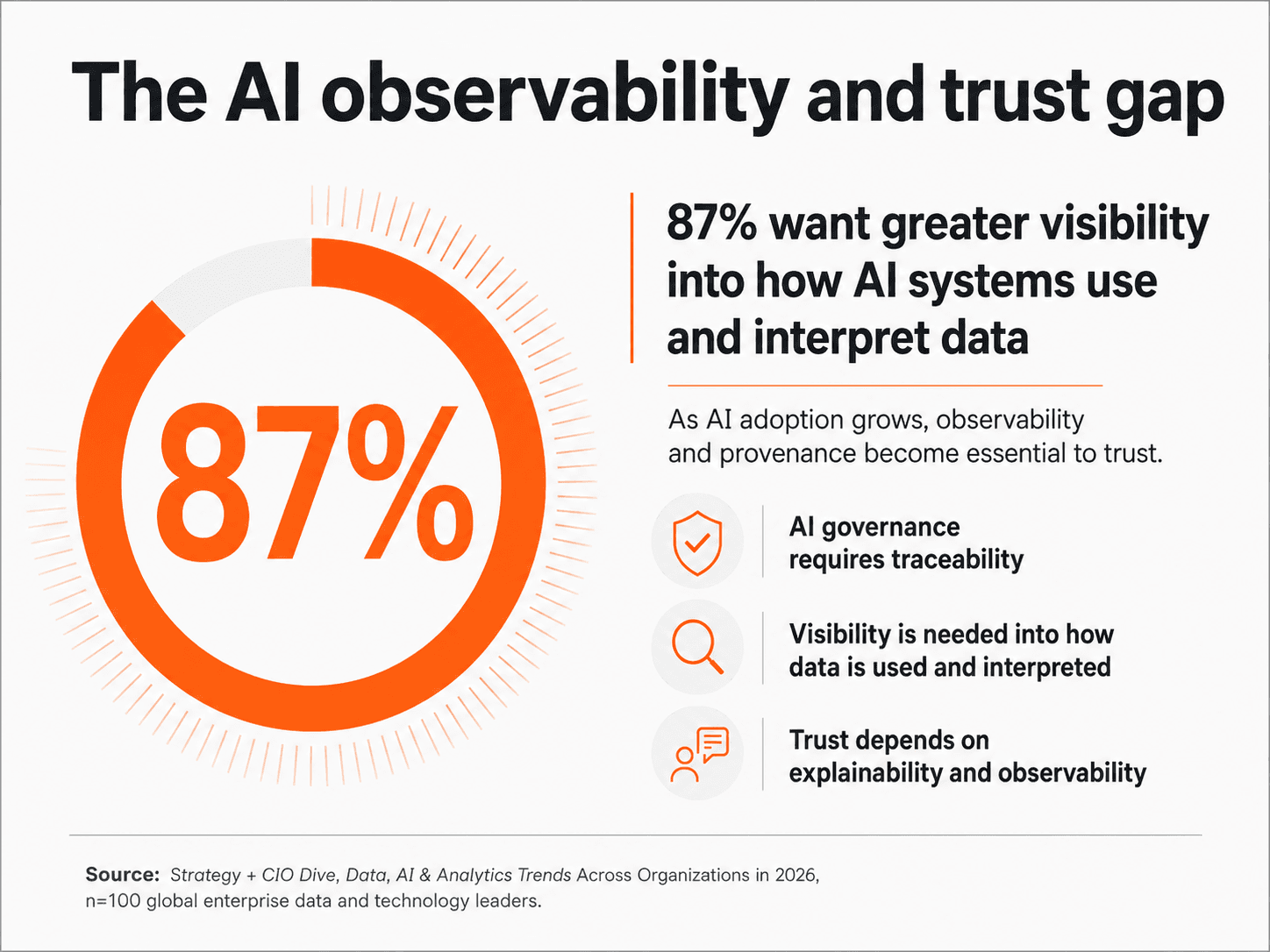
Enterprise AI governance is moving from policy to architecture.
Governed context answers what the agent should know. Continuous assurance answers what the agent may access, what it actually did, and whether you can prove it afterward.
What Continuous Assurance Means for AI Agents
Continuous assurance means applying governance while AI operates, not reconstructing control after the fact.
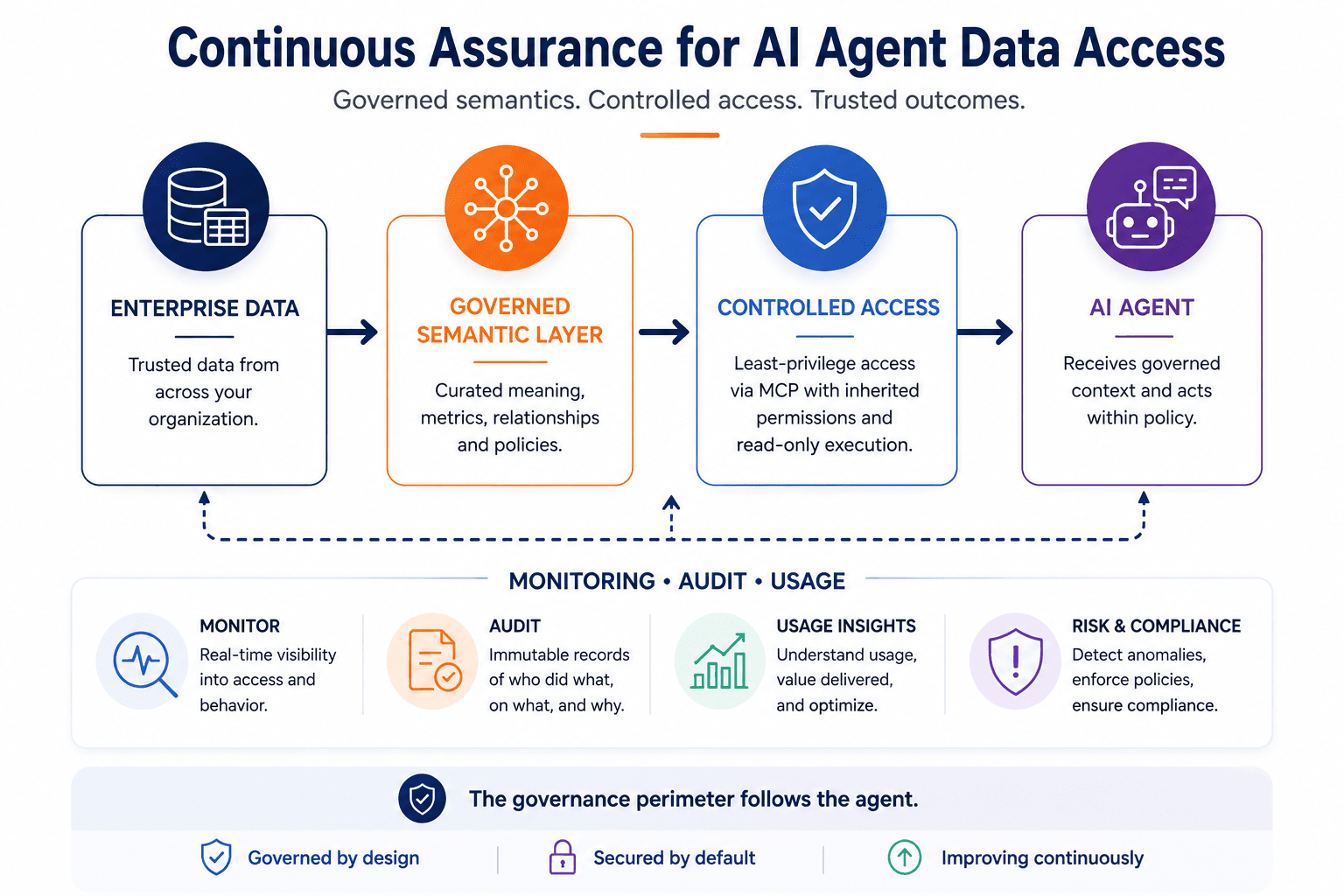
The control loop has four parts:
Prevent → Detect → Prove → Improve
1. Prevent: Put Meaning, Permissions, and Execution Boundaries in the Path
The first job is to prevent bad access or bad interpretation before the query runs.
Security answers one question: Is this user allowed to access the data?
It does not answer another: Does the AI understand what the data means?
An agent may be authorized to query a customer table and still use the wrong definition of active customer. It may have access to revenue data and still choose the wrong metric, join path, or time logic.
That is an AI data governance problem, not just a model-quality problem. In the American Banker and Strategy study, 75% of respondents said inconsistent metric definitions limit their ability to scale AI.
A governed semantic layer puts business meaning into the execution path. It gives humans, analytics tools, and AI systems a shared business vocabulary rather than letting each interpret enterprise data independently. Metrics, dimensions, relationships, hierarchies, and policy-aware context are defined once and reused across BI tools, applications, and AI systems.
Request → Governed business context → Security policy → Query execution → Result
The model still handles language and reasoning. It does not get to invent the company's definition of revenue.
The same principle applies to security. Enterprises already have row-level security, object permissions, identity rules, and access policies. Connecting an AI agent should not create a second version of that security model.
The interface changed. The authorization did not.
The governance perimeter has to follow the agent.
MCP should narrow the path, not widen it
Model Context Protocol (MCP) makes it easier for AI clients to reach enterprise capabilities. Useful, yes. Governed by default, no.
The engineering questions are straightforward:
What can the agent discover and query?
Whose identity and permissions apply?
Is execution read-only, or can the agent change state?
What activity and context are logged?
For analytical use cases, the safest pattern is narrow by default: expose approved semantic models, preserve user permissions, certify what the agent can discover, and keep query access read-only unless there is a deliberate reason to allow more.
Putting controls in the execution path is not free. Identity checks, semantic resolution, policy enforcement, and telemetry all consume resources. The goal is not zero overhead; it is bounded overhead in exchange for fewer ungoverned decisions, fewer retries, and evidence you can trust afterward.
2. Detect: Observe Business Context, Not Just Database Events
Authorization is necessary, but permitted behavior can still be risky. An agent may be authorized to access a sensitive object and still access far more of it than usual, at an unusual time, or through an unexpected workflow.
The useful signal is not simply that a query ran. It is the business context around the query:
Which governed object was accessed? By whom? Through which interface? Was the behavior expected?
That is a more useful unit of observation than a raw database event because the semantic layer knows the business meaning of what was touched.
Agents can generate activity at a scale where humans will never review every query individually. Continuous assurance therefore needs both policy enforcement and behavioral visibility.
Authorization establishes whether access is allowed; behavioral monitoring tells you whether the resulting pattern is expected.
3. Prove: Preserve Identity, Delegated Authority, and Evidence
Agentic AI makes identity more complicated.
A log entry that says service account X queried database Y is not enough when an agent is acting for a human across multiple steps.
The evidence chain increasingly needs to look like this:
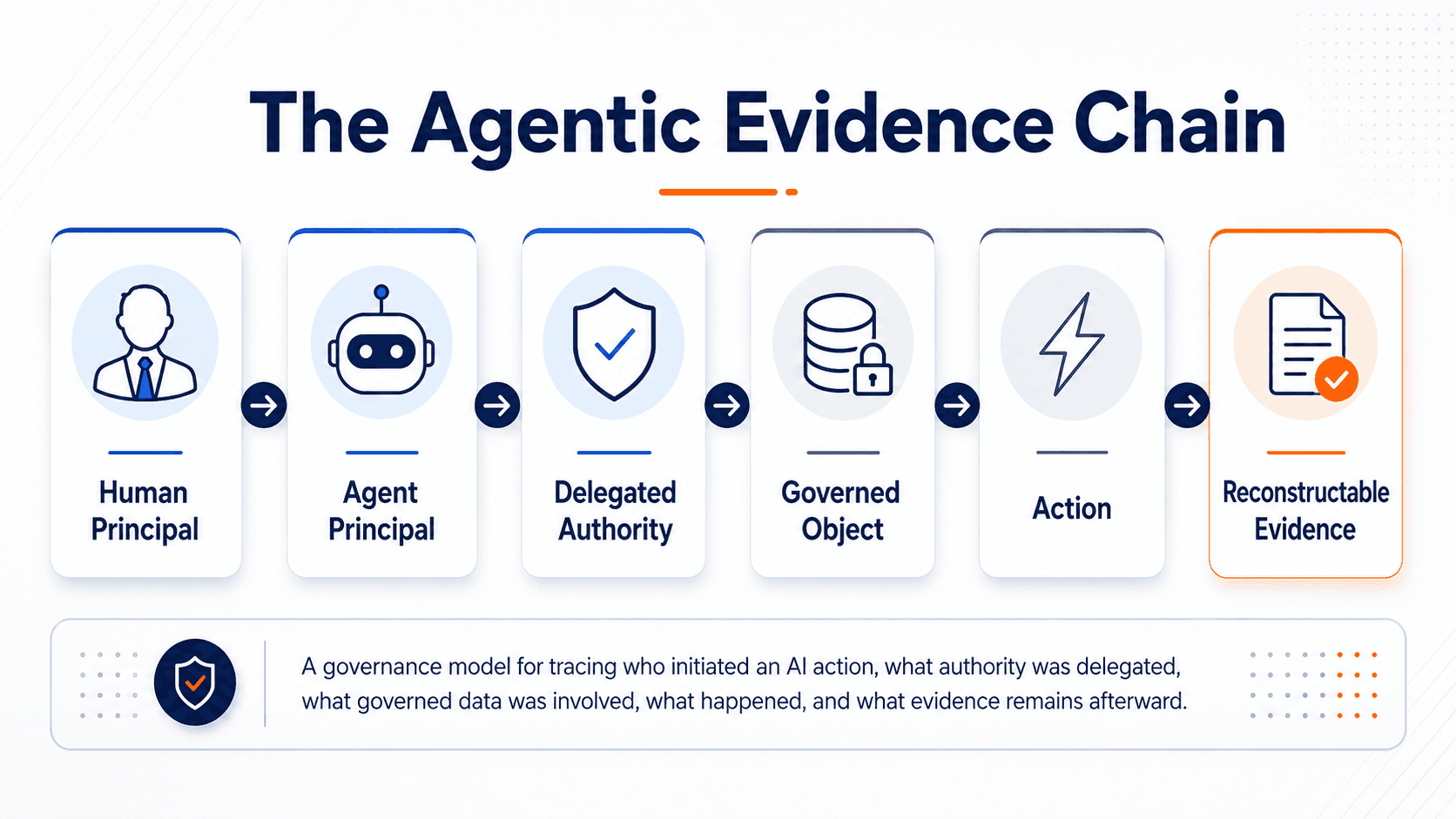
The human principal establishes accountability. The agent principal identifies the non-human actor. Delegated authority defines what the agent can do on someone's behalf. The governed object identifies the business data involved. The evidence shows what actually happened.
In practice, that authority has to be represented in credentials the receiving service can validate, with scopes and audience matched to the resource being accessed. Delegation should narrow authority, not turn a user request into a blanket machine credential, and authorization should be re-evaluated when the action is executed rather than assumed for the life of a long-running agent session.
This gets harder when agent workflows become asynchronous or span multiple tools and agents. The initiating user's session is not a durable authorization model; enterprises need explicit delegation boundaries and a way to re-evaluate or revoke authority rather than assuming it can be propagated indefinitely.
This does not mean every enterprise needs autonomous agents today. It means the governance model should be ready for delegated machine access before agents become more capable.
Auditability also has to extend beyond access logs. If a metric definition changes, teams may need to know not only what data an agent accessed, but which governed definition was in effect when it accessed it.
For business-critical decisions, the semantic state can be part of the audit record, not just the query and identity.
That is the difference between having logs and having evidence.
4. Improve: Feed Usage, Risk, and Cost Back Into Governance
Continuous assurance should not end with an audit trail.
Usage tells you which governed models and business objects are actually being consumed. Risk signals show where behavior is drifting. Cost signals reveal where machine-generated activity is creating inefficient or unexpected consumption.
Those signals should feed back into policy, model design, certification, and operating practices.
The useful feedback is not only cost. Repeated metric retries, authorization denials, misunderstood semantic objects, or recurring human escalations can expose where the model, policy, or agent workflow itself needs attention.
Suppose an agent repeatedly issues the same expensive multi-stage query against a governed model. Each request may be authorized, but the pattern still tells you something: the model may need to be redesigned, cached differently, served through a different execution path, or governed with tighter usage controls.
Prevent → Detect → Prove → Improve
That creates a feedback loop instead of leaving governance as a periodic review exercise.
Strategy Mosaic and Sentinel as a Reference Implementation
The principles above are product-agnostic. Strategy Mosaic and Mosaic Sentinel provide one reference implementation of this architecture.
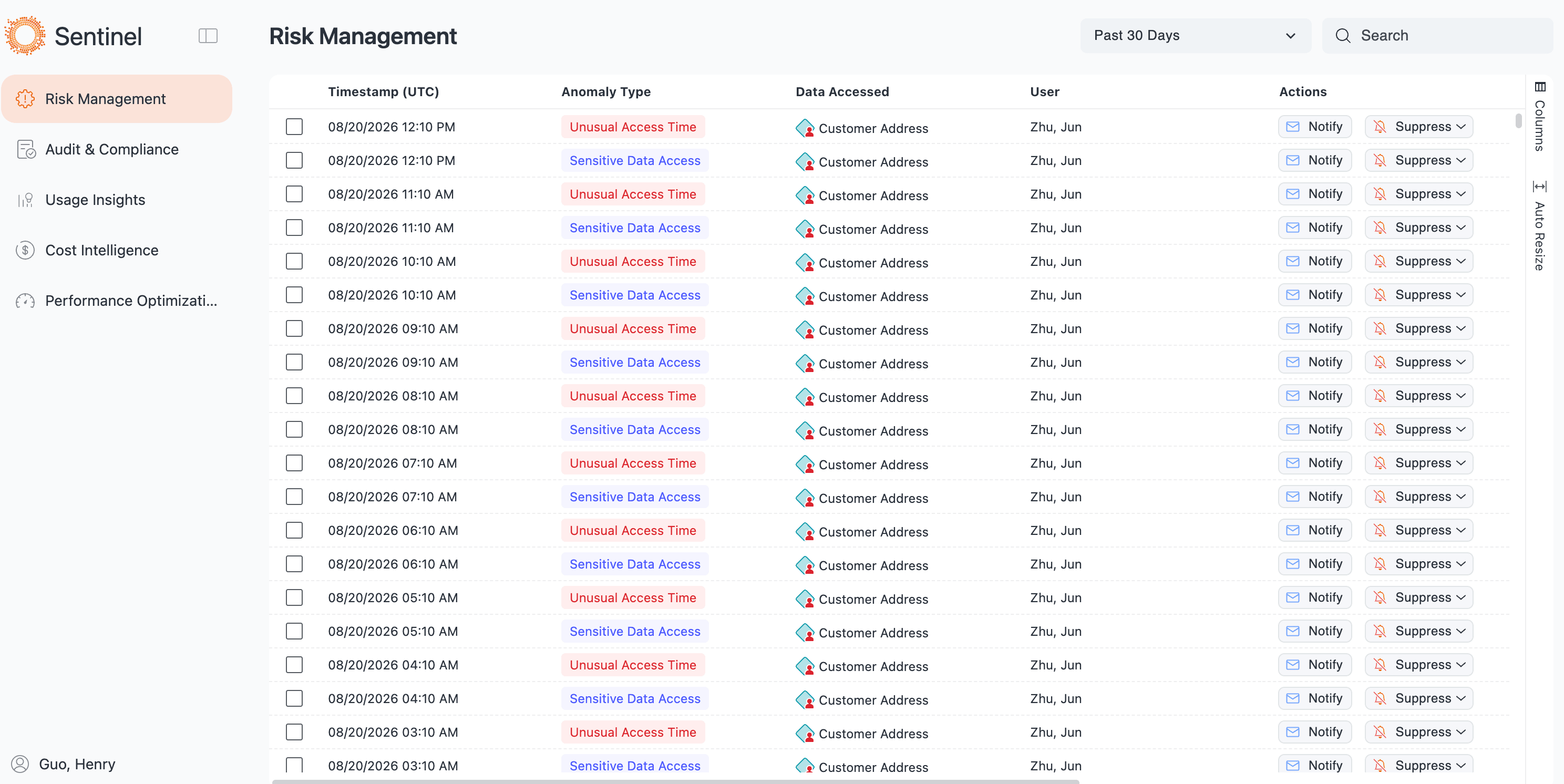
Mosaic Sentinel Risk Management: Continuous visibility into sensitive-data access and anomalous behavior.
Continuous assurance control | Strategy implementation |
|---|---|
Prevent | Mosaic provides governed business definitions; Mosaic Models can inherit centrally defined ACLs and row-level security; and Mosaic MCP exposes approved semantic models while preserving user privileges and enforcing read-only analytical execution. |
Detect | Sentinel Risk Management monitors access involving sensitive semantic objects and abnormal access patterns. |
Prove | Sentinel Audit & Compliance records semantic-object activity and model changes. |
Improve | Usage Insights and Cost Intelligence connect usage, behavior, and supported platform consumption back to governed analytics assets. |
The point is not that every AI security problem belongs in the semantic layer. It does not.
What Continuous Assurance Does Not Mean
One product does not replace the security stack.
Mosaic and Sentinel govern a specific layer: the business meaning, policy, and enterprise data path that AI depends on. Organizations still need separate protections for prompt injection, malicious inputs and outputs, application security, model security, endpoint security, and broader AI runtime threats.
That boundary matters. Credible AI governance starts with knowing exactly which layer you control.
Five Questions to Ask Before Giving an AI Agent Enterprise Data Access
Before moving an agent into production, I would ask:
1 | Does the agent inherit existing user permissions, or are we creating a second security model? |
2 | Can it query governed business definitions instead of interpreting raw schemas? |
3 | Can we restrict exactly which models and data products it can discover? |
4 | Can we detect unusual access to sensitive business objects? |
5 | Can we reconstruct what the agent accessed, under whose authority, and which governed definition was involved? |
If the answer to those questions is no, the organization may have AI access.
It does not yet have AI governance.
Governance Has to Run at the Speed of the Agent
Enterprise AI governance started with policies, model risk, privacy, and approval processes. Those controls still matter.
Agentic AI adds a harder requirement: governance has to operate in the same path, and at the same speed, as the agent.
That means authoritative business context, inherited permissions, execution boundaries, behavioral visibility, and evidence have to travel with each request.
The semantic layer therefore becomes more than the place where companies standardize Revenue for dashboards. It can become the control point where business meaning, access policy, and machine access meet.
Continuous assurance closes that gap by making governance part of execution, not a review after the fact.
Frequently Asked Questions
What is continuous assurance in AI governance?
Continuous assurance moves AI governance into the execution path by combining preventive controls, ongoing monitoring, reconstructable evidence, and feedback while AI systems operate.
What is AI data governance?
AI data governance applies governance to the data, definitions, permissions, and traceability AI systems depend on so they can use enterprise data consistently and within policy.
What is enterprise AI governance?
Enterprise AI governance defines how AI systems operate within organizational policies, permissions, accountability, and oversight. For AI agents, those controls increasingly need to extend into execution.
What is AI data readiness?
AI data readiness means enterprise data is sufficiently accessible, high-quality, consistent, governed, and permission-aware for its intended AI use.
What is the relationship between AI data governance and AI data readiness?
AI data governance helps create AI data readiness by establishing the definitions, permissions, policies, and traceability needed for reliable AI use.
Why do AI agents need a semantic layer?
Raw schemas expose structure, not authoritative business meaning. A semantic layer gives agents governed metrics, relationships, business rules, and access context instead of forcing them to infer critical logic on their own.
Should AI agents inherit existing user permissions?
When an agent acts on behalf of a user, it should preserve applicable entitlements and access boundaries rather than silently broaden them, including row-level security and object permissions.
How can MCP support governed AI agent access?
MCP provides a standard way for AI clients to reach enterprise capabilities, but the protocol alone does not create governance. Governed access still depends on identity, permissions, approved objects, execution boundaries, and auditability behind the endpoint.

Henry Guo
Henry Guo is Director of Outbound Product Management at Strategy, driving go-to-market and turning customer insights into discovery and validation for its semantic layer and AI products. With 15+ years in AI, data and security, he helps ship trusted secure enterprise platforms with measurable value.
Content:
- What Continuous Assurance Means for AI Agents
- 1. Prevent: Put Meaning, Permissions, and Execution Boundaries in the Path
- 2. Detect: Observe Business Context, Not Just Database Events
- 3. Prove: Preserve Identity, Delegated Authority, and Evidence
- 4. Improve: Feed Usage, Risk, and Cost Back Into Governance
- Strategy Mosaic and Sentinel as a Reference Implementation
- What Continuous Assurance Does Not Mean
- Five Questions to Ask Before Giving an AI Agent Enterprise Data Access
- Governance Has to Run at the Speed of the Agent
- Frequently Asked Questions
Related posts
Discover why AI hallucinates SQL and how Strategy Mosaic's governed semantic layer makes enterprise text-to-SQL deterministic and reliable.

Tanmay Ratanpal
August 20, 2026
.png&w=3840&q=75)
Compare the top 5 Domo alternatives for 2026, including Strategy, Power BI, Tableau, Looker, and Qlik, after Domo's sale to Progress Software.
Henry Guo
August 11, 2026
Discover how Pfizer built a governed semantic layer to deliver consistent, mobile-ready insights to 15,000+ field reps across 27 markets.
Tanmay Ratanpal
August 10, 2026
AI agents sound confident but guess without context. See how Mosaic and MCP give agents trusted definitions and governed metrics.

Kaylee Ritter
July 31, 2026