

How Pfizer Put Governed Data at the Fingertips of 15,000+ Users, Wherever They Work
Short Answer
Pfizer needed to deliver consistent insights for 27 markets, directly to field representatives working in hospitals, remote areas, and locations without reliable connectivity.
Strategy partnered with Pfizer to create a common global reporting solution built on a governed semantic foundation. Reusable reporting templates, offline caching, and mobile analytics gave users access to consistent, timely insights wherever they were.
The result was 90% utilization across six business units and a reduction in time to insight from hours to seconds. Pfizer’s data architecture, built on Strategy’s semantic layer, created a governed foundation that now supports its expansion into AI-powered analytics.
A dashboard is only useful when people can access it when they need it.
For a pharmaceutical leader supporting thousands of customer-facing colleagues across global markets, access to consistent data is critical.
Whether in the basement of a hospital in New York City or in rural Montana, Pfizer's field representatives couldn't risk losing important insights due to limited or no cell coverage. They needed reliable access to insights, including in locations with limited connectivity.
This was the challenge Pfizer aimed to solve: putting governed, actionable insights directly at the fingertips of its global field force.
Pfizer had data. It needed an infrastructure to scale it consistently.
Pfizer’s earlier reporting environment relied on static bulk reports, disparate BI tools, and market-specific dashboards that didn't follow the same business logic. A representative could have access to anywhere from one to 30 reports, creating a risk that the same KPI would produce different answers across reporting experiences.
That meant representatives could spend more time finding and reconciling information than preparing for conversations with healthcare providers.
The organization already had many of the required components:
Data existed, but its business rules and definitions needed to remain consistent across reporting experiences.
Insights were available, but field teams needed a mobile and offline way to access them.
BI tools could support global reporting, but only if the governed foundation scaled with them.
Pfizer’s goal was to ensure that every dashboard, market, and device applied the same business logic and KPIs.
Establishing governed analytics across 27 markets
Before scaling the reporting experience geographically, Pfizer needed a common foundation for its data logic: business rules, KPIs, relationships, and definitions.
The pharmaceutical leader partnered with Strategy to establish a shared semantic infrastructure that supported its long-term analytics vision.
Built on Strategy's semantic layer (a precursor to Strategy Mosaic), this infrastructure acted as a business logic layer between Pfizer’s data and the reporting tools used by leadership, analysts, and field teams.
Instead of rebuilding logic inside individual dashboards, Pfizer could define its business rules once and reuse them across reporting experiences.
Pfizer also found that roughly 80% of reporting requirements were common across markets. To ensure a seamless user experience, it converted shared requirements and data logic into reusable templates, while preserving room for market-specific localization.
The result was a governed global reporting solution spanning 27 markets and six business units. Leadership, analysts, and field representatives could work from the same definitions, even when their dashboards, languages, and local requirements differed.
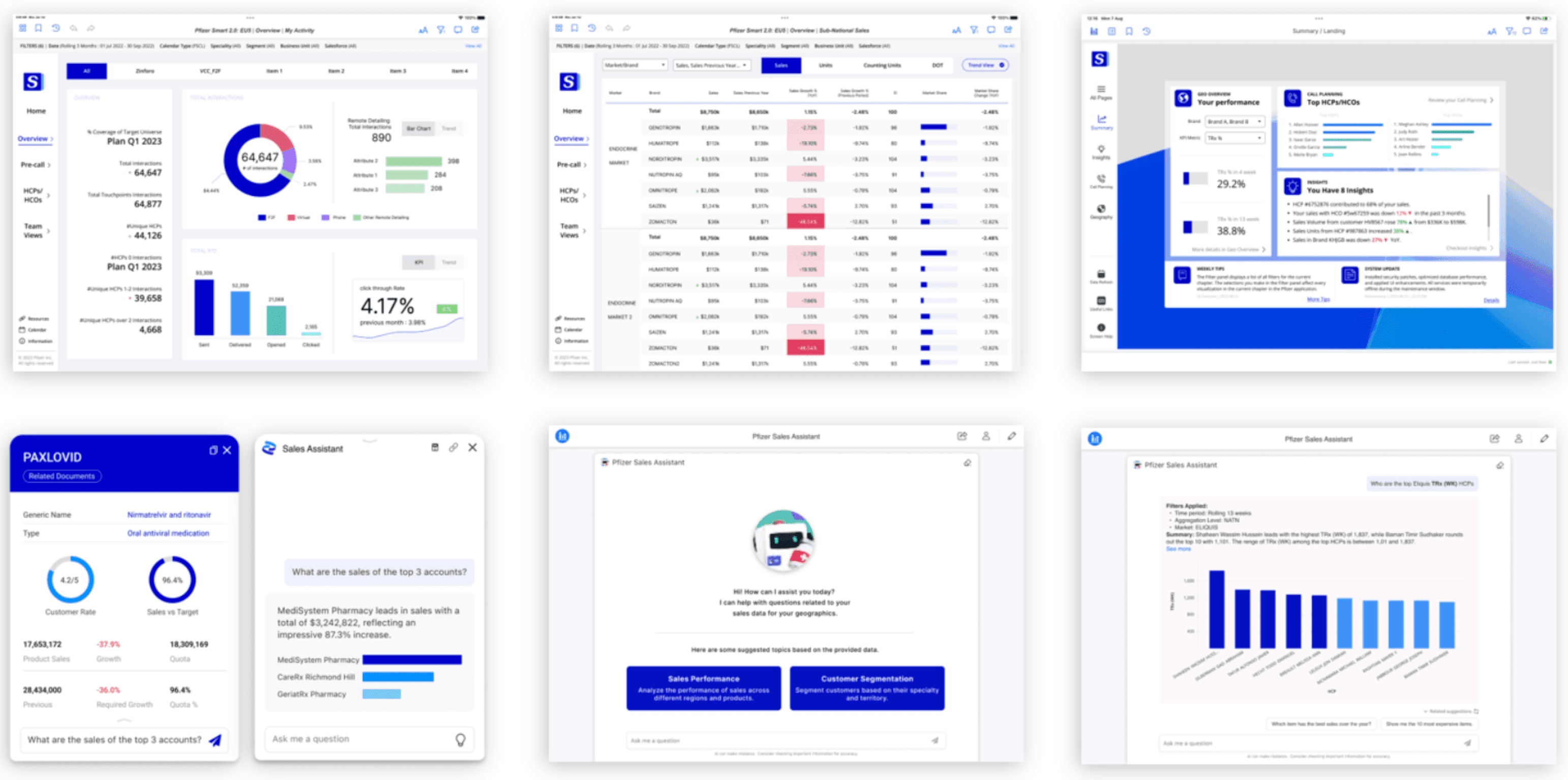
How Pfizer designed mobile analytics around the field experience
Pfizer recognized that more data didn't automatically create more value. Without an action-oriented interface, field representatives would spend more time interpreting insights instead of acting on them.
The company's global reporting solution was designed around two core workflows for field representatives:
Preparing for conversations with healthcare providers through mobile analytics
Planning and managing field territories with on-the-go insights, at scale
For healthcare-provider engagement, the solution ensured that representatives received a 360-degree view of each customer. Sales trends, engagement activity, and relevant messaging stayed consistent, while territory context could be personalized based on location and role.
For planning and managing multiple territories, Pfizer leveraged Strategy's interactive dashboards with one-click navigation and offline access through caching. Multiple languages were incorporated into the shared reporting templates so the experience could scale without requiring a separate solution for every market.
The dashboards were optimized primarily for iPads, reflecting how Pfizer’s field force worked.
Because reusable templates, self-service reports, and ad hoc reporting were built on the same governed semantic layer, Pfizer could respond to temporary or market-specific reporting needs without recreating the underlying business logic.
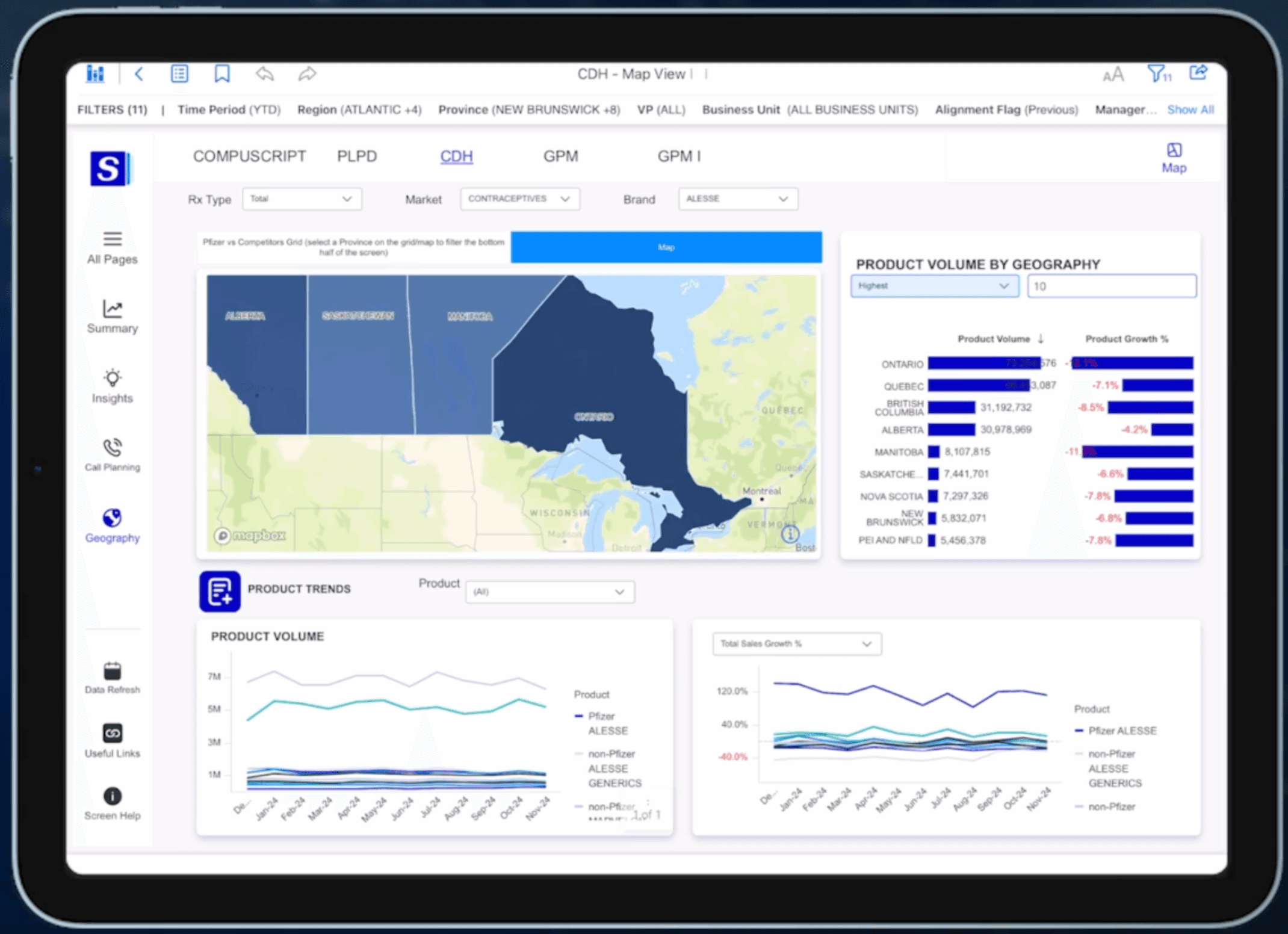
Why does mobile BI need a universal semantic layer?
Mobile BI can deliver dashboards on-the-go, but that doesn't ensure consistency. A universal semantic layer centralizes data logic such as definitions, metrics, relationships, and governance, so users receive the same answer everywhere: across devices, markets, tools, and dashboards. Pfizer’s implementation of Strategy's semantic layer created a governed foundation that allowed consistent, scalable mobile experiences built on top of it.
Turning governed mobile analytics into an AI-ready foundation
Pfizer's global reporting solution changed how quickly users could move from data to insight. As Joseph Simrany, Director of Integrated Insights & Strategy explained:
“At Pfizer, we went from hours to minutes to seconds to be able to generate insights.”
Pfizer’s next step is to embed AI into the reporting workflows its representatives and analysts already use. The company has Strategy's AI bots in place and is exploring additional capabilities, including:
Auto Dashboards
Automated storytelling
Pre-call summaries
Predictive analytics
Geolocation-supported recommendations
As Joseph Simrany explained:
“[With Strategy], we’re going to generate more insights off the data we have, which means productivity gains for analysts, our field force, and anyone using those capabilities.”
A representative can eventually request a provider summary before an appointment. An analyst can generate a dashboard in seconds. A field user with time between meetings can receive a recommendation based on nearby opportunities.
How does a semantic layer support AI analytics?
A semantic layer for AI analytics gives AI applications governed business context instead of forcing them to interpret raw schemas or disconnected reports. The same semantic models and metadata used to keep Pfizer’s dashboards consistent can also support an AI-ready data foundation for future workflows.
What BI leaders can learn from Pfizer’s mobile analytics strategy
Pfizer’s transformation began by understanding the reality of its field representatives. The company worked directly with them to understand their needs, challenges, and expectations and build an architecture that can:
Govern data logic before scaling the experience
Deliver offline access for multiple regions
Centralize business context
Standardize reporting across the organization
Localize what needs to vary by market
Establish a foundation to support analytics and AI
The Strategy-powered solution helped Pfizer scale governed analytics, support 15,000+ users, reach 90% utilization, and reduce insight generation from hours to seconds.
The semantic layer keeps Pfizer's data consistent. Mobile and offline delivery make it accessible. This combination puts governed insights at the fingertips of Pfizer’s field teams wherever they are.
Bring governed insights to every user, wherever they work
Pfizer’s global analytics solution was built on an earlier iteration of Strategy's semantic layer, a precursor to Strategy Mosaic.
Mosaic carries that architecture forward as a Universal Intelligence Layer for modern analytics and AI. By centralizing governed business context, it helps enterprises deliver consistent insights across tools, devices, data environments, and AI workflows.
Build a single source of truth for enterprise analytics and AI.
Discover how Strategy Mosaic can help eliminate data silos, centralize data logic, and deliver trusted data at scale.

Tanmay Ratanpal
A copywriter and brand strategist with 8+ years of experience turning ideas into compelling content. He blends sharp messaging with smart storytelling to build brands that connect, spark conversations, and (mostly) win your boss’s approval.
Content:
- Pfizer had data. It needed an infrastructure to scale it consistently.
- Establishing governed analytics across 27 markets
- How Pfizer designed mobile analytics around the field experience
- Turning governed mobile analytics into an AI-ready foundation
- What BI leaders can learn from Pfizer’s mobile analytics strategy
- Bring governed insights to every user, wherever they work
Related posts
AI agents sound confident but guess without context. See how Mosaic and MCP give agents trusted definitions and governed metrics.

Kaylee Ritter
July 31, 2026
AI agents need governed business context before they act. Learn why a universal semantic layer is now critical infrastructure for agentic AI.

Henry Guo
July 29, 2026
Enterprise AI fails when it lacks business context. Forrester Research shows how ontology, semantics, and knowledge graphs work together to give AI systems the definitions, relationships, and governed meaning they need to answer business questions accurately.

Beata Socha
July 28, 2026
Learn how Mosaic Studio's Universal Semantic Layer governs metrics and unifies data so AI returns trusted, consistent answers every time.
Kaylee Ritter
July 29, 2026