

Your Brain Explains Why LLMs Need a Semantic Layer
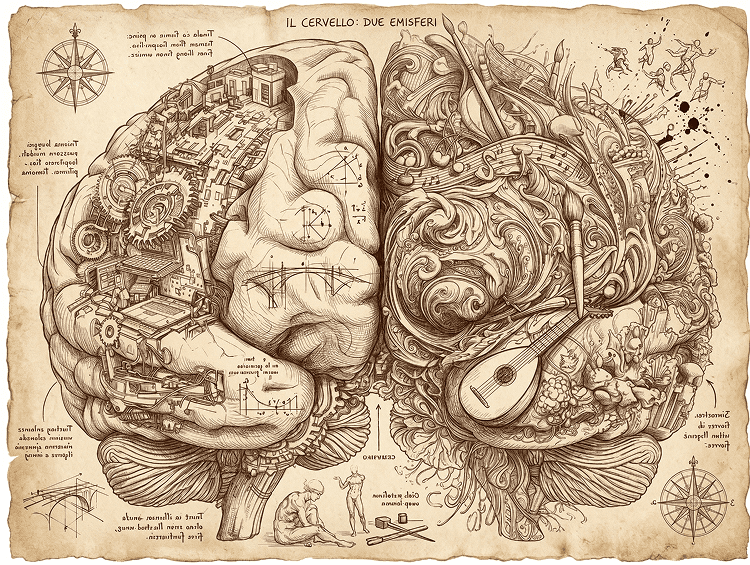
Understanding how large language models (LLMs) and semantic layers work together isn’t always intuitive, but one good analogy is how the human brain works.
The left and right hemispheres of the brain are specialized for different styles of processing. The left hemisphere tends to excel at precision, analysis, categorization, and applying explicit rules. The right hemisphere is better at recognizing patterns, understanding context, interpreting language, and seeing the bigger picture.
Neither side is smarter than the other. They solve different kinds of problems, and intelligence comes from the two working together.
Consider the sentence: The market is on fire.
The left side of your brain recognizes the words 'market' and 'fire.' The right side immediately understands that nobody is talking about literal flames. Together, they arrive at the intended meaning: the stock market is performing exceptionally well.
Now imagine you're asking a business question instead.
"How profitable are our European customers?"
Answering that request requires resolving several hidden assumptions.
The LLM understands the English, but something also needs to know what "Europe" means in your company. Does it include the UK? Turkey? Is it geographic Europe or EMEA?
Similarly, what does "profit" mean? Gross margin? Operating income? Net income? Which exchange rates should be used? Which fiscal calendar? What security rules apply?
An LLM behaves much like the brain's contextual processing (right hemisphere). It understands language, recognizes intent, handles ambiguity, identifies synonyms, and follows the flow of conversation. When someone asks, 'How profitable are our European customers this quarter?' the LLM understands what the user is trying to accomplish.
A semantic layer, on the other hand, plays the role of the analytical specialist (left hemisphere). It knows exactly what "sales" means in your organization. It understands metrics, hierarchies, joins, relationships, governance rules, and security policies. Most importantly, it translates those business concepts into deterministic SQL that will always produce the same answer.
Together, they form a complete system.
Without the semantic layer, the LLM still understands the question, but it has to guess which columns and tables represent concepts like revenue, bookings, or profit. Those guesses are often good—but they remain guesses.
Without the LLM, the semantic layer still knows every business definition, but users must express their questions with much greater precision. It has no intuitive understanding of phrases like "Which regions are struggling?" or "Who should I be worried about?"
Each technology compensates for the other's weaknesses.
Just as the two hemispheres of the brain work together to produce intelligent behavior, LLMs and semantic layers work together to produce AI that can reason and be trustworthy.

Saurabh Abhyankar
Saurabh Abhyankar has been innovating in analytics for 20 years and holds patents in self-service analytics, the semantic graph, and HyperIntelligence. Since 2016, he has held product leadership roles at Strategy, including SVP of Product Management and Chief Product Officer.
Related posts
AI agents need governed context, not guesswork. Explore how the semantic layer becomes context infrastructure for consistent enterprise AI outcomes.

Henry Guo
June 16, 2026
Learn how a semantic layer for data governance enforces business definitions, improves AI accuracy, and ensures consistent KPIs across analytics platforms.

HF Chadeisson
July 7, 2026
Discover why AI hallucinates SQL and how Strategy Mosaic's governed semantic layer makes enterprise text-to-SQL deterministic and reliable.

Tanmay Ratanpal
August 20, 2026
Discover how Pfizer built a governed semantic layer to deliver consistent, mobile-ready insights to 15,000+ field reps across 27 markets.
Tanmay Ratanpal
August 10, 2026