

Your Bank Doesn’t Have an AI Problem. It Has an AI Context Gap.
Quick Answer
When AI produces conflicting answers, the instinct is to blame the model. But in banking, the deeper issue is often that critical metrics, definitions, and relationships don’t have one consistent meaning.
This creates the AI context gap: the data may be accessible, but the business context needed to interpret it consistently is not.
An AI semantic layer helps close that gap by establishing governed business context that can be reused across analytics and AI.
It gives systems consistent metrics, governed definitions, and shared business logic instead of asking AI to infer meaning for itself.
AI Won’t Resolve Definitions Your Bank Can’t Resolve
Banks rarely suffer from a lack of data. They suffer from too many versions of the truth.
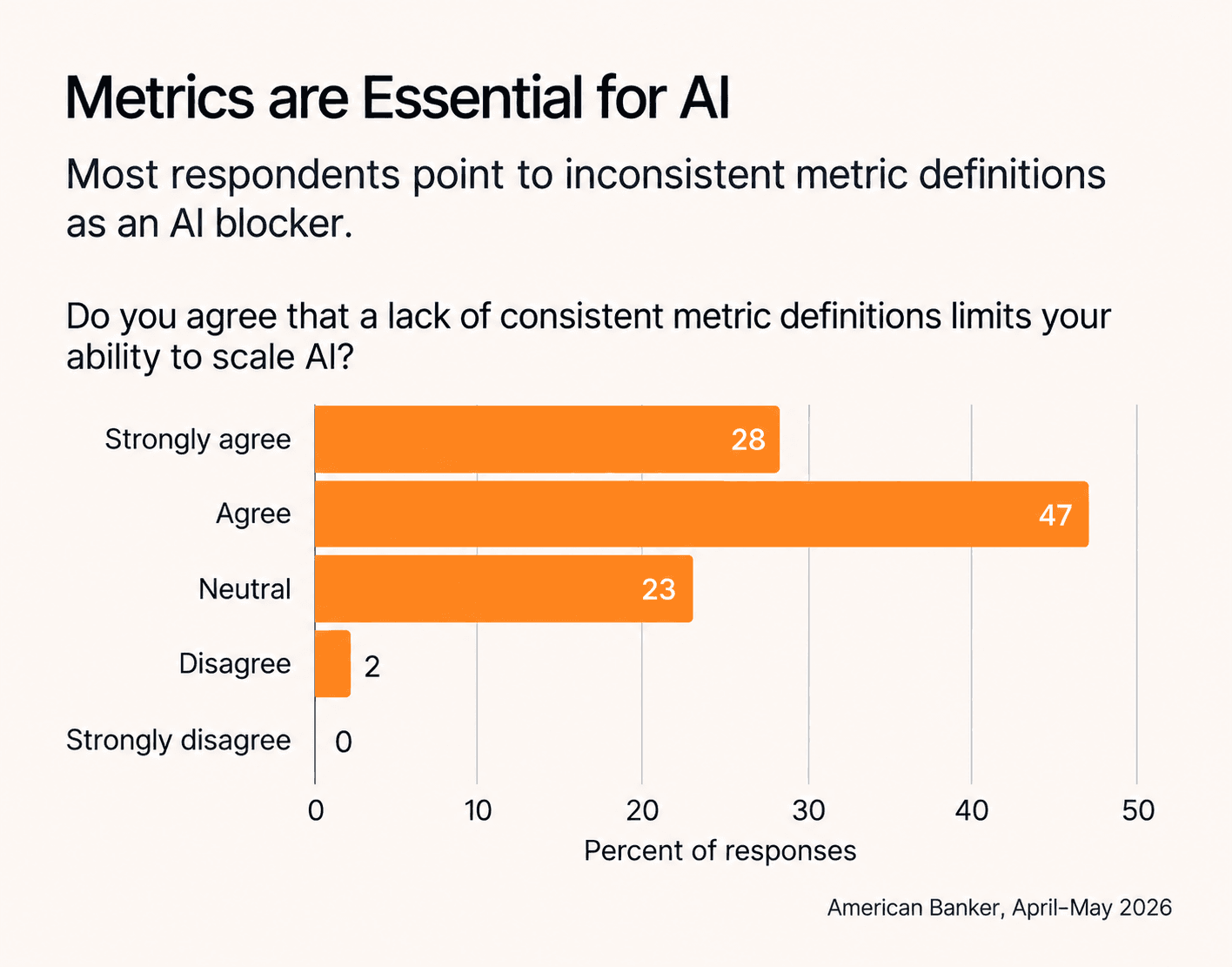
According to the 2026 American Banker Survey, 75% of banks and financial institutions agree that inconsistent metric definitions limit their ability to scale AI.
The same term can mean different things across different departments. Depending on who you ask, the definition of a"customer" might refer to:
- An individual account holder
- A household
- A legal entity
- An active relationship
Similarly, reporting KPIs such as Revenue, Deposit Growth, and Risk Exposure can also vary according to the business unit, source system, or team-specific workflow.
A human analyst may recognize those differences and reconcile them before using the number. An AI system operating at scale can’t be expected to infer which definition the bank intended.
What is the AI context gap?
The AI context gap occurs when an artificial intelligence model can access raw enterprise data but lacks the governed business context needed to interpret it correctly. Data warehouses may expose tables, catalogs may describe assets, and metadata may name fields, but those layers alone don’t determine how the business defines a metric, which relationship governs a query, or which logic applies to a specific scenario.
A Connected Data Ecosystem Can Still Produce Conflicting Answers
The survey exposes a clear gap between data integration and AI data readiness: 71% of organizations report at least partially integrated data systems, yet only 10% describe their data as well-governed, accurate and available in real time as a reliable foundation for AI-driven insights.
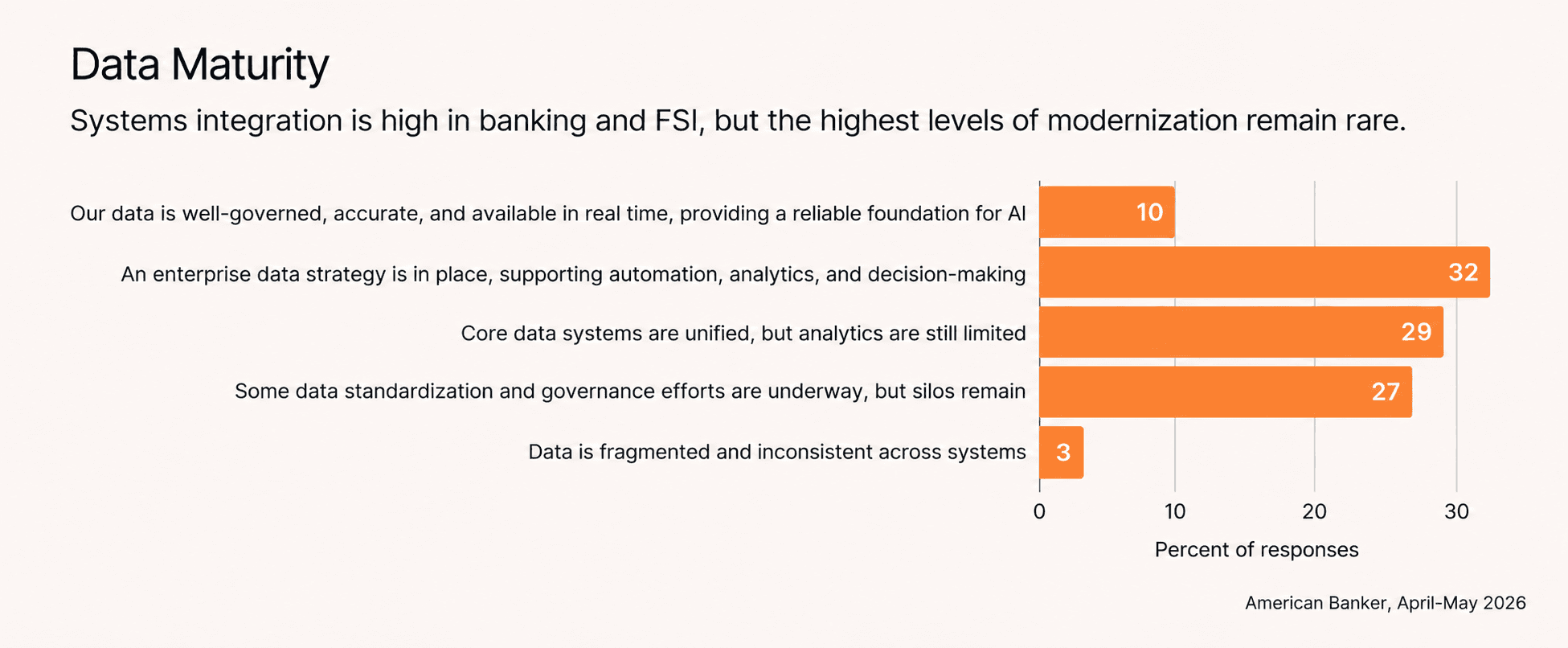
That distinction is critical because connected data systems improve access. They don’t automatically reconcile definitions, ownership or business logic. In other words, AI can reach data, but it lacks the shared meaning required to interpret it consistently.
The problem becomes harder to detect when AI generates the query, because technically valid SQL can still apply the wrong business logic. In text-to-SQL scenarios, the model may generate a valid query against the wrong table, apply the wrong join or use a metric definition intended for another business unit.
This is what AI hallucinating SQL looks like: the syntax works, but the business logic does not.
Shared Meaning is a Governance Requirement
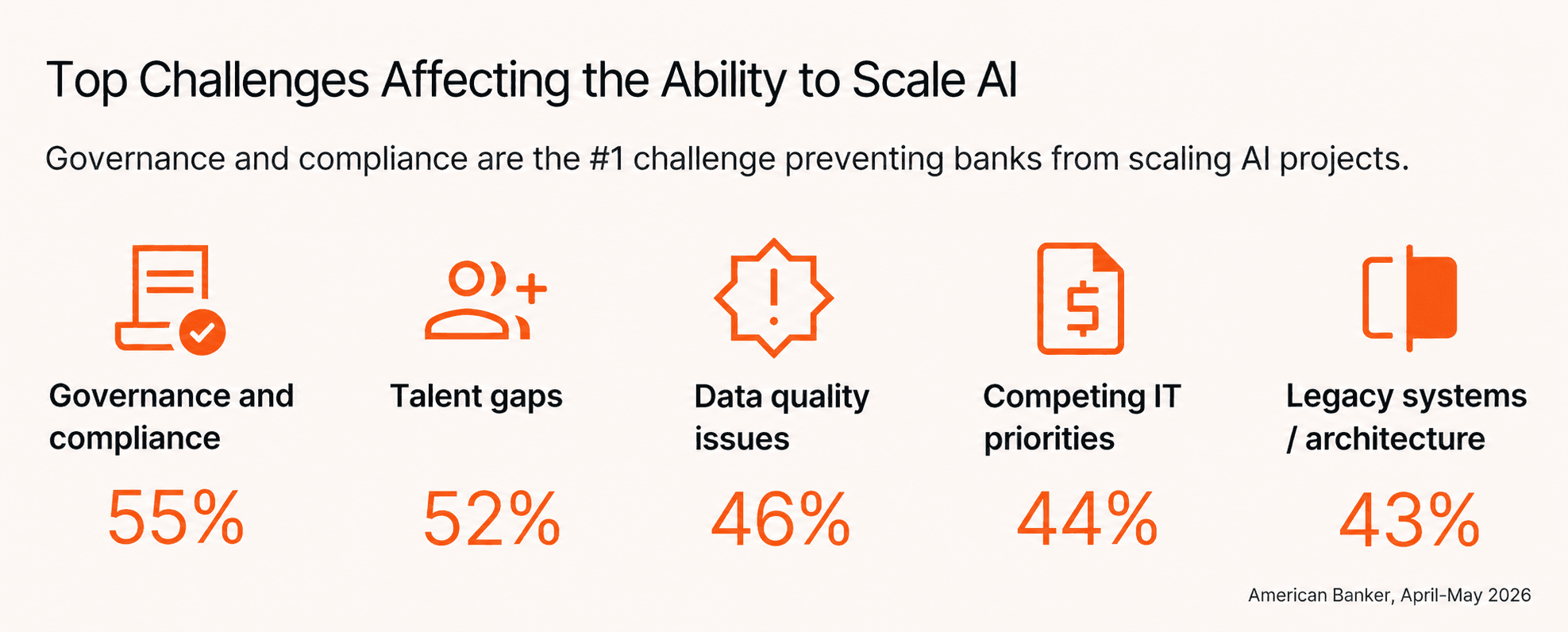
Governance and compliance rank as the top reported challenge affecting banks’ ability to scale AI. Data quality, legacy architecture, and competing IT priorities add further pressure.
Banks already govern who can access data, how it is protected, and how it can be used. AI data governance must extend that control to the context behind that data.
For banking, AI needs explicit business rules:
- Approved definitions for core business concepts: Defining what counts as an Active Customer, so the AI doesn’t guess based on app logins.
- Clear ownership of metrics: Establishing that the Risk Team owns the Churn Risk number, so the AI only relies on an authoritative source.
- Reusable calculation logic: Using one locked formula for the Debt-to-Income Ratio, so the AI doesn’t reconstruct the calculation from incomplete context.
- Consistent policies across every channel: Ensuring a Customer Value score looks identical, whether a genAI bot or an executive asks for it.
Without governed metrics and shared business logic, two authorized users can ask the same question through different tools and receive different answers. An AI agent may use one version of net revenue, while a dashboard uses another.
This is why enterprise AI governance can’t sit only at the model layer. It must extend into the architecture beneath the model, where definitions, relationships, and policies are created and maintained.
A Semantic Layer Turns Context into Reusable Infrastructure
A governed AI semantic layer creates a shared business vocabulary between source systems and the tools, users and AI agents that consume data.
It standardizes definitions and metrics so that concepts such as Revenue, Customer, Risk, and Performance carry the same approved context wherever they are used. Rather than expecting the AI to reconstruct business logic from raw schemas, the organization defines that logic once and makes it reusable across the tools that consume it.
By providing governed business context before AI interprets or queries data, an AI semantic layer creates a more controlled foundation for:
Consistent interpretation of metrics across business units. Governed access and policy enforcement. Stronger compliance and audit readiness. Lower risk of text-to-SQL applying the wrong business logic. More consistent analytics and AI outputs across enterprise tools.
To learn how a semantic layer supports AI-ready analytics, explore Strategy Mosaic →
Trusted AI Starts with Agreement
Banks need consistent definitions for the metrics that drive decisions.
If the bank can’t agree on the meaning of key metrics and definitions, it can’t expect AI to resolve those differences automatically. Instead, AI exposes them further, creating conflicting outputs across the organization. In a regulated environment, that inconsistency can become a governance and auditability problem.
That’s why the path to trusted AI begins before model selection. It begins with shared definitions, governed business logic, and an AI semantic layer that can deliver consistent context across the enterprise.

Beata Socha
With over 15 years of experience as a tech journalist and content creator, Beata heads Content Marketing at MicroStrategy. An economics graduate, she specializes in finance and the impact of AI on business, bringing expert insights to the industry.