

September 2026: Conversational Analytics, Deeper Query Visibility, and Safer Analytics Changes
Quick Answer
Explorer brings conversational analysis into Library, so users can start with an open-ended business question instead of hunting through dashboards and objects.
Mosaic Sentinel adds query-performance visibility across Strategy, Power BI, Tableau, Agents, and MCP workloads, then makes Sentinel data available through the Universal Semantic Layer for SQL, applications, and AI.
Test Center expands regression testing across Strategy Cloud environments, helping teams catch unintended SQL, data, PDF, and performance changes before they reach users.
Richer dataset context, parameterized metrics, and browser-based object authoring make governed analytics easier to understand, reuse, and change without creating parallel logic.
AI is making analytics easier to ask. It is also making analytics harder to operate.
One governed model may now serve a business user asking a question in Explorer, an Agent working through MCP, a Power BI report, a Tableau workbook, and a custom application. That is exactly where enterprise analytics should be heading.
But every new consumption path creates another workload the platform team has to understand. Analysts still need to know what already exists before they build something new. Developers still need to know whether a change altered SQL, data, output, or performance somewhere downstream.
September improves that full loop: ask the data more naturally, see how the workload actually runs, understand the assets behind it, and make changes with less guesswork.
AI: Start with the question, not the interface
Explorer: AI-Powered Answers From Your Data
Traditional analytics assumes the user knows where to start. Which dashboard has the answer? Which dataset should I open? Which filter gets me close enough?
Explorer gives Library users another starting point: the business question itself.
Users can ask open-ended questions against Mosaic data and get conversational answers that pull together HTML reports, email-ready content, and other tool outputs in one response. Long-term memory and Universal Agent integration can carry useful context forward, while Platform Analytics captures usage for governance and operational visibility.
Explorer gives users a faster path from a business question to governed analysis without requiring them to understand how the platform is organized first.
That matters as conversational analytics expands beyond expert analysts. The interface can become simpler without creating a separate, disconnected path to enterprise data.

Google AI model support moves forward underneath existing workflows
Managed Cloud Enterprise environments configured for Google's AI provider are also moving to Gemini 3.x support, with Gemini 3.5 Flash-Lite powering supported AI experiences.
The more important customer outcome is continuity. Existing Agent, dashboard, metric, answer, and narrative workflows can keep operating while the managed model layer evolves underneath them. Model infrastructure should be able to move forward without forcing business teams to rebuild the workflows that depend on it.
Mosaic: When more tools use the semantic layer, observability has to follow
Sentinel Query Performance Analytics
When the same semantic layer serves dashboards, BI tools, Agents, and applications, a slow answer can originate almost anywhere along the path.
Earlier this year, Sentinel Cost Intelligence helped answer a basic operating question: what is this governed workload costing us? September adds the next question: where is that workload spending time?
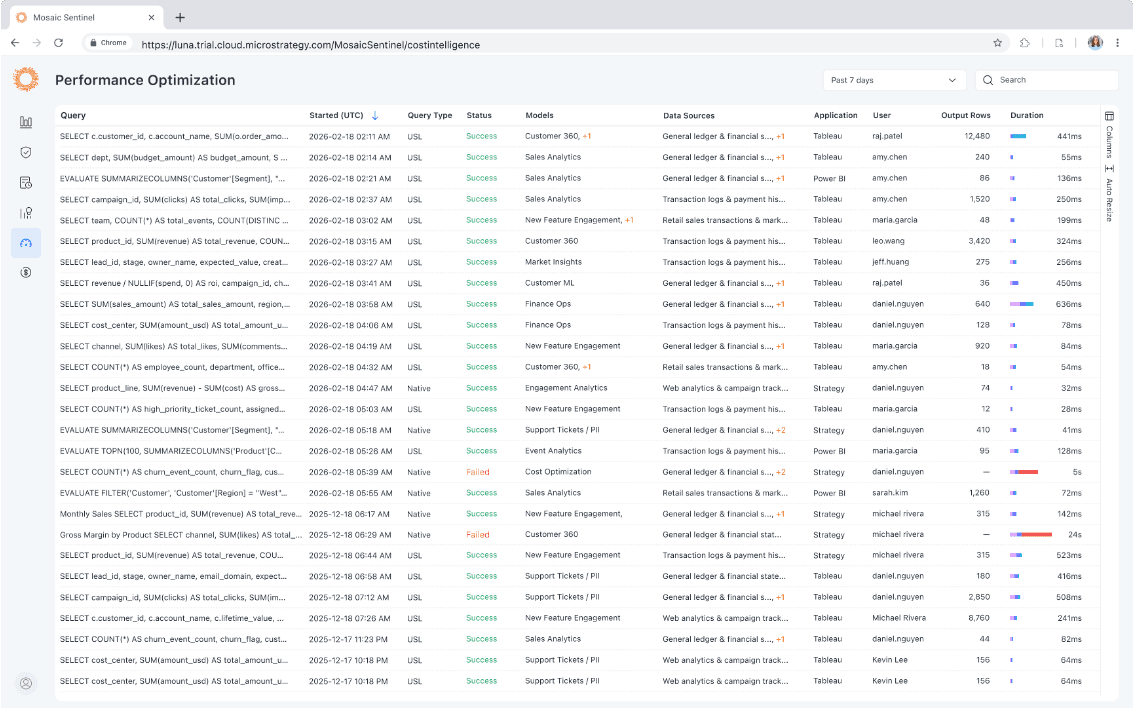
Sentinel can now capture detailed performance information for Mosaic access coming from Strategy dashboards, Strategy Agents, MCP clients, Tableau, and Power BI. Administrators can review end-to-end query duration, drill into execution timeline stages, and analyze component-level statistics over a rolling 30-day window.
That creates a cleaner path from a slow dashboard, BI query, or Agent response to the execution behavior behind it. Instead of treating performance as a front-end symptom, teams can identify bottlenecks and make better decisions about configuration and modeling.
As applications and Agents generate more workloads alongside human users, that visibility needs to become part of the platform rather than an after-the-fact troubleshooting exercise.
Sentinel telemetry becomes data you can use
Observability is more useful when the information does not stop inside an administrative screen.
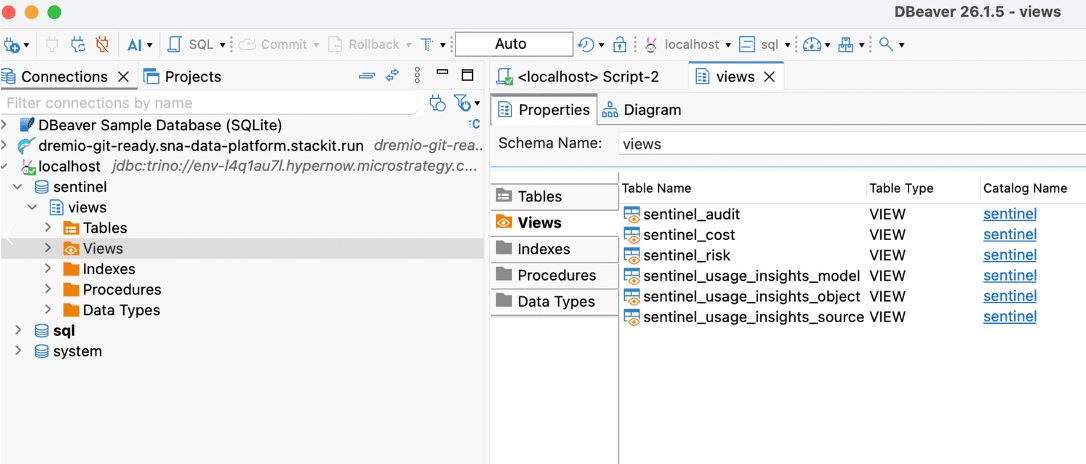
Sentinel insights can now be queried through the Mosaic Universal Semantic Layer catalog using standard SQL. Teams can use that information in custom applications or build Mosaic models that feed MCP clients and Strategy Agents.
That closes an important loop. Mosaic serves governed analytics and AI workloads. Sentinel observes how those workloads behave. Teams can now bring those operational signals back into the same governed analytics and AI environment they use to manage the business.
Performance data becomes something teams can analyze, model, automate around, and expose to AI instead of something an administrator checks only after a problem appears.
Understand what already exists before building again
Before reusing or changing a dataset, teams should be able to answer a few basic questions: What is it? Who owns it? How fresh is it? What sits underneath it? And what depends on it?
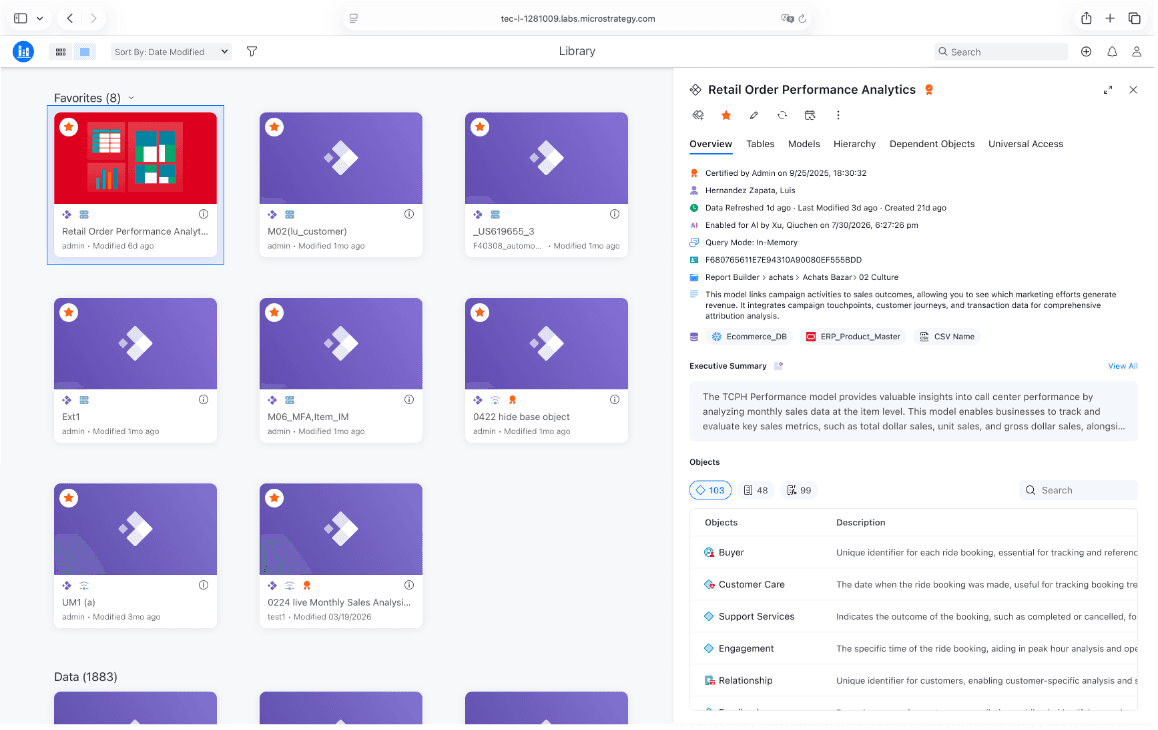
The new Dataset Insights and Dependencies panel brings those answers into Library for Mosaic Models, MTDI Cubes, and OLAP Cubes. Users can review AI-generated summaries, ownership and refresh context, underlying data sources and structures, semantic objects, access details, and downstream dependencies without first opening Mosaic Studio.
For analysts, that makes it easier to choose the right governed asset. For architects and administrators, dependency visibility makes it easier to understand the potential impact of a change before making it.
Better discovery reduces two problems at once: rebuilding logic that already exists and changing an asset without knowing what depends on it.
Parameterized metrics: reuse business logic instead of multiplying it
A small reporting variation should not always require another metric.
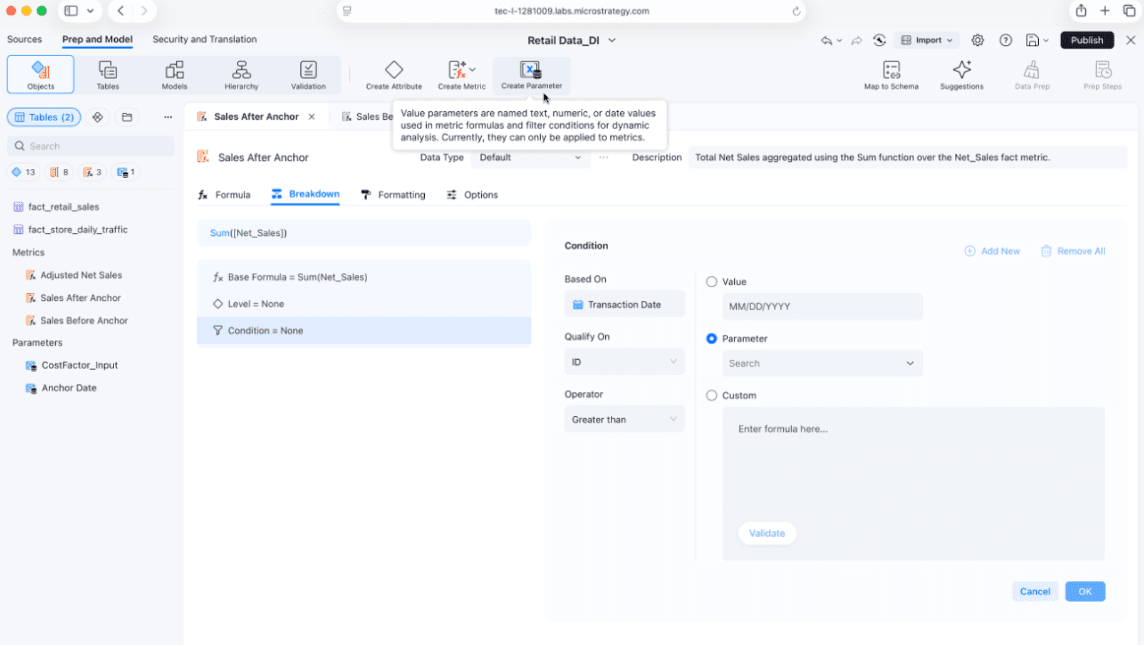
Mosaic Models now support value parameters inside metric formulas and conditions. Modelers can use number, date, or text parameters to make a metric adapt at runtime, including scenarios such as changing time periods or business thresholds without rebuilding near-identical calculations.
Auto Metric also understands value parameters, so teams can use AI-assisted modeling to create parameterized logic in Mosaic Studio.
The practical value is less metric sprawl. One governed definition can support more scenarios while keeping the underlying business logic centralized and reusable.
BI: Change faster without guessing what broke
Test Center: regression testing for the analytics lifecycle
Mature BI environments rarely struggle because nobody can create another report. The harder problem is changing something that users, reports, applications, and downstream workflows already depend on.
Test Center is now available across both containerized and instance-based Strategy Cloud environments, bringing baseline and comparison testing into Workstation. Teams can validate reports, dashboards, datasets, and Report Services Documents before and after a development change, compare projects within one environment, or test across environments during migrations, upgrades, and promotions.
Comparisons can include SQL, returned data, PDF output, and execution performance.
That turns a vague question - did anything important change? - into something teams can test systematically before the change reaches users.
For organizations modernizing long-running BI estates, this is more than a replacement path for legacy Integrity Manager workflows. It brings analytics development closer to the regression-testing discipline teams already expect in software delivery.
More everyday authoring moves into Library, without losing traceability
Browser authoring only helps if teams can do real work without constantly switching tools.
Authors can now create and edit metrics, filters, custom groups, and reusable prompts directly in Library. Those objects surface in Browse Folders for reuse and discovery, and they can also be edited from relevant report-authoring workflows.
When a change is saved, authors can add a Change Journal comment describing what changed and why.
That combination is more important than Strategy Web parity by itself. It reduces context switching while preserving a clearer record of how shared analytical logic evolves over time.
Faster editing and stronger traceability should move together. The goal is not to make governed objects easier to change at the expense of accountability. It is to make the governed path the easier path.
What September makes easier
Explorer makes governed data easier to ask.
Sentinel makes AI and BI workload behavior easier to see.
Dataset context and parameterized metrics make governed logic easier to understand and reuse.
Test Center and Library make analytics changes easier to validate, explain, and move forward.
As analytics becomes more conversational and more open to BI tools, Agents, MCP clients, and applications, the operating model around it has to become more observable and more disciplined at the same time.
September moves both sides forward: less friction for the person asking the question, and less guesswork for the teams responsible for keeping the answers fast, reusable, and safe to change.
Learn more about these September updates on our What's New page and product documentation.
Frequently Asked Questions
What is included in the Strategy Software September 2026 release?
September focuses on three areas: Conversational AI — Explorer brings open-ended analysis into Library, with updated Gemini 3.x support for applicable Managed Cloud Enterprise environments. Observability and modeling — Sentinel adds query-performance visibility and SQL-accessible telemetry, alongside richer dataset context and parameterized metrics. Safer analytics change — Test Center expands regression testing, while Library adds more governed authoring and Change Journal context.
What is Explorer?
Explorer is an AI-driven experience in Library Web that lets users ask open-ended questions against Mosaic data and receive conversational answers that can combine multiple tools and richer outputs in one response. It also integrates with long-term memory and Universal Agent, while Platform Analytics captures usage.
What can Sentinel Query Performance Analytics monitor?
Sentinel can capture performance information for Mosaic access from Strategy dashboards, Strategy Agents, MCP clients, Tableau, and Power BI. Administrators can analyze end-to-end duration, execution timeline stages, and component-level statistics over a rolling 30-day window.
Can Sentinel data be queried programmatically?
Yes. Sentinel insights can be accessed through the Mosaic Universal Semantic Layer catalog using SQL. Teams can use those signals in custom applications or Mosaic models, including models that support MCP and Strategy Agent workflows.
How does Test Center reduce BI change risk?
Test Center supports baseline and comparison testing for reports, dashboards, datasets, and Report Services Documents. Teams can compare SQL, data, PDF output, and execution performance within or across environments to validate development changes, migrations, upgrades, and promotions before those changes reach users.
What can authors now create or edit directly in Library?
Authors can create and edit metrics, filters, custom groups, and reusable prompts in Library, with those objects available through Browse Folders and relevant report workflows. Authors can also add Change Journal comments when saving changes to improve traceability.
What are parameterized metrics in Mosaic Models?
Parameterized metrics use number, date, or text values as runtime inputs inside metric formulas and conditions. This lets one governed metric support more dynamic scenarios, such as time-period or threshold changes, without creating separate near-duplicate metrics for each variation.

Henry Guo
Henry Guo is Director of Outbound Product Management at Strategy, driving go-to-market and turning customer insights into discovery and validation for its semantic layer and AI products. With 15+ years in AI, data and security, he helps ship trusted secure enterprise platforms with measurable value.