

The 5 Best Domo Alternatives in 2026 After the Progress Software Deal
Quick Answer: What are the best Domo alternatives in 2026?
Strategy is the strongest fit for enterprises that want the most widely adopted universal semantic layer and an independent governed foundation across clouds, BI tools, applications, and AI agents.
Microsoft Power BI fits organizations deliberately standardizing data, analytics, productivity, governance, and AI on the Microsoft ecosystem.
Salesforce Tableau remains a strong choice for visual exploration and analyst-led discovery, especially when Salesforce defines the surrounding customer data and AI ecosystem.
Google Looker fits code-first data teams that want governed modeling through LookML and have chosen Google Cloud as a strategic platform.
Qlik fits organizations that prioritize associative exploration and integrated data services, although it introduces another broad proprietary platform.
Why now is the right time to reassess Domo
Your Domo environment may still work. The more important question is whether it remains the right foundation for the next three years.
On July 22, 2026, Domo agreed to sell its operating business to Progress Software. For most customers, that does not create an immediate operational crisis. Dashboards will still run, DataFlows will still refresh, and teams will continue using the platform. The pressure shows up at the next renewal.
That is when BI leaders have to decide whether to commit to another multi-year term while ownership, product investment, support, and commercial policies are changing. The decision gets harder when important pipelines, Beast Modes, embedded applications, and workflows are already deeply tied to Domo.
The question is not whether Domo will disappear. It is whether you want to spend the next three years adding more dependency before you know what the platform will look like under Progress.
Before renewing, the questions become very concrete:
Will Progress keep investing in the Domo products and services your teams depend on?
How will consumption pricing, support, and renewal terms change?
How much of the current estate can your team unwind before the next contract window, and where will you need outside help?
Those questions are enough to justify an alternatives review now, before the renewal process compresses the timeline.
The real decision is where business logic should live after Domo
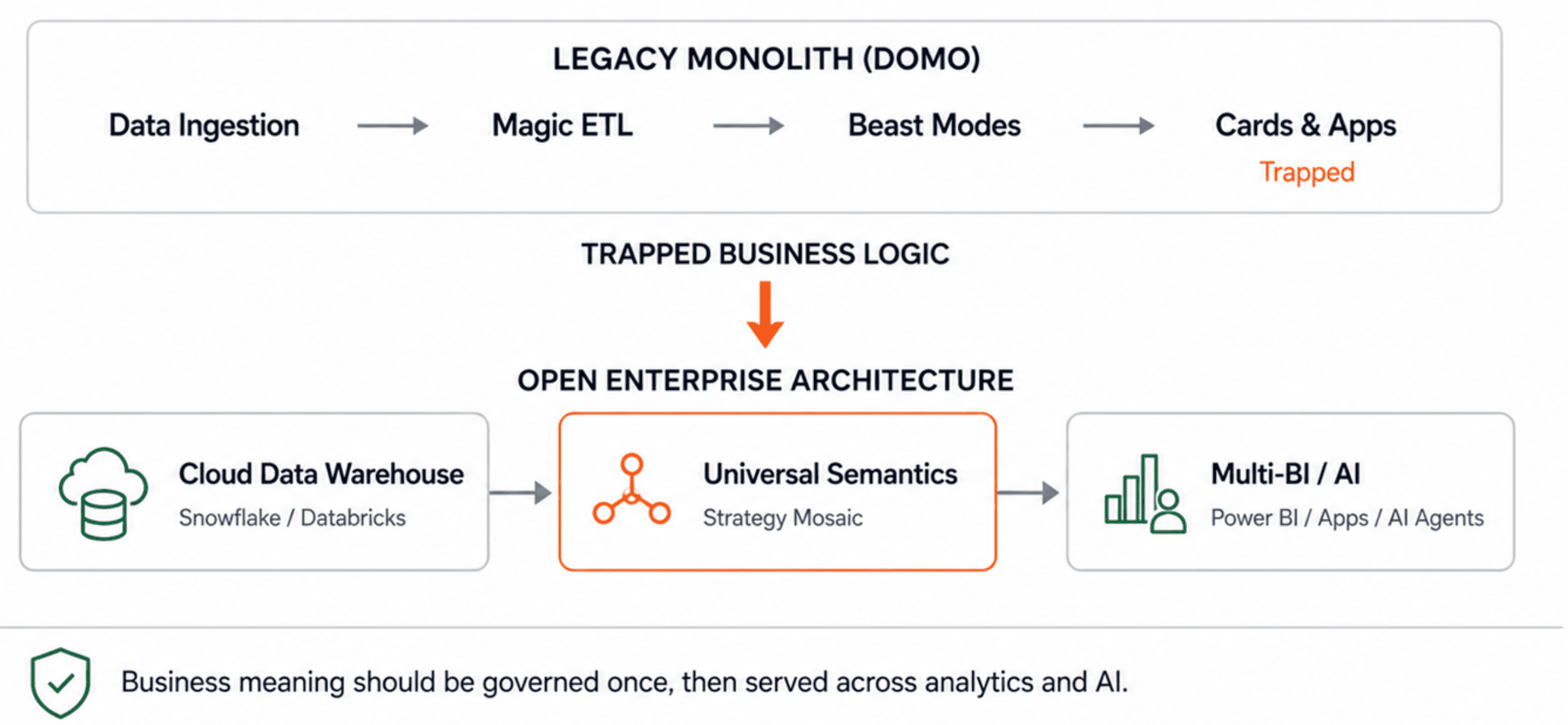
Moving beyond Domo means separating transformation, governed business meaning, and consumption so the same approved metrics can serve multiple BI tools, applications, and AI agents.
Domo gained adoption by bringing data ingestion, visual transformation, dashboards, embedded analytics, workflows, and lightweight applications into one environment. That all-in-one model can accelerate initial delivery, but it also concentrates pipelines, business logic, security behavior, and user experiences inside Domo. The limitation becomes more visible when the same approved metrics and policies must work consistently across Microsoft Power BI, Salesforce Tableau, Excel, customer applications, multiple clouds, and AI agents.
That changes the replacement decision. The goal is not to find the closest dashboard clone. It is to choose an architecture that can support the data, reporting, applications, and AI programs you expect to run three years from now.
Each vendor in this guide can replace part of the Domo estate. Microsoft Power BI, Salesforce Tableau, and Google Looker are strongest when their parent ecosystem is the chosen operating model. Qlik offers another broad proprietary stack. Strategy is the independent option when shared business meaning must outlive any one cloud, application platform, BI tool, or AI model.
Domo alternatives compared
We evaluated the alternatives against the requirements that matter most in a Domo replacement: governance of shared business logic, enterprise reporting, data-preparation strategy, embedded analytics, support for multiple BI and cloud environments, AI readiness, migration effort, long-term operating complexity, and independence from any single cloud or application ecosystem.
For large enterprises, we placed the greatest weight on cross-tool governance, enterprise reporting, migration complexity, AI readiness, and ecosystem independence. Those priorities place Strategy first. Organizations deliberately standardizing on Microsoft, Salesforce, or Google may reasonably rank that ecosystem's platform higher.
Alternative | Best fit | Why it stands out | Main trade-off |
|---|---|---|---|
Large enterprises, multi-cloud and multi-BI estates, governed AI | Most widely adopted universal semantic layer, independent cross-tool governance, enterprise reporting, cost visibility, and governed AI context | Data transformation is handled in the customer's warehouse, lakehouse, or ETL/ELT stack rather than inside the BI platform. | |
Microsoft-first organizations | Deep integration with Microsoft Fabric, Azure, Excel, Microsoft 365, and the broader Microsoft ecosystem | Centers the semantic-model and analytics lifecycle inside Microsoft; DAX and workspace proliferation can recreate governance sprawl | |
Visual exploration and Salesforce-centric teams | Visual exploration, analyst experience, community, and increasing alignment with the Salesforce data and AI ecosystem | Workbook calculations, extracts, and Prep logic can fragment business meaning, while the surrounding architecture becomes more Salesforce-centered | |
Code-first data teams, especially on Google Cloud | LookML, Git-centered modeling, governed BI, embedded analytics, and strong Google Cloud alignment | Developer dependency and a proprietary, Google-centered model lifecycle can limit cross-tool and cross-cloud reuse | |
5. Qlik | Associative exploration plus integrated data movement | Associative engine, integrated data services, and hybrid deployment | Creates another broad proprietary platform and offers less independence for cross-tool semantics, enterprise reporting, and governed AI context |
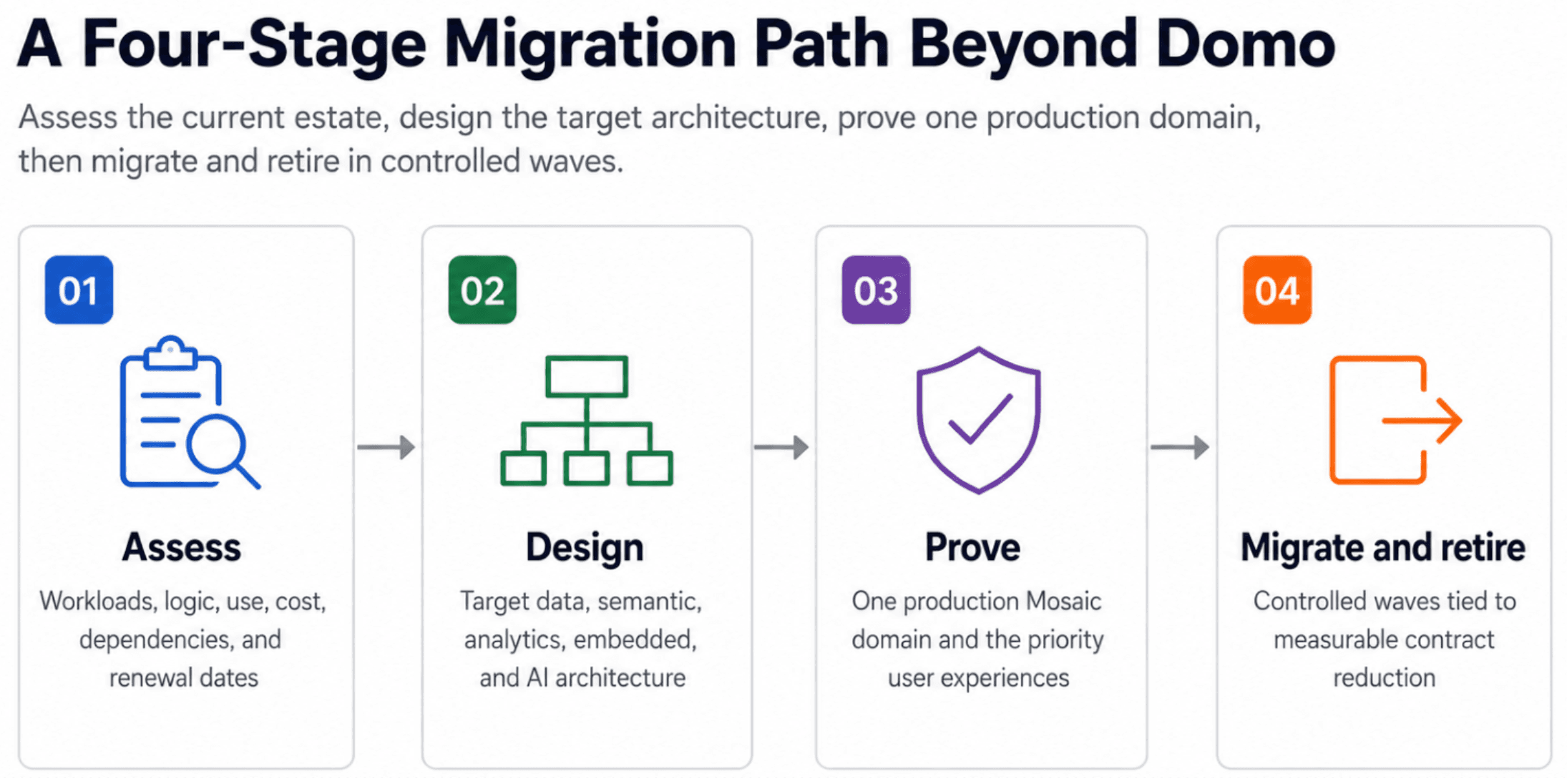
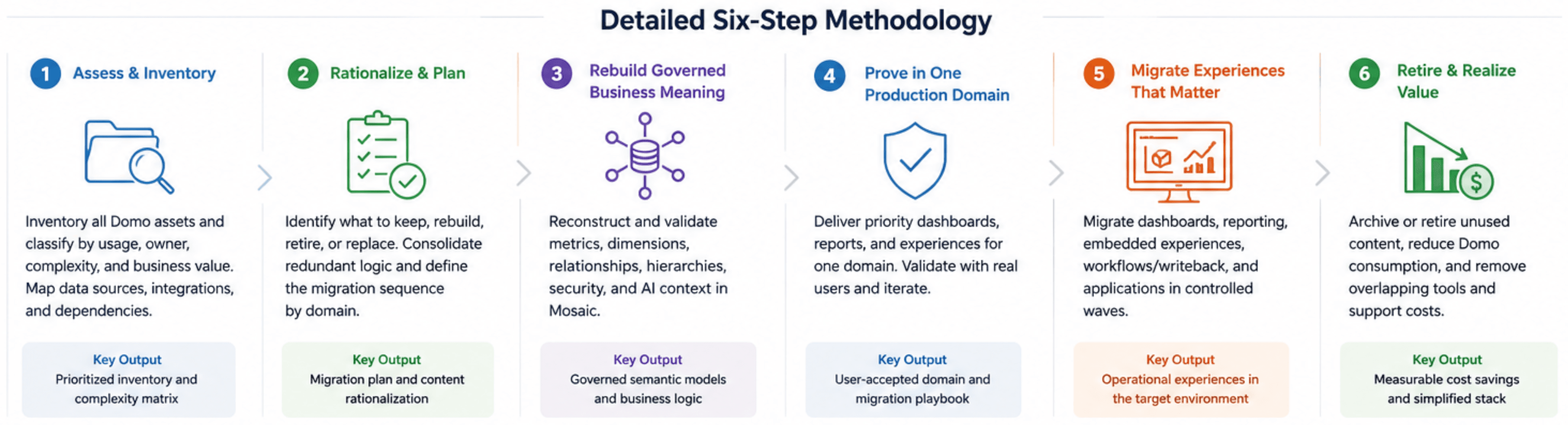
Four-stage Domo migration path showing assessment, target architecture design, validation in one Mosaic production domain, and controlled migration and retirement.
1. Strategy: Best Domo alternative for governed enterprise analytics, reporting, and AI
Strategy is the strongest Domo alternative for enterprises that want an independent universal semantic layer without handing control of that foundation to a single cloud, CRM, BI, or AI ecosystem. Mosaic governs metrics, relationships, security, and lineage, while Strategy BI provides dashboards, enterprise reporting, mobile, embedded, and governed operational experiences from that same foundation.
Strategy separates governed business meaning from the tools and ecosystems that consume it. Data teams can control transformation upstream, govern approved definitions once in Mosaic, and reuse them across Strategy BI, Microsoft Power BI, Salesforce Tableau, applications, APIs, and AI agents.
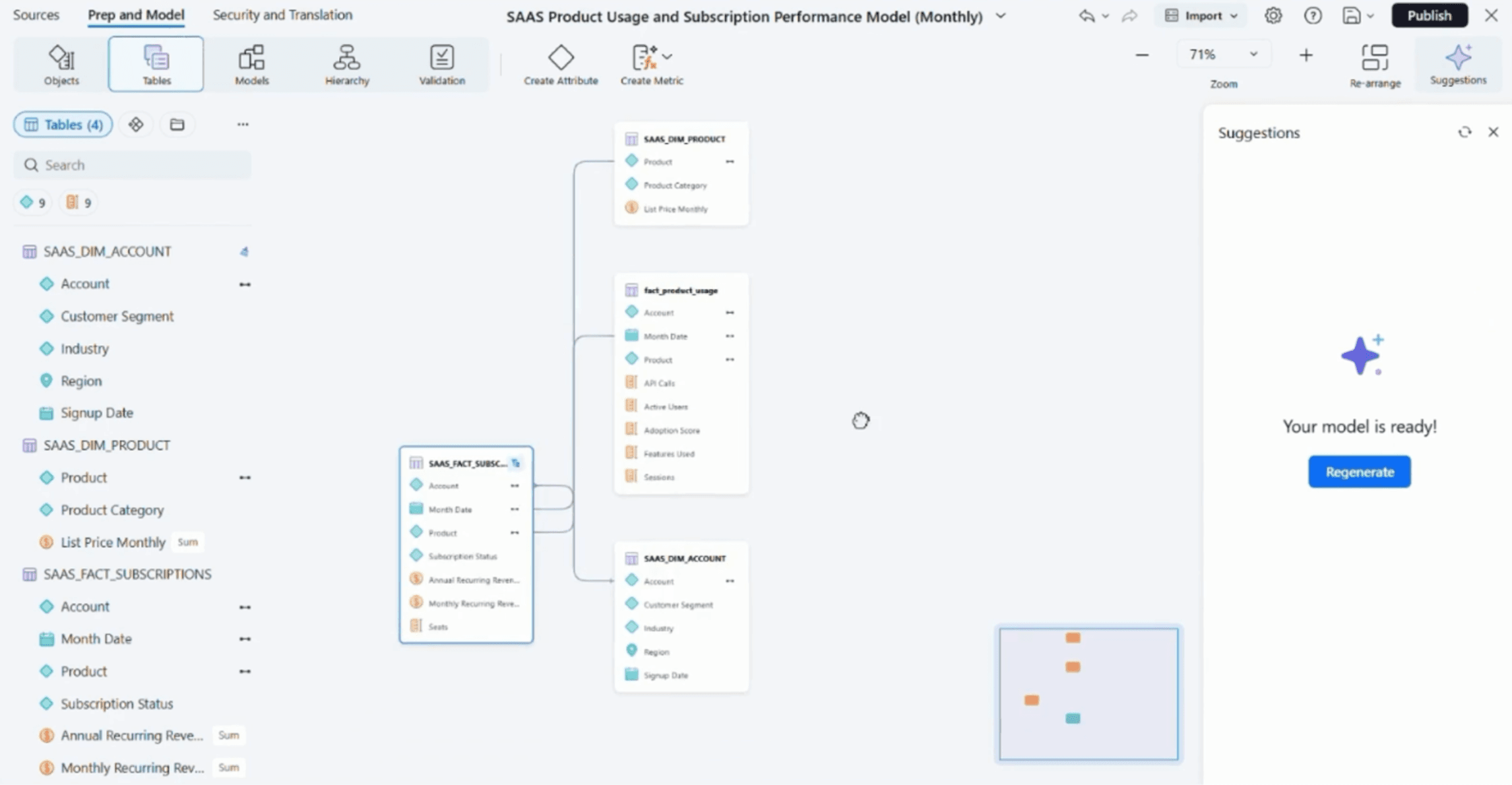
Strategy Mosaic centralizes governed metrics, relationships, and security so the same business meaning can be reused across Strategy BI, Power BI, applications, and AI agents.
What changes in the target architecture
1. Keep business meaning consistent across teams and tools
Mosaic gives teams one governed definition of revenue, customer, margin, and other core concepts across Microsoft Power BI, Salesforce Tableau, Strategy dashboards, applications, and AI agents. Teams can apply inherited security, review changes before production, and exchange supported semantic assets through an open standard. Mosaic Schema, GitHub workflows, and Apache Ossie support those controls. In third-party research commissioned by Strategy, interviewed customers reported a 44% average reduction in redundant metrics and models.
2. Change models without breaking production
Teams can validate joins, calculations, sample data, and security before publishing, then promote or reverse changes across development, test, and production. Sentinel Cost Intelligence can also trace Snowflake and Databricks spend back to the analytics assets driving it, making cost part of the operating model rather than a separate investigation.
3. Use the same approved context across analytics and AI
Microsoft Power BI, Salesforce Tableau, Strategy dashboards, enterprise reports, embedded applications, and AI agents can work from the same approved definitions and permissions. That matters even more for AI: an inconsistent dashboard may confuse one user, while an agent can repeat the same error across thousands of questions and actions. MCP-connected tools and Strategy AI can query Mosaic under existing security and audit controls. During a Domo migration, MCP gives approved AI tools a governed path to validated Mosaic metrics and business concepts instead of forcing each agent to infer meaning independently from raw tables or duplicated dashboard logic. Interviewed customers reported a 22% average decrease in incorrect AI outputs or hallucinations.
How Strategy moves enterprises beyond Domo
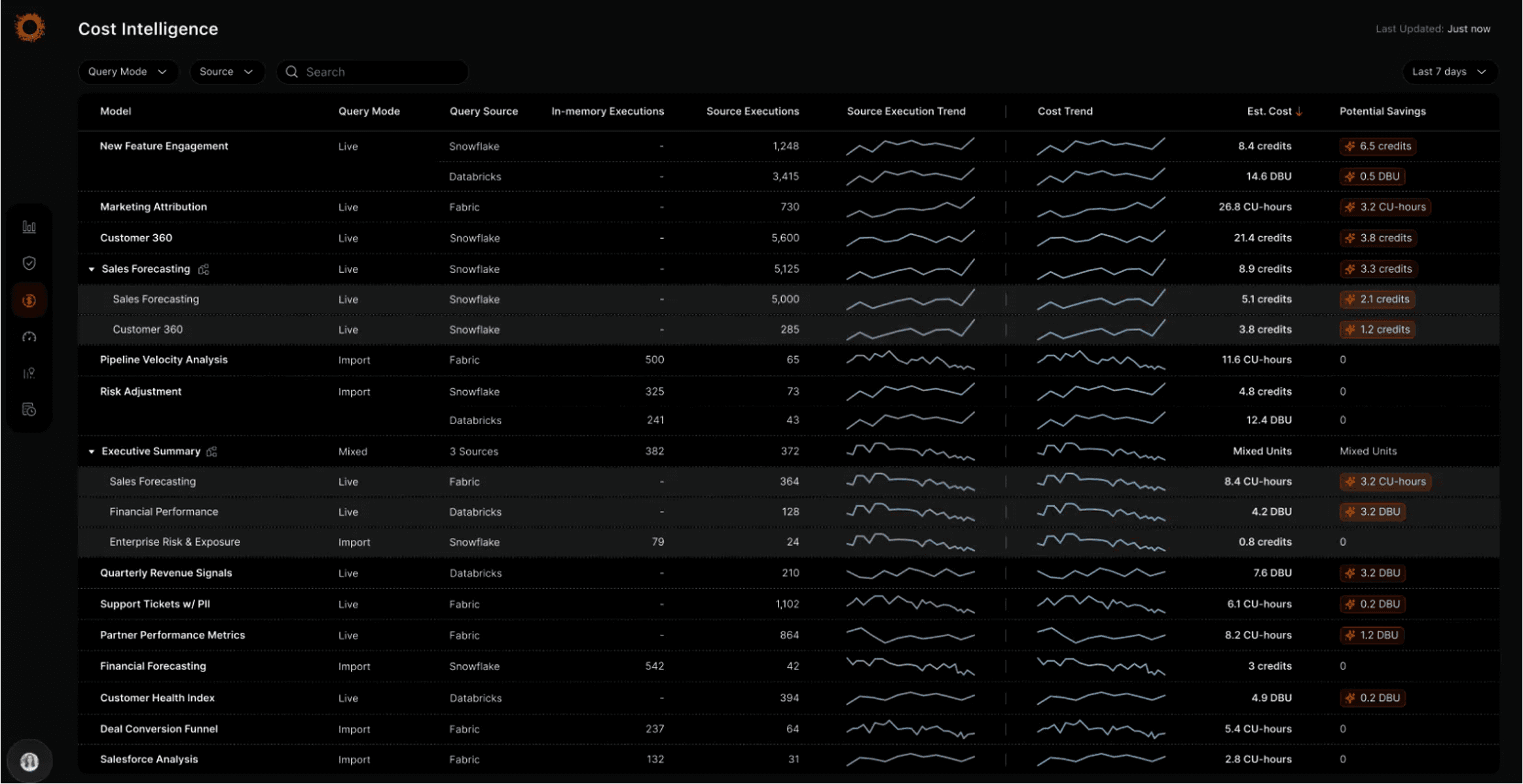
During a Domo migration, Sentinel Cost Intelligence helps teams connect analytics usage to Snowflake and Databricks costs so savings can be measured alongside workload retirement.
For a BI leader, that changes the migration plan. Transformation moves into a customer-controlled data environment, shared logic moves into Mosaic, and only the analytics, reporting, embedded, and AI experiences that still create value are rebuilt.
Magic ETL and DataFlows: Strategy does not replicate Domo's all-in-one ETL layer. Rebuild priority transformations in the customer's warehouse, lakehouse, existing ETL/ELT platform, or cloud-native pipeline so critical data logic remains controlled outside the BI layer.
Beast Modes and semantic logic: Consolidate approved metrics, relationships, hierarchies, and security in Mosaic, then validate them against live data before publication.
Workflows and writeback: Modernize governed operational experiences through Strategy, structured writeback, APIs, and the appropriate workflow platform.
Embedded applications: Rebuild priority Domo Everywhere and App Studio experiences using Strategy embedded analytics, HyperIntelligence, APIs, or the appropriate application layer.
Best fit | Choose Strategy when the objective is to create a durable enterprise architecture with an independent universal semantic layer across clouds, CRM platforms, BI tools, and AI ecosystems. Strategy provides governed business meaning, enterprise analytics and reporting, Snowflake and Databricks cost visibility, and trusted context for both human users and AI agents.
2. Microsoft Power BI: Best for organizations standardizing on the Microsoft ecosystem
Microsoft Power BI is the default Domo alternative for many organizations already committed to Microsoft Fabric, Azure, Excel, Microsoft 365, and Microsoft security and governance services. Its greatest advantage is also its defining architectural trade-off: Power BI works best when Microsoft increasingly becomes the operating environment for data, analytics, productivity, governance, and AI.
Microsoft documents Power BI connectivity as a core part of Fabric's semantic link, and Excel can connect live to Power BI semantic models while inheriting endorsement and sensitivity-label properties.
Where Microsoft Power BI fits best
Microsoft Fabric, Azure, Microsoft 365, and Excel are already strategic standards across the organization.
The organization is comfortable managing DAX, Fabric capacity, workspaces, and Power BI model lifecycle at scale.
What to watch
Microsoft Power BI can replace Domo dashboards and still leave the organization with the same governance problem. A migration may simply exchange Beast Mode sprawl for duplicated DAX across PBIX files, semantic models, and Fabric workspaces. That trade-off may be acceptable when the organization has deliberately chosen a Microsoft-centered architecture. It is a weaker governing foundation when approved business meaning must remain reusable across multiple clouds, BI platforms, applications, and AI agents.
3. Salesforce Tableau: Best for visual analytics inside the Salesforce ecosystem
Salesforce Tableau remains one of the strongest products for visual exploration and analyst-led discovery. It is particularly attractive for organizations already investing in Salesforce data, CRM workflows, and the broader Salesforce AI ecosystem.
Salesforce Tableau supports cloud and server deployment, visual authoring, data-preparation flows, embedded experiences, and deeper integration with Salesforce data and workflows.
Where Salesforce Tableau fits best
Analysts need flexible visual exploration and high-quality interactive dashboards.
The organization already has deep Tableau skills, community practices, or Salesforce investments.
Visual analysis is the main driver, and a broad application-development layer is less important.
What to watch
Salesforce Tableau can be an excellent visualization destination and still preserve semantic fragmentation. A Domo migration may exchange Beast Modes and DataFlows for workbook calculations, extracts, and Tableau Prep logic that are difficult to reuse consistently outside Tableau. That is manageable when Salesforce Tableau is the primary analytics standard. It is a weaker choice when the enterprise needs one independent semantic foundation serving Tableau alongside Microsoft Power BI, enterprise reporting, applications, and AI agents.
4. Google Looker: Best for code-first teams in the Google Cloud ecosystem
Google Looker fits engineering-oriented teams that want centralized modeling through LookML, Git-based development, governed Explores, data applications, and embedded analytics. It is particularly compelling when BigQuery and Google Cloud already define the data-platform strategy.
Google positions Looker as its platform for business intelligence, data applications, and embedded analytics, with a unified data model for governed metrics. LookML developers define models through project files, which makes the modeling lifecycle explicit and code-centered.
Where Google Looker fits best
Analytics engineering teams prefer Git workflows, code review, and governed modeling as code.
BigQuery and Google Cloud are strategic standards.
Embedded analytics and reusable governed Explores are important.
What to watch
Google Looker offers real modeling discipline, but that discipline remains centered on a proprietary LookML development process and Google's broader cloud platform. A Domo migration can reduce dashboard sprawl while increasing dependence on specialist developers and a Google-centered analytics lifecycle. Google Looker is a strong choice when Google Cloud and code-first modeling are deliberate standards. It is less suited to enterprises that want business meaning governed independently of the BI tool, cloud platform, and AI model consuming it.
5. Qlik: Best for associative exploration and integrated data services
Qlik remains differentiated by its associative engine and broad data-integration portfolio, including Talend. It can replace more of Domo's ingestion, preparation, analytics, and automation footprint than a visualization-only product.
Qlik says its platform combines data sourcing, preparation, and analysis, while its associative engine indexes relationships so users can explore data in multiple directions without being limited to predefined queries.
Where Qlik fits best
Associative exploration is a core user requirement.
The company values a broader Qlik and Talend data integration portfolio.
Hybrid or multicloud deployment flexibility matters.
What to watch
That breadth comes with a cost. Moving from Domo to Qlik can replace one broad proprietary platform with another, including another engine, semantic and caching model, and operating footprint. Strategy is the stronger choice when the priorities are governed enterprise semantics, enterprise reporting, multi-BI reuse, cost visibility, and trusted AI context. Qlik remains relevant where associative exploration and integrated data movement outweigh those requirements.
Use the Domo migration to simplify the BI estate
Judge the migration by what the organization removes, not by how many cards, DataFlows, applications, and workflows are recreated. The goal is to reduce duplicated logic, unused content, platform dependency, and overlapping BI cost.
Rebuilding every Domo asset in another BI platform simply transfers the same complexity to a new environment. Rationalize what still matters, move transformation into a customer-controlled data stack, centralize shared logic in Mosaic, and migrate only the experiences that still support real business outcomes.
What should you expect from a Domo migration?
A focused first domain may be validated in several weeks to a few months. A full enterprise exit usually takes multiple waves. The biggest variables are the number and complexity of DataFlows, how much logic lives in Beast Modes, embedded applications, workflow dependencies, data quality, and the volume of reports that still have active users.
The core team usually includes BI and data engineering, security, application owners, procurement, and business owners who can validate key metrics and reports. Strategy, a migration partner, or an SI can carry part of the delivery, but the customer still needs internal owners who understand the current logic and can approve the new result.
The first phase should establish the inventory, target architecture, first production domain, required owners, and the earliest realistic contract-reduction milestone.
Decide what to keep, rebuild, and retire
Domo workload | Target approach and migration check |
|---|---|
Magic ETL and DataFlows | Rebuild priority transformations in a customer-controlled warehouse, lakehouse, ETL or ELT platform, orchestration service, or cloud-native pipeline. Validate refresh timing, dependencies, data quality, and operating cost. |
Beast Modes, dimensions, relationships, and security logic | Consolidate approved business meaning in Mosaic. Validate joins, calculation behavior, aggregation, hierarchies, permissions, and lineage before publication. |
Cards, dashboards, and scheduled reporting | Recreate only the priority experiences in Strategy BI. Use dashboards, enterprise reporting, subscriptions, PDF and Excel delivery, Google Drive or Google Sheets, and mobile experiences where they fit the workflow. |
Workflows and writeback | Use SQL transaction forms for structured dashboard updates, or retain an external workflow and application platform where broader orchestration is required. |
Domo Everywhere and App Studio | Evaluate application by application using Strategy embedded analytics, HyperIntelligence, APIs, or a separate application layer. Validate authentication, row-level security, performance, and user experience. |
Domo.AI and conversational use cases | Ground Strategy Agents and external MCP-compatible AI tools in Mosaic so the same metrics, permissions, and audit controls apply to human and agent requests. |
Legacy and overlapping BI tools | Use the Domo event to retire Cognos, SAP BusinessObjects, and clearly redundant departmental content instead of preserving the existing BI sprawl. |
This is where many migrations go wrong
Take a company that calculates gross margin in twelve Beast Modes, three executive cards, and a separate Power BI report. Rebuilding those assets screen by screen can leave the company with sixteen versions of gross margin. The dashboards may look migrated while the underlying disagreement survives.
Start with the logic, not the dashboards. Move the approved gross-margin definition into Mosaic first. Dashboards, reports, applications, and AI agents can then use the same calculation instead of recreating it in every experience.
What must be rebuilt and validated
Beast Modes may contain Domo-specific expressions, context, or aggregation behavior that must be translated and tested rather than copied blindly.
DataFlows can combine ingestion, transformation, orchestration, and business logic. Those responsibilities often need to be separated before rebuilding them upstream.
Security, ownership, certifications, alerts, application behavior, and workflow state do not move simply because a dashboard or semantic definition has been recreated.
A technical conversion is not enough. The new result still has to match the original meaning, performance, permissions, and operating cost, and it should be validated against live data and real user workflows.
How to sequence the work
- Start with what is actually used. Inventory datasets, DataFlows, Beast Modes, cards, dashboards, embedded applications, workflows, owners, refresh patterns, users, costs, and contract dates.
- Move transformation to a customer-controlled data environment. Replace priority Magic ETL and DataFlows with warehouse-native SQL, established ETL or ELT tooling, orchestration platforms, or cloud-native pipelines.
- Rebuild the shared logic before the visualizations. Centralize metrics, relationships, hierarchies, security, lineage, and AI context before recreating every dashboard.
- The first production domain is the proof point. Choose a high-value domain with visible cost or governance pain, then validate data, performance, reports, and user workflows in parallel.
- Move the experiences that still matter. Replace priority dashboards, reports, embedded experiences, workflows, and AI use cases. Retire or archive unused content rather than recreating it.
- Contract reduction has to be part of the plan from the beginning. Establish dates for reducing consumption, retiring named workloads, ending overlapping BI support, and not renewing Domo at the next viable window.
Questions to ask Domo and Progress before your next renewal
Which core Domo products and capabilities will receive sustained investment after closing, and which roadmap commitments can be documented as part of the renewal?
How will consumption credits, overages, renewals, and any transition to Progress commercial terms be handled during and after integration?
What native export paths exist for Beast Modes, DataFlow logic, metadata, security policies, application dependencies, and other assets a customer may need to migrate?
How will Domo and Progress enforce row-level security, permissions, lineage, and auditability when external models or AI agents query enterprise data?
What support SLAs, customer-success resources, price protections, and transition assistance can be contractually committed through the integration period?
Which Domo alternative should you choose?
Microsoft Power BI, Salesforce Tableau, Google Looker, and Qlik each fit a specific ecosystem or interaction model. Strategy is the strongest fit when the enterprise needs an independent semantic and reporting foundation that can serve multiple clouds, BI tools, applications, and AI agents.
Final recommendation | Do not wait for the Progress transaction to close before evaluating your options. Start with the next Domo renewal, the workloads driving consumption, and the business logic that must remain consistent across the enterprise. Then select the alternative that fits the architecture you want to operate, not merely the dashboard you need to replace.
Assess your path beyond Domo
Review your DataFlows, Beast Modes, business logic, dependencies, usage, and renewal dates. Identify the first production domain and the earliest realistic opportunity to reduce Domo consumption.
Planning your next step with Domo?
See how Strategy can help you assess your current environment, identify migration priorities, and plan a phased transition.
Frequently Asked Questions
What is the best Domo alternative in 2026?
Strategy is the strongest overall fit for large, heterogeneous enterprises that want the most widely adopted universal semantic layer and an independent foundation across BI tools, clouds, applications, and AI agents. Microsoft Power BI, Salesforce Tableau, Google Looker, or Qlik may be better fits when the organization has deliberately standardized on that ecosystem or interaction model.
Is Domo going away?
Domo has agreed to sell substantially all of its operating business to Progress Software. Progress says it intends to continue serving customers and supporting the platform. The transaction is expected to close within Progress's fiscal year ending November 30, 2026, subject to approvals and closing conditions. Customers should evaluate integration and roadmap questions without assuming an immediate shutdown.
Can Strategy replace Domo in a Microsoft environment?
Yes. Strategy BI can become the governed destination for dashboards, enterprise reporting, mobile, embedded analytics, and operational experiences, while Strategy Mosaic provides a universal semantic layer across both Strategy and Microsoft tools. Organizations can continue using Microsoft Power BI and Excel where they add value, but manage shared metrics, relationships, hierarchies, and security in Mosaic so the same business meaning is reused across Strategy BI, Power BI, applications, and AI agents.
Can Domo Magic ETL and DataFlows be migrated?
Yes, but usually not through a simple automatic conversion. Teams should inventory the flows, separate transformation logic from presentation logic, and rebuild priority pipelines in a customer-controlled warehouse, lakehouse, ETL or ELT platform, or cloud-native orchestration environment. The new pipelines should be validated for data quality, refresh behavior, dependencies, and cost before cutover.
What should be migrated first from Domo?
Start with a production domain that has high consumption, duplicated business logic, visible governance risk, or an approaching renewal. Move and validate the metrics and security model first, then the pipelines, reports, applications, and AI experiences required for that domain.
How long does a Domo migration take?
Timing depends on DataFlow complexity, embedded applications, data quality, report volume, and the number of users and tools involved. A phased program can prove one domain in weeks or a few months, while a full enterprise exit commonly requires multiple waves aligned to contract and operating windows.
What business value can a governed semantic layer deliver?
UserEvidence research commissioned by Strategy found that interviewed customers achieved an average modeled net impact of $3.4 million, a 551% ROI, and a two-month payback period from Strategy's semantic layer. Customers also reported a 44% reduction in redundant metrics and models, along with faster reporting, lower manual effort, and reduced tooling and infrastructure costs. The study was not specific to Domo migrations, but it shows the potential value of consolidating duplicated logic and making governed business definitions reusable across analytics and AI.
Can Apache Ossie migrate Domo into Mosaic?
No. Apache Ossie is a semantic interchange format, not a one-click Domo migration utility. It can move supported semantic structures between implementations, but Domo-specific Beast Modes, DataFlows, workflows, security, and application behavior still require inventory, translation, and validation.

Henry Guo
Henry Guo is Director of Outbound Product Management at Strategy, driving go-to-market and turning customer insights into discovery and validation for its semantic layer and AI products. With 15+ years in AI, data and security, he helps ship trusted secure enterprise platforms with measurable value.
Content:
- Why now is the right time to reassess Domo
- The real decision is where business logic should live after Domo
- Domo alternatives compared
- 1. Strategy: Best Domo alternative for governed enterprise analytics, reporting, and AI
- 2. Microsoft Power BI: Best for organizations standardizing on the Microsoft ecosystem
- 3. Salesforce Tableau: Best for visual analytics inside the Salesforce ecosystem
- 4. Google Looker: Best for code-first teams in the Google Cloud ecosystem
- 5. Qlik: Best for associative exploration and integrated data services
- Use the Domo migration to simplify the BI estate
- Which Domo alternative should you choose?
- Assess your path beyond Domo
- Frequently Asked Questions
Related posts

Master Strategy with free courses, tutorials, and hands-on practice. Unlock data insights and sharpen your skills—start learning today at no cost!

Lauren O’Connor
March 21, 2025
Enterprise AI fails when it lacks business context. Forrester Research shows how ontology, semantics, and knowledge graphs work together to give AI systems the definitions, relationships, and governed meaning they need to answer business questions accurately.

Beata Socha
July 28, 2026
Learn how Mosaic Studio's Universal Semantic Layer governs metrics and unifies data so AI returns trusted, consistent answers every time.

Kaylee Ritter
July 29, 2026
Learn how Franklin Templeton unified three BI environments post-merger using Strategy to build a governed, AI-ready analytics foundation.

Tanmay Ratanpal
July 27, 2026