

What Is a Context Layer?
A Context layer combines metadata, semantic definitions, relational structure, and live data so that AI can answer using your organization's actual business logic instead of guessing. Without one, AI operating on raw enterprise data produces faster, more confident wrong answers.
Table of Contents:
- 1. How does a context layer work?
- 2. What is the AI context gap?
- 3. What is the difference between a context layer and a semantic layer?
- 4. Why do AI agents need a context layer?
- 5. What are the benefits of a context layer?
- 6. Which industries need a context layer?
- 7. How does Strategy Mosaic implement a context layer?
- Frequently Asked Questions
The Brief
A context layer is the system that assembles business meaning at the moment a question is asked. A context layer combines metadata, semantic definitions, relational structure, and live data so that AI can answer using your organization's actual business logic instead of guessing. Without one, AI operating on raw enterprise data produces faster, more confident wrong answers.
The context layer sits between an enterprise's raw data systems and its AI tools. It translates raw, technical data into semantically meaningful, governed, business-ready context that AI can interpret reliably. Enterprises cannot simply connect AI directly to their databases and expect trustworthy outputs.
The context layer doesn't store business meaning — it assembles the right answer for the right person at the right moment. Metadata tells AI where data lives. The semantic layer tells it what terms mean at your company. The ontology maps relationships. The knowledge graph holds live facts. The context layer pulls it all together on demand.
The AI context gap occurs when a model can access raw enterprise data but lacks the governed business context needed to interpret it correctly. Data warehouses expose tables, catalogs describe assets, and metadata names fields — but those layers alone don't determine how the business defines a metric, which relationship governs a query, or which logic applies to a specific scenario.
1. How does a context layer work?
A context layer typically handles five interconnected functions, each building on the last to transform raw data into AI-ready business intelligence.
Semantic translation: mapping raw table and column names to business-meaningful terms — for example, translating `tbl_rev_q3` into "Q3 Revenue" — so AI doesn't have to infer meaning from schema names alone.
Business logic enforcement: encoding calculation rules, hierarchies, and metric definitions so AI uses them consistently across every query, every tool, and every user.
Governance: controlling which data AI can access and how, enforcing access policy before queries run rather than auditing violations afterward.
Grounding: ensuring AI answers are anchored in verified data rather than hallucinated from statistical patterns in training data.
Metadata and relationships: providing lineage, definitions, and relational structure so AI can reason correctly about how business concepts connect.
The distinction between these functions and a simple data catalog or metadata store is that the context layer is active at query time. It doesn't just describe data — it applies business logic before a single row is read.
2. What is the AI context gap?
Your AI might understand general terms like revenue, customer, risk, or performance. But it doesn't automatically know what those terms mean inside your organization.
Consider what happens when a business user asks, "Who are our top five customers?" Without a semantic layer, the AI has to interpret this from scratch. Top by revenue? By contract value? By growth rate? By number of active seats? In the last 12 months, or all time? A sufficiently detailed prompt might narrow some of these choices, but "sufficiently detailed" quickly becomes unwieldy — and even then the model is interpreting instructions probabilistically.
In financial services, the same term can mean different things across departments. Depending on who you ask, "customer" might refer to an individual account holder, a household, a legal entity, or an active relationship. A human analyst may recognize those differences and reconcile them before using the number. An AI system operating at scale can't be expected to infer which definition the bank intended.
Forrester on context: According to Forrester Research, no matter how well modeled, data without the context provided by shared semantics and mature ontologies will fall short for agentic AI use cases.
What AI is missing when it fails on enterprise data is the conceptual map that your organization has built over years: what a "customer" means in your context, which dimensions apply to which business units, what rules govern which data is trustworthy and which is stale. Prompting can't bridge this gap reliably. Once business logic is encoded in a context layer, each subsequent query operates on a compressed, context-rich representation of your world instead of a raw, ambiguous schema.
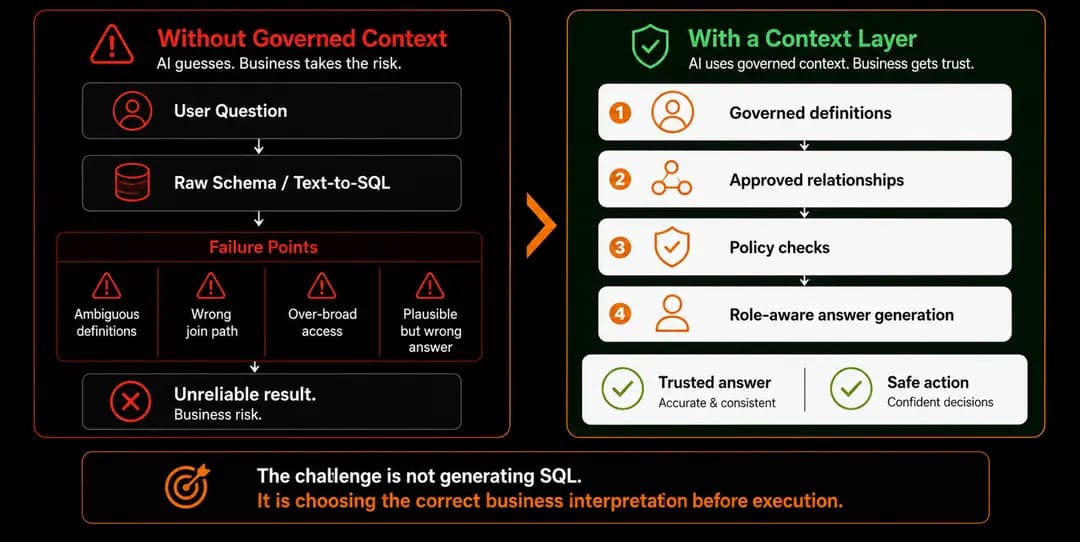
The AI context gap: semantic layer as context infrastructure for AI
3. What is the difference between a context layer and a semantic layer?
The context layer is the broader architectural concept; the semantic layer is its most common technical implementation. Every semantic layer is a context layer, but a context layer could also include knowledge graphs, ontologies, or other metadata systems.
A semantic layer standardizes business definitions, metric logic, relationships, and governance so data can be interpreted consistently across tools and users. A context layer is what the semantic layer becomes when it is extended for AI — it adds the broader context AI agents need to reason and act across systems, not just serve a dashboard or answer a structured query.
The building blocks work in sequence. Metadata tells you a completion-rate field exists. The semantic layer tells you what "retention impact" means at your company. The ontology maps a content title to its subscribers, budget, and slate window. The knowledge graph holds the live numbers. The context layer pulls it together on demand — assembling the right answer for the right person at the right moment.
None of those capabilities can reliably produce a trusted answer, however, if "renewal candidate" means 80% completion in one meeting and 75% in the next. The semantic layer establishes the approved definition and applies it consistently. The final answer is only as trustworthy as the business logic behind it.
For a deeper treatment of the semantic layer specifically, see What is a semantic layer?
4. Why do AI agents need a context layer?
The context layer becomes even more critical when AI moves from answering questions to taking actions. An autonomous agent that misinterprets "revenue" or "coverage limit" doesn't just return a wrong number — it acts on that number, at speed, across systems.
Most organizations piloting AI start with simple questions against clean data, and early results look encouraging. Then they move to production: complex schemas, multi-source queries, autonomous agents acting across systems. The gaps that did not exist in the controlled environment appear quickly. What worked in the pilot does not hold at scale.
Better AI models are necessary but not sufficient. A more capable model operating on ungoverned data does not produce better intelligence — it produces faster, more confident wrong answers. The context layer is the difference between AI that earns a place in workflows that matter and AI that stays in the sandbox.
Wrong fact table selection: the model picks a plausible table that isn't the right one for the query's business intent.
Fan-out inflation: multi-table joins inflate aggregates, producing numbers that look valid but overcount.
Incorrect aggregation of snapshot data: point-in-time tables treated as cumulative, or vice versa.
Ambiguous metric definitions: different teams receive different answers to the same question because the underlying definition was never locked.
Governed context is the answer — not more context, but governed context. That means definitions your business has approved, exposed through an auditable interface, enforced above every platform your data touches. Organizations that recognize this are not waiting for better models to solve a context problem — they are governing the context first.
5. What are the benefits of a context layer?
When the context layer is properly built and enforced, several things change at once across the enterprise AI stack.
Consistent answers across tools and users: not because you wrote a better prompt, but because queries are generated deterministically from a shared definition. Two authorized users asking the same question through different tools receive the same answer.
Reusable business logic: one locked formula for a metric like Debt-to-Income Ratio means the AI doesn't reconstruct the calculation from incomplete context each time it's invoked.
Governance enforced at the architecture layer: access policy and metric definitions are validated before queries reach any data source, so control doesn't depend on prompt engineering or model behavior.
Auditability across every access event: every governance decision is observable, not just the model's outputs — providing the tamper-evident record regulated industries require.
AI agents that act reliably at scale: because the conceptual map is machine-readable and enforced, agents can move from answering questions to taking governed actions without requiring human review of every step.
Key principle: The difference between a semantic layer and a governed context layer isn't a product distinction — it's an architectural commitment. Either your metric definitions are the source of truth for every system that touches your data, or they're one input among many.
6. Which industries need a context layer?
The context gap is an enterprise-wide problem, but certain industries feel it most acutely because their data carries regulatory, financial, or operational stakes that leave no margin for misinterpretation.
Financial services: according to the 2026 American Banker Survey, 75% of banks and financial institutions agree that inconsistent metric definitions limit their ability to scale AI. Terms like "customer," "revenue," "deposit growth," and "risk exposure" can mean different things across departments, source systems, and team-specific workflows — and an AI operating at scale can't infer which definition the bank intended.
Retail: customer segmentation, promotional attribution, and inventory metrics vary by channel and business unit; a context layer ensures agents act on the same definitions whether fulfillment, merchandising, or finance is asking.
Manufacturing: production KPIs, quality thresholds, and supply-chain relationships must be interpreted consistently across facilities and ERP systems for AI to surface reliable operational signals.
Technology: product usage metrics, ARR calculations, and customer-health scores are often defined differently by sales, finance, and customer success — a context layer establishes a single authoritative version.
Education: enrollment, completion, and outcome metrics vary by program, cohort, and reporting period; governed definitions prevent AI from conflating them across institutional reporting.
goeasy, one of Canada's leading non-prime consumer lenders, has used Strategy Mosaic to scale trusted data across retail banking, loan underwriting, and branch operations — providing a universal semantic foundation for its early agentic-AI work.
7. How does Strategy Mosaic implement a context layer?
Strategy Mosaic is the governed semantic layer where your business definitions live, where metrics are calculated consistently, and where AI queries get answered deterministically rather than inferred.
Most AI tools try to guide the LLM to a better answer. Mosaic takes a different approach: the LLM handles natural language, Mosaic handles the actual data request, applying your business definitions before a single row is read. The result is not a better guess — it is a governed answer.
Mosaic is designed to be platform-agnostic. Business definitions, governance rules, and access policies are defined once and applied consistently across dashboards, SQL, APIs, and AI agents. Queries are validated before they reach any data source; those that fail policy return structured errors rather than executing. Mosaic Sentinel observes every access event and provides tamper-evident auditability across governance decisions.
Through Mosaic MCP (Model Context Protocol), AI agents running on Claude, Copilot, ChatGPT, Gemini, and AWS can query the same governed semantic definitions that power every BI dashboard in the enterprise. The same definitions that power dashboards power agents — one governance policy set, regardless of the consuming system.
Mosaic is built on 25 years of battle-tested enterprise analytics experience, extended for the age of AI agents. It is not a new category — it is a semantic layer whose scope now extends to every system that touches your data, including the autonomous agents that act on it.
Frequently Asked Questions
What is a context layer?
A context layer is the system that assembles business meaning at the moment a question is asked. It combines metadata, semantic definitions, relational structure, and live data so that AI can answer using your organization's actual business logic instead of guessing. Strategy Mosaic works as this layer, applying governed definitions before a query ever touches raw data.
What is the difference between a context layer and a semantic layer?
A semantic layer standardizes business definitions, metric logic, relationships, and governance so data can be interpreted consistently across tools and users. A context layer is what the semantic layer becomes when it is extended for AI — it adds the broader context AI agents need to reason and act across systems. The context layer is the broader architectural concept; the semantic layer is its most common technical implementation. Every semantic layer is a context layer, but a context layer could also include knowledge graphs, ontologies, or other metadata systems.
Why does AI fail on enterprise data without a context layer?
Without a context layer, AI agents must infer business meaning from raw schemas. These inferences can produce wrong answers that look correct: syntactically valid SQL that executes, returns rows, and appears plausible, but applies the wrong business logic. Common failure patterns include wrong fact table selection, fan-out inflation from multi-table joins, incorrect aggregation of snapshot data, and ambiguous metric definitions that produce different answers for different teams.
What is the AI context gap?
The AI context gap occurs when an artificial intelligence model can access raw enterprise data but lacks the governed business context needed to interpret it correctly. Data warehouses may expose tables, catalogs may describe assets, and metadata may name fields — but those layers alone don't determine how the business defines a metric, which relationship governs a query, or which logic applies to a specific scenario.
What is the difference between an AI control plane and a context layer?
An AI control plane governs how agents behave: audit logs, action rollback, runtime visibility. A context layer governs what agents reason over: metric definitions, business logic, data context. Strategy Software's position is that enterprises need both, but a control plane alone cannot prevent a confidently wrong answer because it has no opinion on what "revenue" or "coverage limit" actually means. Control planes catch what an agent did. They cannot catch what the agent should not have computed in the first place.
What is Strategy Mosaic?
Mosaic is the universal semantic layer from Strategy Software. It is platform-agnostic, governed, and built for production deployments at Fortune 500 scale. The same metric definitions that power Strategy dashboards are exposed to AI agents through MCP, so dashboards and agents return the same answer to the same business question. It applies governed business definitions before a query reaches raw data, producing deterministic answers rather than probabilistic inferences.
Do enterprises need a context layer, a semantic layer, an ontology, and a knowledge graph as separate products?
Not as five separate products. These layers describe complementary capabilities, not separate purchases. Metadata tells AI where data lives. An ontology maps how the business is connected. A knowledge graph holds the live facts. The semantic layer establishes what business terms mean and applies those definitions consistently. The context layer assembles these capabilities on demand at query time. The critical dependency is the semantic layer: none of the other capabilities can reliably produce a trusted answer if metric definitions shift between conversations.